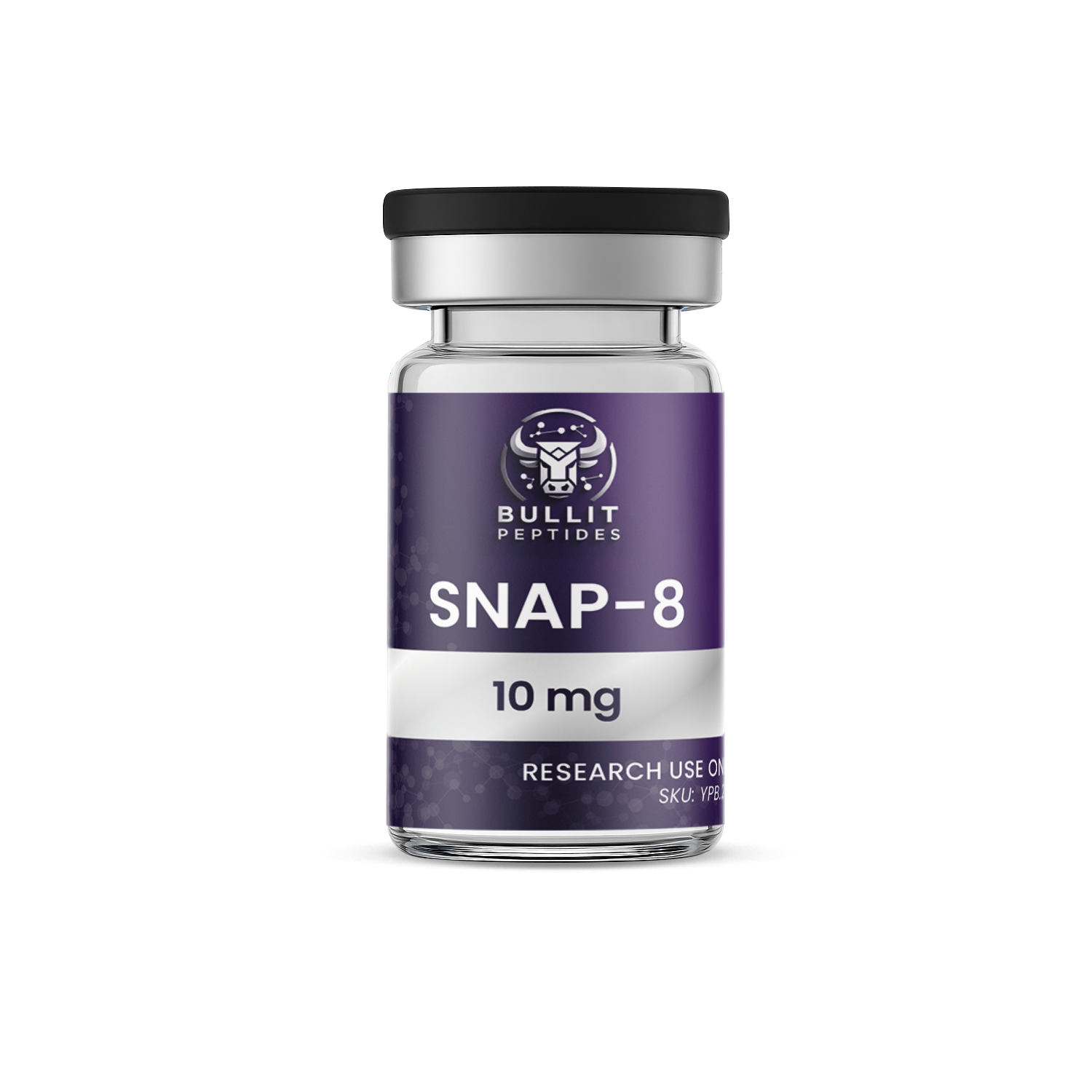
Snap-8 (10mg)
$100.00
Description
A single-component research material supplied for controlled research environments. Snap-8 (10 mg) is a synthetic octapeptide designed for studies investigating peptide interactions with SNARE complex proteins and their role in neurotransmitter release and cellular signaling in model systems.
Composition
• Snap-8
• Appearance: Lyophilized powder in a sealed research vial
Research Focus (non-clinical)
• Evaluation of Snap-8 in studies related to SNARE complex modulation
• Biochemical and structural characterization using HPLC/LC-MS
• Development of in-vitro assays to study synaptic vesicle fusion models
• Stability and solubility profiling under controlled laboratory storage conditions
For qualified research professionals and institutional laboratories. Not for human use.
Documentation & Quality Assurance
Each lot is sourced through our verified global supply chain with emphasis on traceability and quality control. We work diligently to obtain and maintain third-party analytical reports (HPLC/LC-MS) and Certificates of Analysis for each batch, as part of our ongoing quality process. These documents are reviewed internally and displayed as they become available. Independent third-party testing is also performed on select lots to confirm identity, purity, and alignment with our internal specifications.
Important Notice
This product is intended for laboratory research use only. It is not intended for human or veterinary use, and must not be used for diagnostic, therapeutic, or clinical purposes.
This material is not a drug, medical device, or dietary supplement, and has not been evaluated by the U.S. Food and Drug Administration.
Quality & Manufacturing
All materials are sourced from carefully vetted domestic and international manufacturing partners who follow quality systems consistent with ISO and cGMP principles. Each supplier is reviewed for reliability, documentation integrity, and transparency in testing.
We require a verified purity of 99% or higher and perform independent third-party spot testing to confirm that select lots meet our internal standards for identity, purity, and composition. Where available, endotoxin testing results are included on Certificates of Analysis to verify laboratory purity; their inclusion is for research quality assessment only and does not imply suitability for human or veterinary use.
All research materials are sealed for integrity and packaged for stability during storage and transport from manufacturing through final delivery.
Additional information
| Weight | 0.2 lbs |
|---|
Storage Instructions
All our research peptides are manufactured using a lyophilization (freeze-drying) process. This method is designed to maintain product integrity and allows vials to remain stable during shipping for approximately 3–4 months.
Once a vial is reconstituted with bacteriostatic water, it should be stored in the refrigerator to help maintain stability. Under these conditions, reconstituted material is generally considered stable for up to 30 days.
Lyophilization is a dehydration technique in which compounds are frozen and then exposed to low pressure. This causes the water in the vial to sublimate directly from solid to gas, leaving behind a stable, crystalline white structure. This powder can be kept at room temperature until reconstitution.
Upon receipt, products should be stored away from heat and light. For short-term use, refrigeration at approximately 4°C (39°F) is suitable. For long-term storage (several months to years), vials may be placed in a freezer at approximately -80°C (-112°F). Freezing is the preferred method for preserving product stability over extended periods.
⚠️ Important Notice: These products are intended for research use only. Not for human consumption.
Certificate of Analysis
Every batch undergoes rigorous third-party laboratory testing to verify identity, purity (≥98%), and quality before release.
View Certificate of AnalysisResearch Use Only
These studies reference research-grade peptides for laboratory and scientific investigation only. Not for human consumption. Not intended to diagnose, treat, cure, or prevent any disease.
Published Scientific Research
Peer-reviewed laboratory research investigating research peptides from leading scientific databases
Peptide Technologies at Energypolis.
The new Energypolis campus brings together the skills of EPFL Valais-Wallis, HES-SO Valais-Wallis, and the Ark Foundation's services. Together these partners respond to today's major concerns in the domains of energy, health, and the environment cutting-edge technology. The spirit of this new campus is to foster innovation in these disciplines and emulate the creation of start-up companies. The HES-SO hosts the School of Engineering (HEI) at this campus, which includes the following degree progr
View Full StudyAdvances in Molecular Understanding of α-Helical Membrane-Active Peptides.
We focus on α-helical amphiphilic peptides and their ability to (1) translocate across phospholipid bilayers, (2) form transmembrane pores, or (3) act synergistically, i.e., to produce a significantly more potent effect in a mixture than the individual components.We refined the description of peptide translocation using computer simulations and demonstrated the effect of selected residues. Our simulations showed the necessity to explicitly include charged residues in the translocation description to correctly sample the membrane perturbations they can cause.
View Full StudyPeptides in BioNMR Research.
Heteronuclear NMR in combination with isotope labelling is used to study folding of polypeptides induced by metals in the case of metallothioneins, binding of the peptidic allosteric modulator ρ-TIA to the human G-protein coupled α adrenergic receptor, the development of therapeutic drugs that interfere with the biosynthesis of the outer membrane of Gram-negative bacteria, and a system in which protein assembly is induced upon peptide addition.
View Full StudyMechanisms Inspired Targeting Peptides.
Peptides targeting ligands or receptors in CIP have been designed based on three-dimensional structures of target proteins or directly selected by random peptide libraries in biological display systems.
View Full StudyTargeting Tumors Using Peptides.
To penetrate solid tumors, low molecular weight (Mw < 10 KDa) compounds have an edge over antibodies: their higher penetration because of their small size. Because of the dense stroma and high interstitial fluid pressure of solid tumors, the penetration of higher Mw compounds is unfavored and being small thus becomes an advantage. This review covers a wide range of peptidic ligands-linear, cyclic, macrocyclic and cyclotidic peptides-to target tumors: We describe the main tools to identify peptid
View Full StudyDesigner Peptide and Protein Dendrimers: A Cross-Sectional Analysis.
Dendrimers have attracted immense interest in science and technology due to their unique chemical structure that offers a myriad of opportunities for researchers. Dendritic design allows us to present peptides in a branched three-dimensional fashion that eventually leads to a globular shape, thus mimicking globular proteins. Peptide dendrimers, unlike other classes of dendrimers, have immense applications in biomedical research due to their biological origin. The diversity of potential building
View Full StudyRelated products
-
-
MOTS-c
Price range: $100.00 through $200.00Select options This product has multiple variants. The options may be chosen on the product page -
Sale!
RT
Price range: $160.00 through $290.00Select options This product has multiple variants. The options may be chosen on the product page