
If you're delving into metabolic research, you've undoubtedly come across three heavy-hitters in the conversation about weight management: Semaglutide, Tirzepatide, and Tesamorelin. These aren't just random compounds; they've become the focal point of countless studies because their mechanisms for tackling appetite, fat metabolism, and hormonal signaling are both potent and distinct.
The Top Research Peptides for Weight Loss Explained
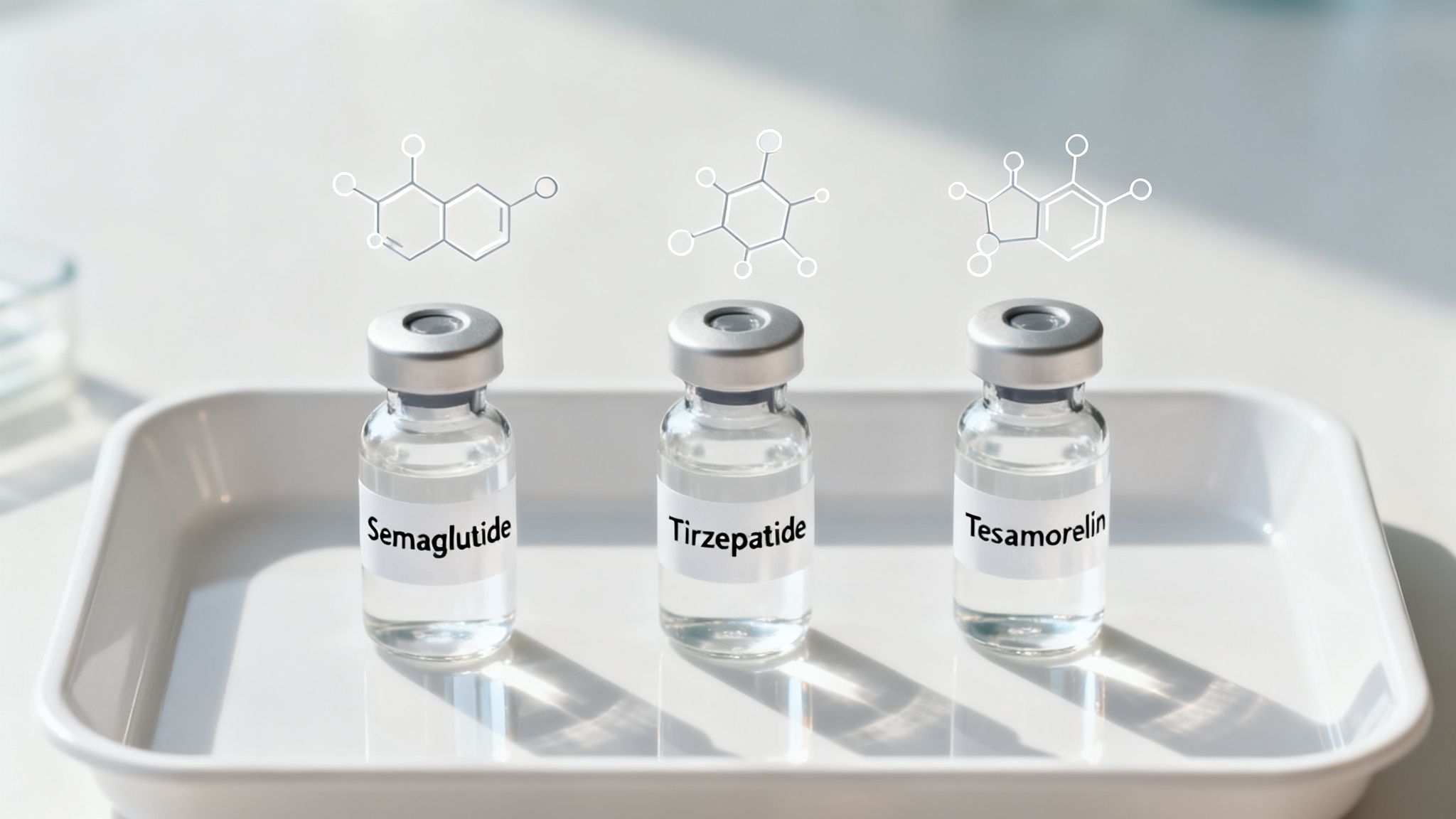
While the field is full of interesting compounds, these three stand out because of the solid clinical data behind them. Each one takes a different road to get to the destination, which makes them suitable for very specific research questions. Getting a handle on these differences is the first real step in designing a meaningful experiment.
At a high level, Semaglutide and Tirzepatide are known as incretin mimetics. They essentially copy the homework of hormones that manage appetite and insulin. Tesamorelin, on the other hand, plays in a completely different sandbox. It's a growth hormone-releasing hormone (GHRH) analogue, designed to kick the body’s own growth hormone production into high gear to specifically target stubborn fat.
Comparing the Top Three Peptides
To really see where each one shines, you have to look at what they do at a biological level.
Semaglutide (GLP-1 Agonist): Think of this as the master of appetite control. By activating GLP-1 receptors, it puts the brakes on how quickly your stomach empties and sends loud-and-clear "I'm full" signals to the brain. This makes it a go-to for studies focused squarely on reducing calorie consumption.
Tirzepatide (Dual GLP-1/GIP Agonist): This one is a double threat. Tirzepatide activates both GLP-1 and GIP receptors, a one-two punch that often produces more dramatic results in clinical settings for both blood sugar management and pure weight reduction.
Tesamorelin (GHRH Analogue): Tesamorelin is highly specialized. It doesn’t really mess with appetite. Instead, its job is to nudge the pituitary gland to release more growth hormone. This has a direct impact on lipolysis—the breakdown of fats—and it's particularly good at targeting visceral adipose tissue (VAT), the dangerous fat that wraps around organs. While fantastic for this purpose, it won't deliver the appetite suppression you get from the GLP-1 agonists. For a different take on fat-burning, some researchers also investigate AOD-9604, a peptide fragment you can learn more about here.
The buzz around these compounds isn't just academic; it's driving a huge market shift. The market for GLP-1 targeted peptides hit USD 61.18 billion in 2024 and is expected to explode to USD 193.44 billion by 2034. That growth is fueled by stunning trial results where users saw average weight loss of 15-20% over 68 weeks.
Key Insight: The choice between these isn't about finding the "best" one overall. It's about matching the peptide to the specific research question. Are you studying pure appetite suppression, the synergy of dual-receptor action, or targeted visceral fat loss? The answer dictates your compound.
Top Research Peptides for Weight Loss At a Glance
For a quick side-by-side comparison, this table breaks down the essential differences between these leading research peptides.
| Peptide | Primary Mechanism | Average Weight Loss (Clinical Data) | Key Research Focus |
|---|---|---|---|
| Semaglutide | GLP-1 Receptor Agonist | ~15% | Appetite suppression, glycemic control |
| Tirzepatide | Dual GLP-1/GIP Agonist | Up to 22.5% | Maximizing fat loss, insulin sensitivity |
| Tesamorelin | GHRH Analogue | Modest overall, significant visceral fat reduction | Targeting visceral adipose tissue (VAT) |
This at-a-glance view helps clarify which peptide aligns best with different experimental goals, from broad metabolic impact to highly specific fat reduction.
How Peptides Actually Work for Fat Loss
To really understand what makes certain peptides stand out for weight loss, we have to look deeper than just the number on the scale. Think of these compounds less as a blunt force and more as a set of keys, each designed to unlock specific metabolic pathways in your body. They're not just burning calories; they're sending precise signals that fundamentally change how your body handles energy, hunger, and fat.
Instead of a simple "calories in, calories out" approach, these peptides essentially flip a switch, telling your body to shift from storing fat to burning it for fuel. They do this by tapping into the powerful hormonal systems that control everything from your appetite to your insulin response.
Taming Hunger with GLP-1 and GIP Agonists
The biggest names in metabolic research right now, like Semaglutide and Tirzepatide, fall into a category called incretin mimetics. In simple terms, they copy the actions of two gut hormones your body already produces: Glucagon-Like Peptide-1 (GLP-1) and Glucose-dependent Insulinotropic Polypeptide (GIP).
When these peptides activate their corresponding receptors, they set off a chain reaction with huge benefits for weight management:
- Powerful Appetite Control: One of the most significant effects of GLP-1 agonists is their ability to signal satiety directly to the hypothalamus—the hunger center of your brain. This quiets the constant "noise" of hunger, making it much easier to stick to a calorie-controlled diet without feeling deprived.
- Slowing Down Digestion: These peptides also delay gastric emptying, meaning food stays in your stomach longer. This creates a natural feeling of fullness that lasts for hours, helping you control portions and cut down on snacking.
- Improving Insulin Action: Both GLP-1 and GIP help your body use insulin more effectively. When your insulin sensitivity is better, your system is far less likely to shuttle excess glucose into fat cells, especially the stubborn fat around your abdomen.
The dual-agonist approach of a peptide like Tirzepatide is what makes it so interesting to researchers. By hitting both the GLP-1 and GIP pathways, it can tackle metabolic issues from two different angles, which studies often link to greater success in both weight loss and blood sugar control compared to single-agonist peptides.
Unlocking Stored Fat with the GHRH Pathway
Then you have a completely different class of peptides, like Tesamorelin, which are known as Growth Hormone-Releasing Hormone (GHRH) analogues. These don't work on appetite in the same way at all.
Their job is to prompt your pituitary gland to release more of its own natural growth hormone. This is a key difference. A boost in growth hormone directly ramps up lipolysis—the body's process for breaking down stored fats (triglycerides) and releasing them into the bloodstream to be burned for energy.
This mechanism is especially good at going after hard-to-lose fat. Clinical research has shown that GHRH analogues are incredibly effective at reducing visceral adipose tissue (VAT), which is the dangerous, metabolically active fat that wraps around your internal organs. For any researcher focused on not just weight loss but on improving body composition and cutting the health risks tied to visceral fat, this pathway provides a highly specific and potent tool.
Semaglutide vs. Tirzepatide vs. Tesamorelin: A Researcher's Guide
When you're deep in metabolic research, the conversation around weight loss peptides always circles back to the big three: Semaglutide, Tirzepatide, and Tesamorelin. They're all heavy hitters, but they are absolutely not interchangeable. Picking the right one hinges entirely on your research goal.
Are you looking for broad-spectrum weight reduction? Do you need to maximize fat loss by hitting two hormonal pathways at once? Or is your focus surgically precise, targeting only dangerous visceral fat? The answer dictates your choice.
Semaglutide and Tirzepatide are masters of caloric control, working primarily on appetite and insulin signaling. Tesamorelin, on the other hand, plays a different game entirely. It bypasses appetite and instead directly cranks up the body's own fat-burning machinery via the growth hormone axis.
Mechanism of Action: A Tale of Three Pathways
The real story is in how they work. Semaglutide is a classic GLP-1 receptor agonist. By mimicking the GLP-1 hormone, it puts a powerful brake on appetite, slows down stomach emptying, and improves the body's handling of sugar. This makes it a go-to compound for studies focused on cutting overall caloric intake and improving glycemic control.
Tirzepatide takes that idea and puts it on steroids. It’s a dual GLP-1 and GIP receptor agonist, meaning it activates two key incretin hormone pathways at the same time. This one-two punch not only crushes appetite via GLP-1 but also boosts insulin sensitivity and energy metabolism through GIP. It's this synergy that likely explains its chart-topping performance in weight loss trials.
Tesamorelin is in a league of its own. As a GHRH analogue, its job is to poke the pituitary gland, telling it to produce and release more of your body's own growth hormone. This surge in GH directly accelerates lipolysis—the breakdown of stored fat for energy—with a specific and powerful effect on visceral adipose tissue (VAT).
The Critical Difference: Semaglutide and Tirzepatide work by changing the energy balance equation (calories in vs. calories out). Tesamorelin doesn't care about the equation; it goes straight to the source and promotes the breakdown of existing fat, especially the metabolically dangerous fat wrapped around your organs.
This diagram helps visualize how these different approaches come together to influence appetite, satiety, and fat metabolism.
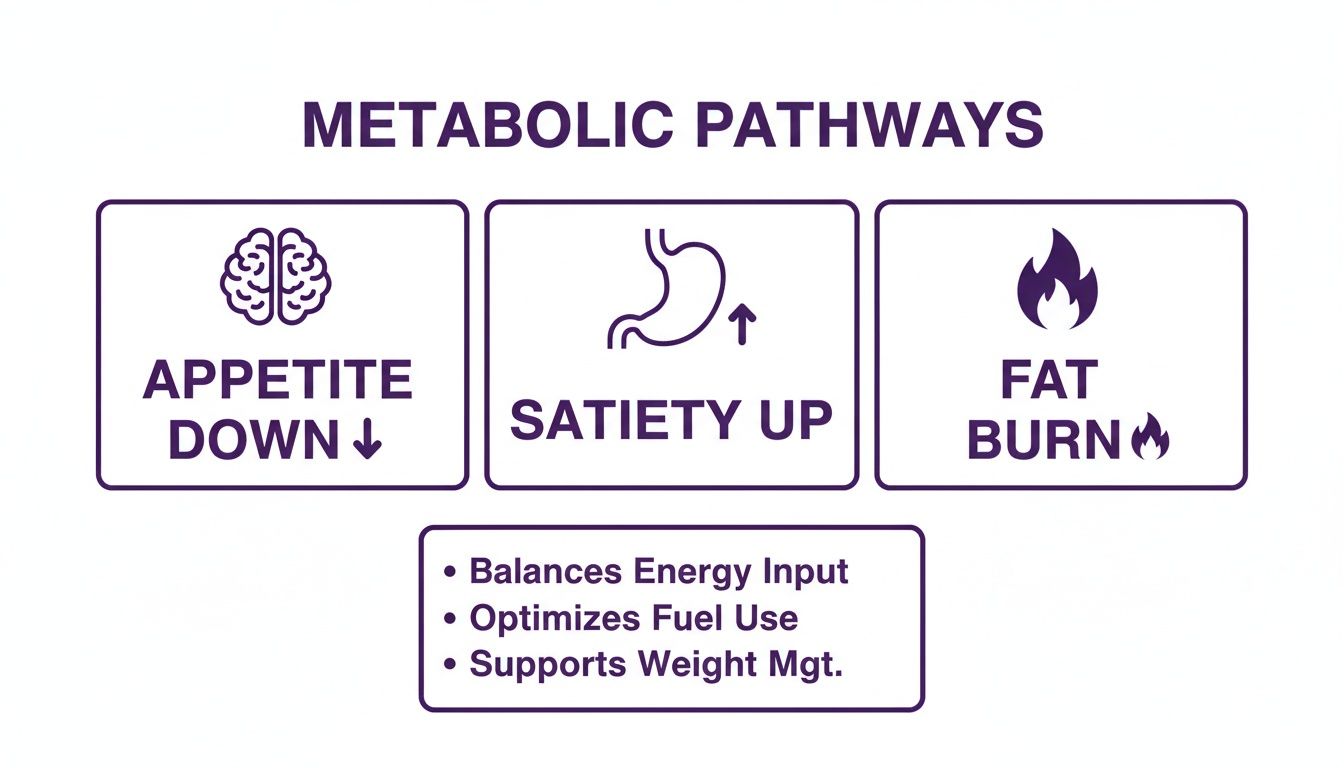
As you can see, the incretin mimetics (Semaglutide, Tirzepatide) tell the brain it's full, while GHRH analogues like Tesamorelin directly tell the body to burn fat.
Head-to-Head Peptide Comparison for Research Applications
To make selection easier, it helps to see these compounds laid out side-by-side. This table breaks down their key attributes based on what matters most in a research context.
| Attribute | Semaglutide | Tirzepatide | Tesamorelin |
|---|---|---|---|
| Primary Mechanism | GLP-1 Receptor Agonist | Dual GLP-1/GIP Agonist | GHRH Analogue |
| Primary Effect | Appetite Suppression | Maximum Appetite & Metabolic Control | Visceral Fat Reduction |
| Avg. Weight Loss | ~15% over 68 weeks | Up to 22.5% over 72 weeks | Minimal overall weight loss |
| Key Strength | Strong, well-documented appetite control | Highest efficacy for total weight loss | Targeted reduction of visceral fat |
| Best For | Foundational metabolic & obesity studies | Advanced studies on dual-pathway effects | Body recomposition & VAT research |
This comparison clarifies that the "best" peptide is entirely dependent on the specific research question being asked.
Clinical Efficacy and Potency
If you're judging by sheer weight reduction, the numbers don't lie. Tirzepatide consistently comes out on top. Clinical trials have shown it can lead to an average body weight reduction of up to 22.5%—a figure that significantly outpaces Semaglutide's already impressive 15-17% in similar studies.
The data gets even more granular. One study found that 64.6% of participants on Tirzepatide lost at least 15% of their body weight after 72 weeks, compared to just 40.1% on Semaglutide (Wegovy). A massive 2024 analysis of over 18,000 patients confirmed this, showing Tirzepatide users lost 5-15% more weight than their Semaglutide counterparts after 40 weeks, with better glycemic control and smaller waistlines to boot.
Semaglutide, however, remains a powerhouse and is arguably the gold standard for GLP-1 research. Its ability to produce an average weight loss of around 15% is well-established, and its profound effect on appetite makes it the perfect tool for foundational studies.
Tesamorelin's results need to be viewed through a different lens. It won't give you the dramatic scale-tipping results of the others. Its power is in its precision. Study after study has shown it can slash visceral fat by up to 20% with little to no effect on the subcutaneous fat just under the skin. This makes it an indispensable tool for research targeting the metabolic diseases driven by VAT.
Ideal Research Scenarios
So, which one do you choose? It's not about which is "better," but which is right for the job.
For General Weight Loss and Appetite Studies: Go with Semaglutide. It's the established workhorse with a mountain of data behind it. It's perfect for experiments where appetite suppression is your primary driver of caloric restriction.
For Maximum Efficacy and Dual-Pathway Research: Tirzepatide is the clear choice. If your goal is to push the limits of weight reduction or to investigate the synergistic power of activating both GLP-1 and GIP pathways, this is your compound.
For Targeted Visceral Fat Reduction and Body Recomposition: Tesamorelin owns this niche. It's the ideal peptide for researchers focused on the health risks of visceral fat or for studies where the goal is to sculpt a better body composition by melting away deep abdominal fat while holding onto lean muscle. You can dive deeper into its specific applications with our comprehensive product guide for Tesamorelin.
Ultimately, a clear understanding of these distinct profiles is what allows a researcher to move from a good experimental design to a great one—perfectly matching the tool to the intended metabolic outcome.
Choosing the Right Peptide for Your Research Goals
Getting a handle on the mechanisms and data behind Semaglutide, Tirzepatide, and Tesamorelin is one thing. But the real work begins when you have to translate that knowledge into a smart choice for your own research. This isn't about crowning a single "best" peptide for weight loss; it's about making a strategic match between a compound's strengths and your specific experimental goals.
To do that, you need to look past the raw numbers and think about practical application. The right peptide will be the one that fits perfectly with the metabolic puzzle you're trying to solve—whether that's exploring broad appetite control, pushing for maximum fat loss with dual-hormone action, or surgically targeting dangerous visceral fat.
Aligning Peptides with Foundational Metabolic Research
If your work is centered on the fundamentals of metabolic syndrome, your main targets are likely glycemic control and appetite. For these kinds of foundational studies, you need a reliable, well-documented tool that delivers predictable results.
This is where Semaglutide really excels. As a powerful GLP-1 receptor agonist, its effect on satiety and gastric emptying is both potent and consistent. That predictability makes it the perfect instrument for experiments where you need to isolate the impact of reduced calorie intake on various metabolic markers.
The sheer volume of public data on Semaglutide is a massive advantage, creating a rich context for any new research. Its commercial success is staggering—driving Novo Nordisk's GLP-1 revenue to $31.1 billion in 2024, a 161% leap from 2022. With 70% of U.S. obesity drug sales linked to its brand names, it gives you an unmatched baseline for comparison. You can discover more insights about its market impact on Innerbody.com.
Scenario Recommendation: For foundational studies on metabolic syndrome focused on glycemic control and appetite modulation, Semaglutide offers a robust and well-documented option. Its established efficacy provides a reliable foundation for exploring the downstream effects of powerful appetite suppression.
Targeting Maximum Efficacy in Advanced Studies
When the goal shifts from understanding the basics to achieving the greatest possible fat loss, you need a more powerful tool. Advanced studies often aim to see just how far metabolic outcomes can be pushed, and that means exploring synergistic hormonal actions.
In this arena, Tirzepatide is the clear frontrunner. Its dual-agonist action on both GLP-1 and GIP receptors creates a powerful one-two punch that consistently delivers superior weight loss in clinical trials. This unique mechanism is a game-changer for researchers, allowing them to investigate how hitting these two pathways at once affects insulin sensitivity, energy expenditure, and overall fat reduction.
Choosing Tirzepatide is a strategic move for any experiment designed to produce the most dramatic change in body composition. It's the compound you reach for when your primary question is all about hitting peak metabolic enhancement and observing the physiological fallout from maximum-effort fat loss.
Precision Targeting for Body Recomposition
Finally, some research questions call for a scalpel, not a hammer. For highly specific experiments focused on body recomposition—especially reducing visceral adipose tissue (VAT) without messing with appetite—you need a specialized tool.
Tesamorelin offers this uniquely precise approach. As a GHRH analogue, it completely bypasses the hunger pathways and instead works by stimulating the body's own growth hormone production. This action has a well-documented, targeted effect on breaking down fat, particularly in the stubborn visceral depots cushioning our internal organs.
This makes Tesamorelin invaluable for studies where you need to keep caloric intake stable to isolate the effects of hormonal fat mobilization. It’s the perfect choice when you’re focused on improving metabolic markers directly tied to visceral fat, or for physique-oriented studies aiming to enhance body composition while holding onto lean mass. Its specialized function ensures your results are from its direct fat-burning action, not a side effect of appetite changes.
The Next Frontier: Exploring Synergistic Peptide Stacks
While a single peptide can deliver powerful, targeted results, the real bleeding edge of metabolic research is in combining them. This practice, often called "stacking," is all about creating synergy—pairing compounds that work on complementary biological pathways to achieve something greater than any single peptide could on its own.
This isn't about just throwing more ingredients into the mix. It's a strategic approach. For researchers looking to design truly next-level protocols, understanding how these compounds can work together is everything.
Why Stacking Works: A Multi-Pronged Attack
The logic behind stacking is simple: hit a complex problem from multiple angles. When it comes to body composition, a researcher might want to curb appetite, accelerate fat breakdown (lipolysis), and protect hard-earned muscle mass all at once. The thing is, no single peptide is the master of all three. But a well-designed stack? That's a different story.
One of the most effective experimental pairings combines a GLP-1 agonist with a GHRH/GHRP stack. Let's break down that dynamic:
- GLP-1 Agonist (like Semaglutide): This is your caloric control agent. It powerfully suppresses appetite and improves how your body handles insulin, making it far easier to create the calorie deficit needed for fat loss.
- GHRH/GHRP Stack (like CJC-1295 + Ipamorelin): This half of the duo focuses on what the body does with its energy. By stimulating the body’s own growth hormone, this combination directly ramps up fat burning and, crucially, helps protect lean muscle tissue from being lost during a diet.
By putting these two together, a researcher can investigate a potent one-two punch: eating less while simultaneously telling the body to burn fat for fuel and hold onto muscle. It’s a strategy designed for much more efficient and targeted body recomposition.
The Big Idea: Stacking isn't just about piling on more of the same effect. It’s about orchestrating a metabolic strategy. You use one peptide to manage the "calories in" side and another to optimize how the body burns stored energy and preserves its most valuable tissue.
Common Stacks Making Waves in Research
In practice, the most popular stacks often involve pairing a growth hormone secretagogue with another compound that amplifies its benefits. Perhaps the most famous combination in research circles is CJC-1295 with Ipamorelin.
CJC-1295, a GHRH analogue, tells the pituitary to release growth hormone. Ipamorelin, a GHRP, then magnifies that signal. The result is a much stronger, more sustained pulse of natural growth hormone than either could ever produce alone. This synergy is exactly why it's so prized in studies aiming to maximize lipolysis while also supporting recovery and lean mass.
Another sophisticated approach pairs a heavy-hitter like Tirzepatide with a dedicated muscle-preserving peptide. This lets researchers take full advantage of Tirzepatide's incredible fat-loss capabilities while adding an insurance policy against muscle breakdown. For those looking into pre-formulated blends for research, products like our 4X Blend Research Peptide offer a glimpse into how these compounds are combined for experimental protocols. These advanced strategies are where peptide science is heading—a more holistic way to influence metabolic health.
A Guide to Sourcing High-Purity Research Peptides
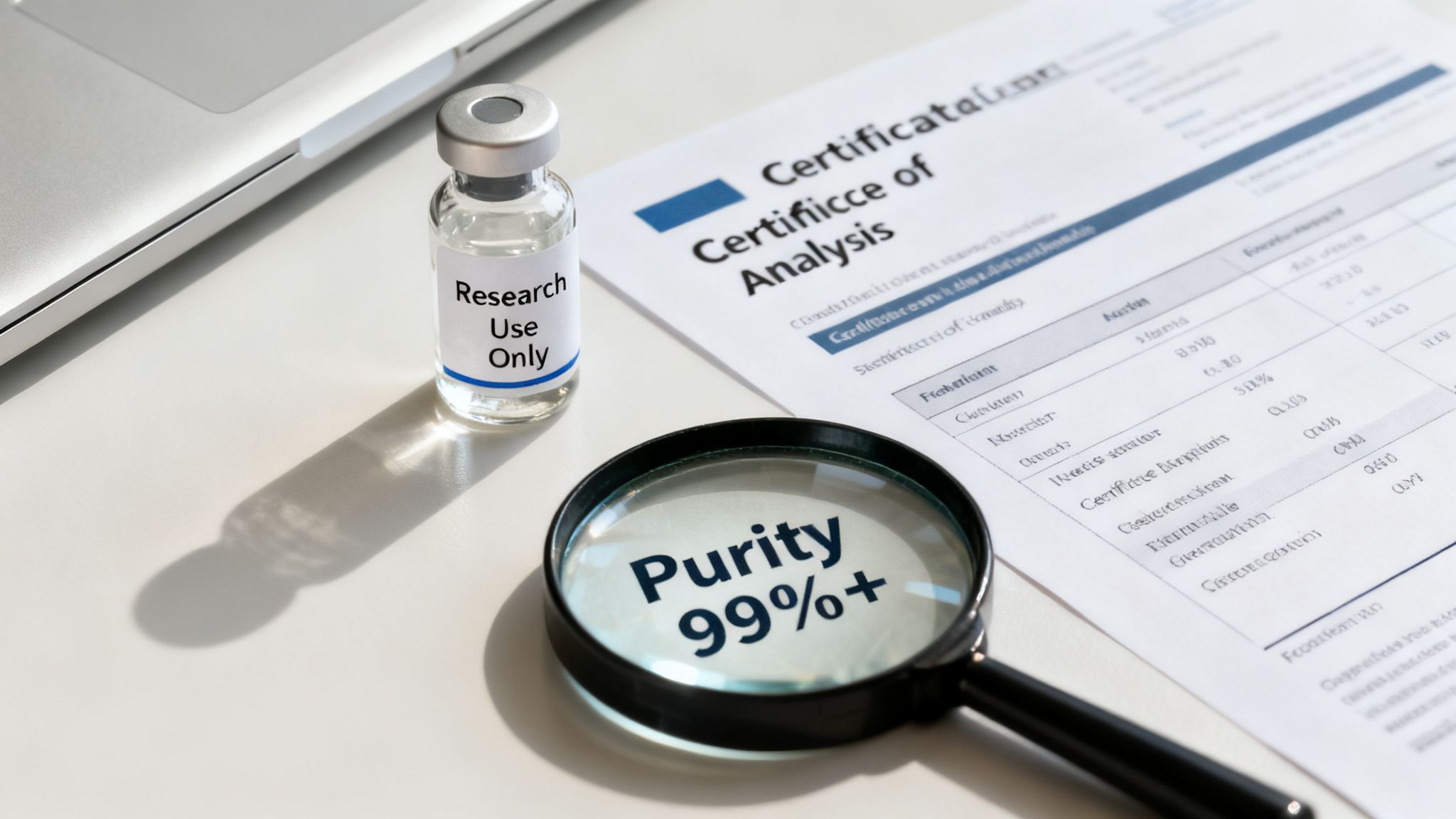
The success of any experiment boils down to the quality of your materials. When it comes to peptides for weight loss research, the line between a high-purity compound and a contaminated one is the line between valid data and a wasted study. Legitimate suppliers build their reputation on transparency and verification, making sure every vial is exactly what it claims to be.
The absolute baseline for any serious research is a guaranteed purity level of 99% or higher. Anything less is an unacceptable variable. But a company’s word isn’t enough; this purity must be confirmed by independent, third-party lab testing for every single batch they sell.
This is where the most important document in your purchasing process comes in: the Certificate of Analysis (CoA). Getting comfortable reading a CoA is non-negotiable for anyone conducting credible research.
Decoding a Certificate of Analysis
A proper CoA is the chemical fingerprint of your peptide. It’s the proof in the pudding. When you get one, you need to zero in on two specific tests:
- High-Performance Liquid Chromatography (HPLC): This technique separates everything in the vial. A clean HPLC report will show one dominant peak—that's your peptide. The area of that peak tells you the purity, and you should be looking for a number that’s clearly >99%.
- Mass Spectrometry (MS): This analysis measures the molecular weight of the compound. The MS result must match the known molecular weight of the peptide you’re buying. It’s the ultimate confirmation that you actually have the right molecule.
Researcher's Takeaway: If a supplier can't or won't provide recent, batch-specific HPLC and MS reports from a third-party lab, walk away. Immediately. Transparency isn't a perk; it's the bare minimum for legitimate scientific supply.
Adherence to Research Use Only Protocols
Finally, any supplier worth their salt operates strictly under ‘Research Use Only’ (RUO) protocols. This isn't just bureaucratic jargon; it's a critical legal and ethical line in the sand. It means these compounds are produced exclusively for laboratory experiments and are absolutely not for human or animal use.
This RUO designation is what separates a professional research chemical company from a shady gray-market website. Vendors who respect RUO guidelines are committed to scientific integrity. They ensure their products are synthesized, handled, and sold correctly for an experimental setting, which is the only way to lay the groundwork for reliable, reproducible results.
Your Questions About Weight Loss Peptides Answered
Diving into metabolic research means asking tough questions. As you start to compare different peptides for weight loss studies, it's completely normal to want more clarity on the practical, legal, and scientific lines that define this work. Let's tackle some of the most common queries we hear from researchers.
What's the Real Difference Between Research Peptides and Prescription Drugs?
This is probably the single most important distinction to get right. A research peptide like Semaglutide might be molecularly identical to its FDA-approved version, but they operate in two completely different worlds from a legal and regulatory standpoint.
Research-Use-Only (RUO) peptides are exactly what they sound like: compounds intended strictly for laboratory experiments and in-vitro studies. They aren't meant for human or animal use, period.
Prescription drugs, conversely, have passed through years of intense, multi-phase clinical trials to prove their safety and effectiveness to the FDA. They're produced in facilities compliant with strict cGMP (Current Good Manufacturing Practice) standards and are given out by doctors to treat or prevent a specific illness.
The Bottom Line: That "RUO" label is a clear boundary. It means the compound is a tool for scientific discovery, not a therapy. Any reputable supplier will make this designation impossible to miss.
In a Study, How Long Until Peptides Start Showing Results?
Setting a realistic timeline is crucial for good experimental design. The truth is, it really depends on the specific peptide and the parameters of your study. We can, however, look to the landmark clinical trials for a solid benchmark.
For instance, the big Semaglutide studies ran for a full 68 weeks to reach their widely cited ~15% average weight loss figure. Tirzepatide trials were even longer, lasting 72 weeks to document the full extent of its effects. This tells us that significant metabolic shifts are a marathon, not a sprint. While certain effects like reduced appetite might be observable relatively quickly, major changes in body composition take time and sustained investigation.
Can You "Stack" Different Weight Loss Peptides in an Experiment?
Absolutely. Combining peptides—or "stacking"—is a more advanced research strategy aimed at uncovering potential synergistic effects. The whole idea is to target multiple metabolic pathways at once, hoping to produce a result more powerful than any single compound could deliver on its own.
A popular experimental model might involve pairing a GLP-1 agonist with a GHRH analogue. In this scenario, the GLP-1 peptide works on appetite and caloric intake, while the GHRH is studied for its potential to speed up the breakdown of stored fat. This lets a researcher investigate a two-pronged approach to body recomposition. It's critical to remember, of course, that any protocol like this is purely for investigational purposes and requires a controlled, methodologically sound setup.
At Bullit Peptides, our mission is to equip the scientific community with the high-purity, third-party tested compounds you need to do your work. Explore our full catalog of peptides to find the right tools for your next study.