Deciding between Ipamorelin, Sermorelin, and Tesamorelin really comes down to the specific goals of your research. There's no single "best" option—it's about picking the right tool for the job. If your work is zeroed in on visceral fat, for example, Tesamorelin is in a class of its own. For clean, precise growth hormone pulses with virtually no unwanted hormonal noise, I lean towards Ipamorelin. And for a solid, foundational approach that won't break the bank, Sermorelin remains the classic go-to.
Understanding Key Peptide Differences
At first glance, these three peptides might seem similar. They all operate within the growth hormone (GH) axis and are staples in research for that very reason. But make no mistake, they are not interchangeable. Their mechanisms are distinct, their effects are unique, and mistaking one for another can derail an entire study.
Ipamorelin stands out as a highly selective ghrelin mimetic. Think of it as a sniper—it precisely targets the ghrelin receptor to trigger a GH pulse from the pituitary. Crucially, it does this without poking other hormonal systems like cortisol or prolactin. This clean signal makes it the top choice for studies focused purely on GH-mediated effects like muscle accrual and recovery.
On the other hand, Sermorelin and Tesamorelin are Growth Hormone-Releasing Hormone (GHRH) analogs. They work a step higher up the chain, mimicking the body's own GHRH to signal the pituitary. Sermorelin is a bio-identical fragment of natural GHRH, offering a gentle, rhythmic push. Tesamorelin, however, is a more robust, stabilized version engineered for a much stronger and longer-lasting effect.
You'll often find these peptides are paired with other compounds to create a synergistic effect. To get a better sense of these combinations, you can dive deeper into our guide on what CJC-1295 is.
Quick Look Ipamorelin Vs Sermorelin Vs Tesamorelin
For researchers needing a quick, at-a-glance reference, this table breaks down the core differences. It's a great starting point for seeing how these peptides stack up and which one aligns with your experimental design.
| Attribute | Ipamorelin | Sermorelin | Tesamorelin |
|---|---|---|---|
| Mechanism | Ghrelin Mimetic / GH Secretagogue | GHRH Analog (1-29 fragment) | GHRH Analog (44 amino acids) |
| Primary Goal | Selective GH Pulse, Muscle Growth | Foundational Wellness, Anti-aging | Targeted Visceral Fat Reduction |
| Effect on Cortisol | Minimal to none | Minimal | Potential for slight increase |
| Half-Life | ~2 hours | ~10-12 minutes | ~25-40 minutes |
| Cost | Mid-range | Most cost-effective | Highest cost |
The table gives you the data, but the real art is in the application. Each peptide serves a distinct purpose, and knowing when to use which is what separates a good research plan from a great one.
Key Insight: The choice boils down to precision versus power. Ipamorelin gives you a highly selective, clean GH signal. Tesamorelin delivers a powerful, targeted strike against visceral adipose tissue. Sermorelin is your foundational workhorse, supporting the body’s natural GH rhythms. Matching the peptide’s specific action to your primary research objective isn't just best practice—it's essential for getting accurate and meaningful results.
Tesamorelin for Advanced Visceral Fat Research
When you need to go beyond general wellness and launch a full-scale attack on visceral adipose tissue (VAT), Tesamorelin is the specialist you call in. It’s not a jack-of-all-trades like some other peptides; it's a precision tool built for one high-stakes job. That specific focus is why it’s a critical part of any serious "ipamorelin vs sermorelin vs tesamorelin" debate.
The power is in its design. Tesamorelin is a synthetic version of Growth Hormone-Releasing Hormone (GHRH), but calling it a simple copy of Sermorelin would be a mistake. This is GHRH 2.0. With a beefy 44-amino acid chain, it was engineered from the ground up for superior stability and a much stronger grip on pituitary receptors.
That enhanced structure means you get a bigger bang for your buck. Once administered, Tesamorelin triggers a massive, pulsatile surge of growth hormone (GH), which in turn ramps up Insulin-Like Growth Factor 1 (IGF-1). It's this one-two punch that drives its remarkable effects on body composition.
The Science of Visceral Fat Reduction
What really sets Tesamorelin apart is its near-exclusive war on visceral fat—the nasty, deep-belly fat that wraps around your organs and fuels metabolic chaos. While other peptides might help you shed some overall body fat, Tesamorelin has shown a unique and aggressive talent for singling out this specific, dangerous adipose tissue.
How it does this is a fascinating piece of science. The flood of GH and IGF-1 seems to put lipolysis (fat-burning) into overdrive, but it does so preferentially in visceral fat deposits. Remarkably, it tends to leave the subcutaneous fat just under your skin alone.
This incredible selectivity makes Tesamorelin an absolute game-changer for researchers looking to isolate the health effects of VAT reduction. Its use in the clinic has already yielded some game-changing insights.
Key Takeaway: Don't think of Tesamorelin as a general fat-loss peptide. It's a surgical instrument for carving away visceral adipose tissue—a major driver of insulin resistance, inflammation, and cardiovascular risk. Its ability to do this without torching subcutaneous fat or muscle is what makes it so unique.
The clinical data is what gets everyone’s attention. When it comes to that stubborn visceral fat, the numbers are hard to ignore. In Phase III trials for HIV-associated lipodystrophy—a condition infamous for causing deep abdominal fat—an incredible 69% of participants achieved at least an 8% reduction in visceral adipose tissue (VAT) in only six months. That's compared to just 33% in the placebo group.
Even more impressive, follow-up studies found liver fat plummeted by an average of 40%. That kind of laser-focused impact is exactly what biohackers and researchers are looking for to optimize metabolic health. Learn more about the peptide therapy findings on valley-weightloss.com.
Practical Research Applications and Considerations
Let's be blunt: choosing Tesamorelin for a study means you're prioritizing potent, targeted results over your budget. It’s the priciest of the three peptides, and that cost has to be justified by the specific research goal.
So, when does it make sense to bring out the big guns?
- Metabolic Health Studies: This is Tesamorelin’s home turf. It’s the top choice for experiments designed to crush insulin resistance, reverse fatty liver (NAFLD), or lower the inflammatory markers tied to visceral obesity.
- Body Composition Re-engineering: For any protocol where the main objective is shrinking waist circumference and obliterating abdominal fat while preserving every ounce of lean muscle.
- Cognitive Function Research: There’s growing evidence that links lower VAT to better brain health. This has made Tesamorelin a hot topic in neuro-endocrinology circles.
Because it's so potent, research protocols usually call for a daily morning administration. The goal is to create a strong GH pulse that mimics a natural peak and then subsides, which is a different strategy than the nighttime dose often used with Sermorelin to support circadian rhythm. For a head-to-head on these two GHRH analogs, our Tesamorelin vs Sermorelin guide breaks it all down.
Its safety profile is solid, backed by its FDA approval for lipodystrophy. However, its powerful effect on GH means you have to watch for the usual GH-related side effects like fluid retention, achy joints, or injection site reactions. These are almost always mild, temporary, and dose-dependent.
Ultimately, using Tesamorelin is a strategic decision. It's the heavy artillery in the peptide arsenal, brought in when the mission is crystal clear: the significant and selective destruction of harmful visceral fat. It’s for advanced applications where nothing less than precision and power will do.
Ipamorelin: The Specialist for Selective Growth Hormone Stimulation
When you need a clean, targeted spike in growth hormone (GH) without any hormonal crosstalk, Ipamorelin is the peptide that should be at the top of your list. In any comparison between Ipamorelin, Sermorelin, and Tesamorelin, Ipamorelin stands out as the precision tool. It’s the specialist.
Unlike its counterparts, Sermorelin and Tesamorelin, which are essentially synthetic versions of GHRH, Ipamorelin works through a completely different channel. It's a ghrelin mimetic, which means it directly activates the ghrelin receptor (GHSR-1a) in the pituitary gland. Think of it as hitting a dedicated "release GH" button.
This isn't just a minor technical detail; it’s the entire basis for its unique profile. By acting as a Growth Hormone Secretagogue, Ipamorelin delivers a powerful and incredibly specific signal for GH release.
Why High Selectivity is Its Superpower
The real magic of Ipamorelin’s mechanism is just how selective it is. While other peptides in this class can sometimes trigger a cascade that raises other hormones, Ipamorelin is known for its ability to boost GH with virtually zero effect on cortisol and prolactin.
In any research focused on body composition, performance, or recovery, this is a game-changer. Cortisol, the body’s main stress hormone, is catabolic—it actively breaks down muscle. Prolactin can mess with other important hormonal functions. By sidestepping these issues, Ipamorelin ensures the anabolic, restorative signals from GH can do their job without interference.
The Bottom Line: Ipamorelin’s signature is its clean, potent GH pulse. If your study protocol absolutely must avoid raising stress hormones—like in studies on lean muscle gain, tissue repair, or optimizing post-exercise recovery—Ipamorelin is the clear frontrunner.
This clean signal makes it a favorite in research settings. It’s perfect for delivering pure GH pulses without unwanted baggage. Unlike GHRH analogs, this ghrelin mimetic works on the pituitary without touching cortisol or ACTH—stress hormones that can sabotage muscle growth and slow down recovery. Preclinical findings highlight its potential for building lean mass and repairing tissue, while anecdotal reports often mention deeper sleep within two weeks and visible body composition changes around the 8-12 week mark. You can read more about these experiences and insights on Hone Health.
A More Sustained Release for Better Applications
Another key difference is its pharmacokinetic profile. Ipamorelin has a half-life of around 2-3 hours. Compare that to Sermorelin’s fleeting 11-12 minutes, and you can see the advantage. This gives you a more sustained, yet still natural-feeling, elevation in growth hormone.
This longer window of action makes it a far more practical tool for a variety of research models. Instead of a quick, sharp spike, you get a prolonged period of elevated GH, which is ideal for studies looking at:
- Lean Muscle Accrual: A sustained anabolic environment is exactly what’s needed to support protein synthesis and muscle repair.
- Improved Sleep Quality: GH is closely tied to our deep, restorative sleep cycles. Ipamorelin's profile can enhance and support this natural rhythm.
- Tissue Repair and Recovery: Higher GH levels are known to speed up the healing of connective tissues, bones, and muscles.
It's also worth noting that Ipamorelin's mechanism presents a lower risk profile when it comes to insulin sensitivity. By avoiding certain pathways, it neatly sidesteps some of the concerns about potential insulin resistance that can come with other peptides, making it a sound choice for longer-term wellness investigations.
So, when weighing Ipamorelin vs. Sermorelin vs. Tesamorelin, your experimental goal is what matters most. Tesamorelin is the sledgehammer for fat reduction and Sermorelin offers a more foundational, broader approach. But Ipamorelin is the scalpel—a sophisticated, targeted strategy for pure growth hormone stimulation. It’s what you choose when you need the benefits of GH without the noise, making it a priceless tool for focused research.
Sermorelin: The Foundational Wellness Peptide
When you look at the family of GHRH analogs, Sermorelin is the classic, the original. As the first-generation compound in this class, it offers a gentle, bioidentical nudge to the body's own growth hormone production. It doesn't force a massive release; instead, it provides a natural, rhythmic stimulus.
Sermorelin is a 29-amino acid fragment that's a perfect match for the active portion of your body’s own GHRH. Because it's structurally identical, it binds to pituitary receptors and encourages a release of growth hormone that mimics the body’s natural pulse. This makes it a trusted starting point for research focused on broad wellness and anti-aging applications.
The Reliable Starting Point for Research
If you're just starting to explore GHRH analogs in your research, Sermorelin is almost always the best place to begin. Its action isn't overpowering. It works with the body's circadian rhythm, making it a fantastic tool for studies aiming to restore a more youthful hormonal balance without being too aggressive.
This is why you'll see it chosen for foundational research protocols that prioritize overall vitality over sharp, targeted changes. In a research setting, its primary applications often center on:
- General Wellness: Investigating improvements in energy, mood, and an overall sense of well-being.
- Sleep Quality Enhancement: Studying its effect on deeper, more restorative sleep by supporting natural GH release patterns during the night.
- Body Composition Support: Observing gradual, steady improvements in lean body mass and reductions in fat over longer experimental periods.
- Anti-Aging Research: Exploring its potential to enhance skin elasticity, support bone density, and improve immune function as part of a long-term wellness strategy.
Understanding Its Key Limitation: The Half-Life
But Sermorelin has a well-known Achilles' heel: its incredibly short half-life. At just 10-12 minutes, its direct stimulating action is gone in a flash. After administration, it delivers a quick signal to the pituitary and is then rapidly cleared from the system.
This fleeting presence is really a double-edged sword. On one hand, it’s a big part of Sermorelin's strong safety profile, as it prevents the kind of prolonged, unnatural stimulation that can cause issues. On the other hand, it creates a practical challenge for researchers.
Key Consideration: Sermorelin's fleeting half-life is its defining characteristic. This means you either need to administer it more frequently or, far more commonly, pair it with another peptide to get a more sustained and powerful effect on growth hormone levels.
This is exactly why you'll so often see Sermorelin used in tandem with a GHRP (Growth Hormone Releasing Peptide) like Ipamorelin. The Sermorelin provides the initial GHRH "on" signal, and the GHRP amplifies the pituitary's response to that signal. The result is a more robust GH pulse than either compound could ever hope to produce on its own—a synergistic approach that has become a cornerstone of advanced peptide research.
Ultimately, Sermorelin’s value lies in its role as the foundational workhorse. It’s the most cost-effective of these three peptides and has a long track record, giving it a high degree of predictability. While Tesamorelin brings targeted power and Ipamorelin offers clean selectivity, Sermorelin delivers a dependable, gentle lift to the entire GH axis. It’s the perfect gateway into the world of GHRH research.
Choosing the Right Peptide for Your Research Goal
So, how do you decide between Ipamorelin, Sermorelin, and Tesamorelin? The truth is, it comes down to what you're trying to achieve. Each of these peptides has a very distinct personality and application. Picking the right one isn't about which is "best" overall, but which is the perfect tool for your specific research objective.
Let's cut through the complexity. Your primary goal—whether it's general wellness, targeted fat loss, or building lean mass—should be your guiding star.
This decision tree offers a quick visual shortcut, pointing you to the most logical starting point based on your main objective.
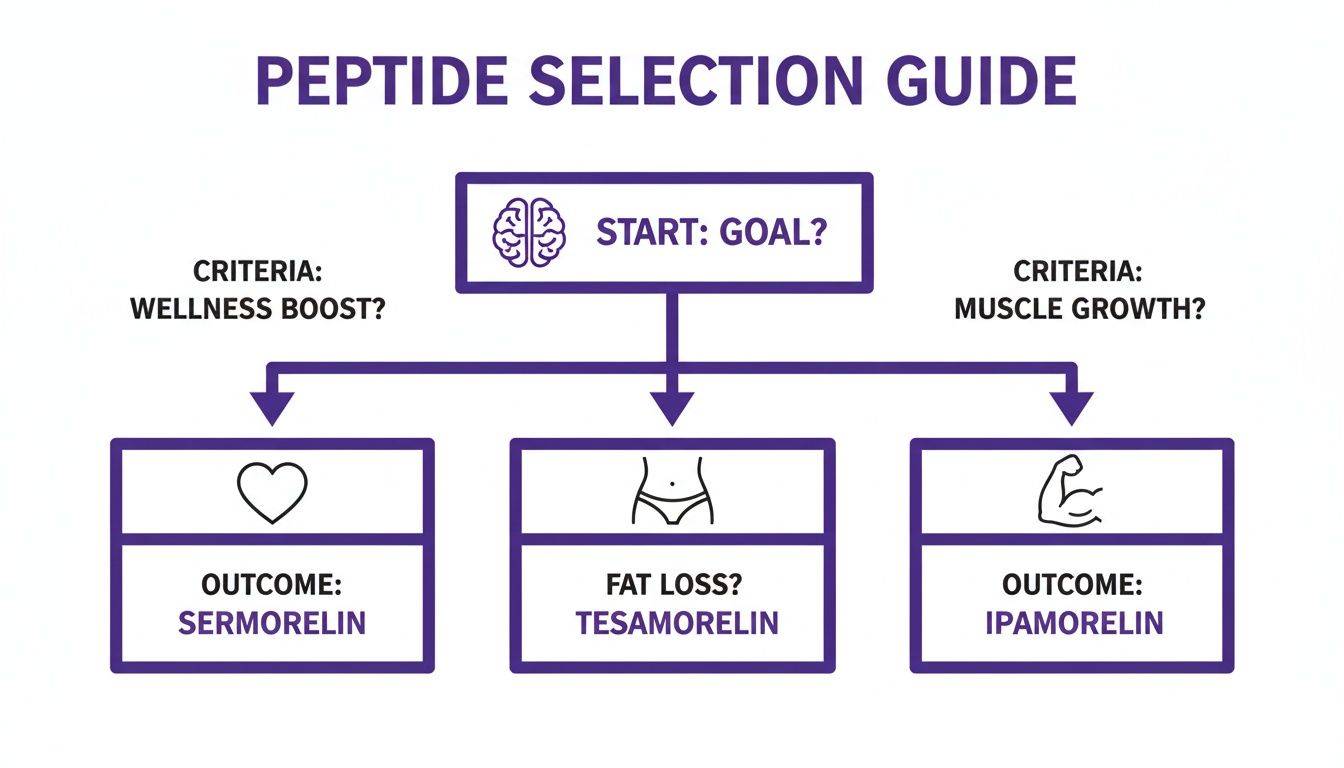
As you can see, the path is pretty clear: Sermorelin for wellness, Tesamorelin for fat loss, and Ipamorelin for muscle. Now, let’s dive into the practical scenarios where these distinctions really matter.
When Your Goal Is Maximum Visceral Fat Reduction
Let's say your study's primary endpoint is a significant reduction in visceral adipose tissue (VAT)—the dangerous fat that wraps around your organs. You need to produce measurable, impactful changes in abdominal fat and see a corresponding shift in metabolic markers.
In this case, Tesamorelin is the heavy hitter. It's not even a close contest.
Tesamorelin was practically engineered for this purpose. Its stabilized GHRH analog structure triggers a powerful, sustained growth hormone pulse that aggressively targets lipolysis, especially in stubborn visceral fat stores. For this specific goal, it’s the most potent tool in the arsenal.
Expert Insight: When designing a study focused on VAT, the higher cost of Tesamorelin is justified by its unmatched efficacy. You're paying for results. The clinical data on its ability to slash visceral fat is robust, giving you the best chance at statistically significant outcomes. A typical protocol would involve a morning administration to align with and amplify the body’s natural GH peak, maximizing its fat-burning effects throughout the day.
When Your Study Focuses on Recovery and Sleep Quality
Imagine your research is exploring more subtle, long-term anti-aging benefits. You're interested in improving sleep architecture, speeding up recovery, and enhancing overall vitality without shocking the endocrine system. Here, safety and a clean mechanism are paramount.
This is where Ipamorelin shines.
As a highly selective ghrelin mimetic, Ipamorelin delivers a clean, precise GH pulse. Crucially, it does this without stimulating a cascade of other hormones like cortisol or prolactin. This clean profile makes it the perfect candidate for long-term studies where you want to avoid unwanted side effects and maintain hormonal equilibrium.
Its longer half-life of roughly 2 hours also provides a more sustained GH elevation compared to Sermorelin. This is ideal for enhancing deep, slow-wave sleep and promoting the tissue repair that happens overnight. For this reason, an evening administration is common to work in concert with the body’s natural circadian GH release.
For Foundational Research on General GH Optimization
Perhaps you're conducting a more foundational study on the general effects of optimizing growth hormone. You need a reliable, well-understood, and cost-effective compound to establish baseline data on wellness, energy, and gradual body composition changes.
Your go-to here is Sermorelin.
Sermorelin is the classic, the original. It’s a bioidentical fragment of GHRH, meaning it provides a gentle, natural nudge to the pituitary gland. This makes it an incredibly safe and predictable compound to work with, especially for initial or exploratory research. It’s also the most budget-friendly, which is a major factor for larger-scale or pilot studies.
The one thing to keep in mind is its very short half-life of only ~10-12 minutes. Because of this, it’s often paired with a GHRP (like Ipamorelin) to create a more powerful, synergistic pulse. If used alone, you’re looking at a milder effect. Protocols typically involve nighttime administration to support the body’s largest natural GH pulse during deep sleep.
Peptide Selection Matrix Based On Research Goals
To make the choice even clearer, this matrix maps the best peptide to common research goals. Think of it as a cheat sheet for your experimental design.
| Primary Research Goal | Top Recommendation | Secondary Option | Rationale |
|---|---|---|---|
| Visceral Fat Reduction | Tesamorelin | Ipamorelin | Tesamorelin is engineered for potent VAT reduction. Ipamorelin offers moderate fat loss, but it's a secondary effect, not its specialty. |
| Lean Muscle & Recovery | Ipamorelin | Tesamorelin | Ipamorelin's clean GH pulse (no cortisol) creates a superior anabolic state. Tesamorelin also boosts IGF-1 but is less selective. |
| Sleep Quality | Ipamorelin | Sermorelin | The sustained, selective action of Ipamorelin is highly effective for improving deep sleep cycles. Sermorelin provides a gentler, supportive pulse. |
| General Wellness & Anti-Aging | Sermorelin | Ipamorelin | Sermorelin is the foundational, cost-effective choice for gradual, systemic improvements. Ipamorelin is a cleaner but pricier alternative. |
| Cognitive Function | Tesamorelin | Ipamorelin | Emerging research links the VAT reduction from Tesamorelin to cognitive improvements. Ipamorelin's clean GH signal may also benefit neural health. |
Ultimately, your choice hinges on a crystal-clear primary objective. If you're chasing aggressive fat loss, Tesamorelin is in a league of its own. For a clean, selective boost to muscle, recovery, and sleep, Ipamorelin is the more sophisticated choice. And for foundational wellness studies, Sermorelin remains the reliable and economical workhorse.
Sourcing and Handling: Protecting the Integrity of Your Peptide Research
Let's be blunt: all the careful analysis of ipamorelin vs. sermorelin vs. tesamorelin is useless if the peptides you're working with are impure or have degraded. Getting this part right isn't just a box to check—it's the bedrock of any valid, repeatable experiment. The entire process starts with your supplier.
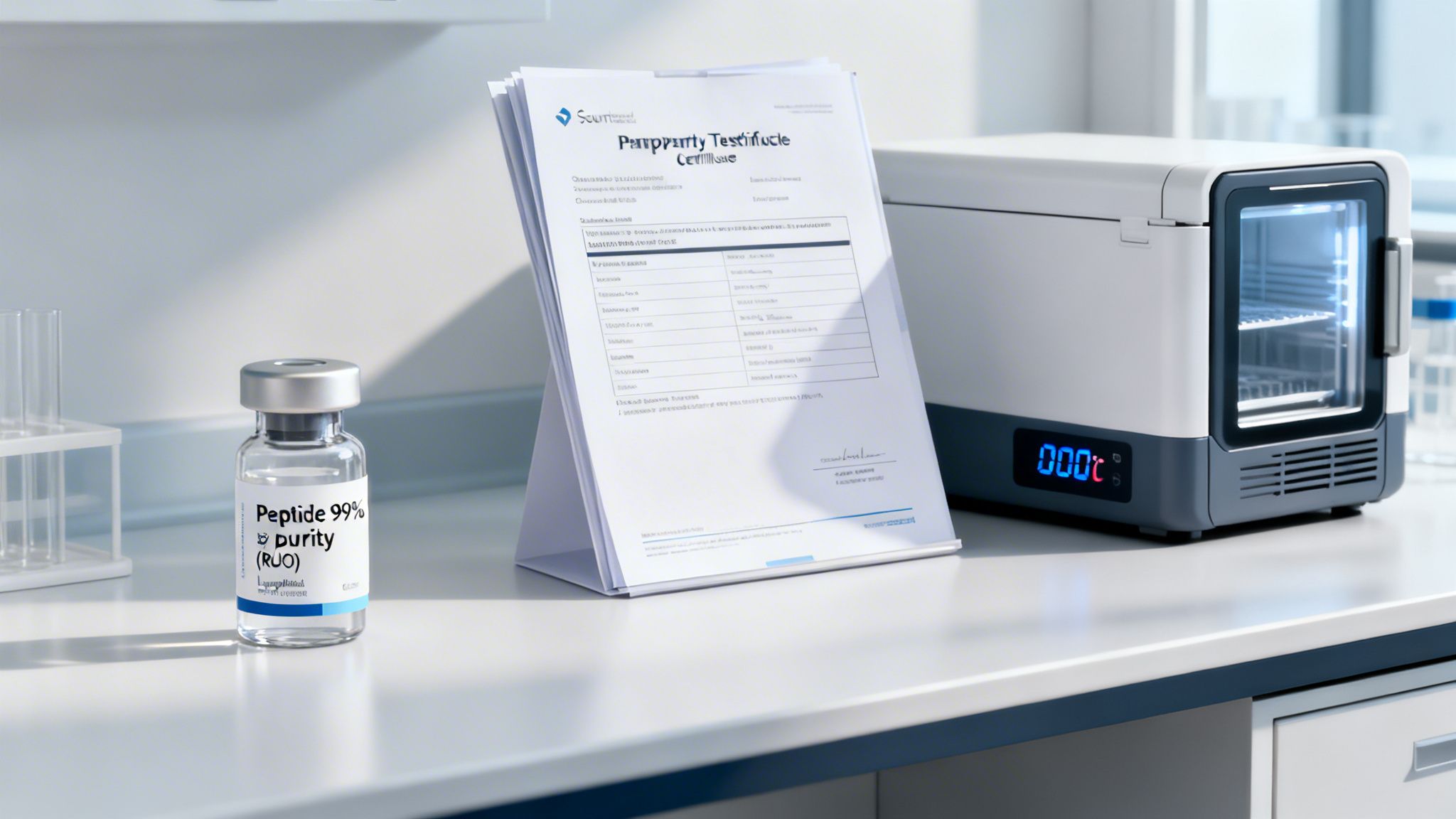
Any serious vendor will provide clear documentation showing their products meet or exceed 99% purity. Anything less introduces contaminants that will absolutely throw off your results. This proof should come in the form of third-party lab reports, typically High-Performance Liquid Chromatography (HPLC) and Mass Spectrometry (MS) data.
Expert Tip: Don't even think about using a peptide without seeing its Certificate of Analysis (CoA) first. That document is your only guarantee that the vial contains what you ordered at the purity you need for credible work.
Reconstitution and Storage Protocols
Peptides like these almost always arrive in a lyophilized (freeze-dried) state. This white powder is incredibly stable and built for shipping. But the moment you reconstitute it with a solvent like bacteriostatic water, the clock starts ticking on its stability.
From here on out, meticulous handling is what separates clean data from a wasted experiment.
- Reconstitution: When adding the solvent, let it run gently down the side of the vial. Never shake it. Vigorous shaking can physically shear and destroy the delicate peptide chains. Instead, roll the vial gently between your palms until all the powder has dissolved.
- Storing Lyophilized Vials: Before reconstitution, the freeze-dried powder should be kept in a freezer at around -20°C (-4°F). Stored this way, it will remain stable and potent for many months, giving you a long shelf life.
- Storing Reconstituted Solutions: Once liquefied, the peptide is far more fragile and must be refrigerated at 2°C to 8°C (36°F to 46°F). Even in the fridge, you should plan to use the solution within a few weeks to ensure you’re working with a compound of known and consistent potency.
Following these handling protocols is non-negotiable for anyone serious about their research. It’s how you protect your materials, and more importantly, the validity of your findings. If you're interested in a deeper dive into quality verification, check out our post on third-party tested peptides. Remember, your results are only as good as your starting materials.
Common Questions in Peptide Research
When you're designing an experiment with GHRH and GHRP analogues, a few key questions always surface. Let's clear up some of the most common points of confusion when choosing between ipamorelin, sermorelin, and tesamorelin.
Can You Use Ipamorelin, Sermorelin, and Tesamorelin Together?
The idea of "stacking" peptides is a hot topic, but from a rigorous research perspective, it's uncharted territory. There's simply no formal data exploring how these three specific compounds interact—whether they work together synergistically or potentially cancel each other out.
For clean, reproducible data, the gold standard is to start by isolating your variables. That means studying the effects of each peptide on its own before even considering a more complex, multi-agent protocol.
Which Peptide is the Most Cost-Effective?
This really boils down to what you're trying to achieve with your experiment.
- If you're running foundational studies or need a large quantity of material for broad wellness research, Sermorelin is often the most practical, budget-friendly choice.
- Ipamorelin occupies a sweet spot in the middle. Its high selectivity makes it a cost-effective option for targeted experiments where minimizing off-target effects is a top priority.
- Tesamorelin, on the other hand, is a premium compound. Its cost is justified only in high-stakes experiments specifically focused on its primary, potent effects, like reducing visceral adipose tissue.
How Do Their Side Effect Profiles Compare?
This is where the differences become crystal clear. Ipamorelin is widely considered the leader for its exceptionally clean safety profile.
Ipamorelin's strength lies in its selectivity. By triggering growth hormone release without meaningfully affecting cortisol or prolactin, it sidesteps many of the hormonal side effects that can complicate research.
Sermorelin is also known for being very well-tolerated. Tesamorelin, due to its sheer potency, is more likely to produce the classic side effects associated with elevated GH levels, such as fluid retention or joint discomfort. It’s a trade-off for its powerful primary action.
At Bullit Peptides, we're committed to the integrity of your research. We provide high-purity, third-party tested compounds to ensure your results are both accurate and reproducible. Find the right research-grade peptides for your next project by exploring our catalog at https://bullitpeptides.com.