When you see a reference to a CJC-1295 Ipamorelin blend at 5/5mg, it means the vial contains two separate research peptides, each at a 5mg quantity, for a total of 10mg of lyophilized (freeze-dried) powder. In a lab setting, this blend is reconstituted and administered in micrograms (mcg), not milligrams. Common experimental protocols often explore dosages in the 100-200 mcg range for each peptide per administration, leveraging a 1:1 ratio designed to produce a synergistic effect on growth hormone release in test subjects.
What Is The CJC-1295 Ipamorelin Research Blend?
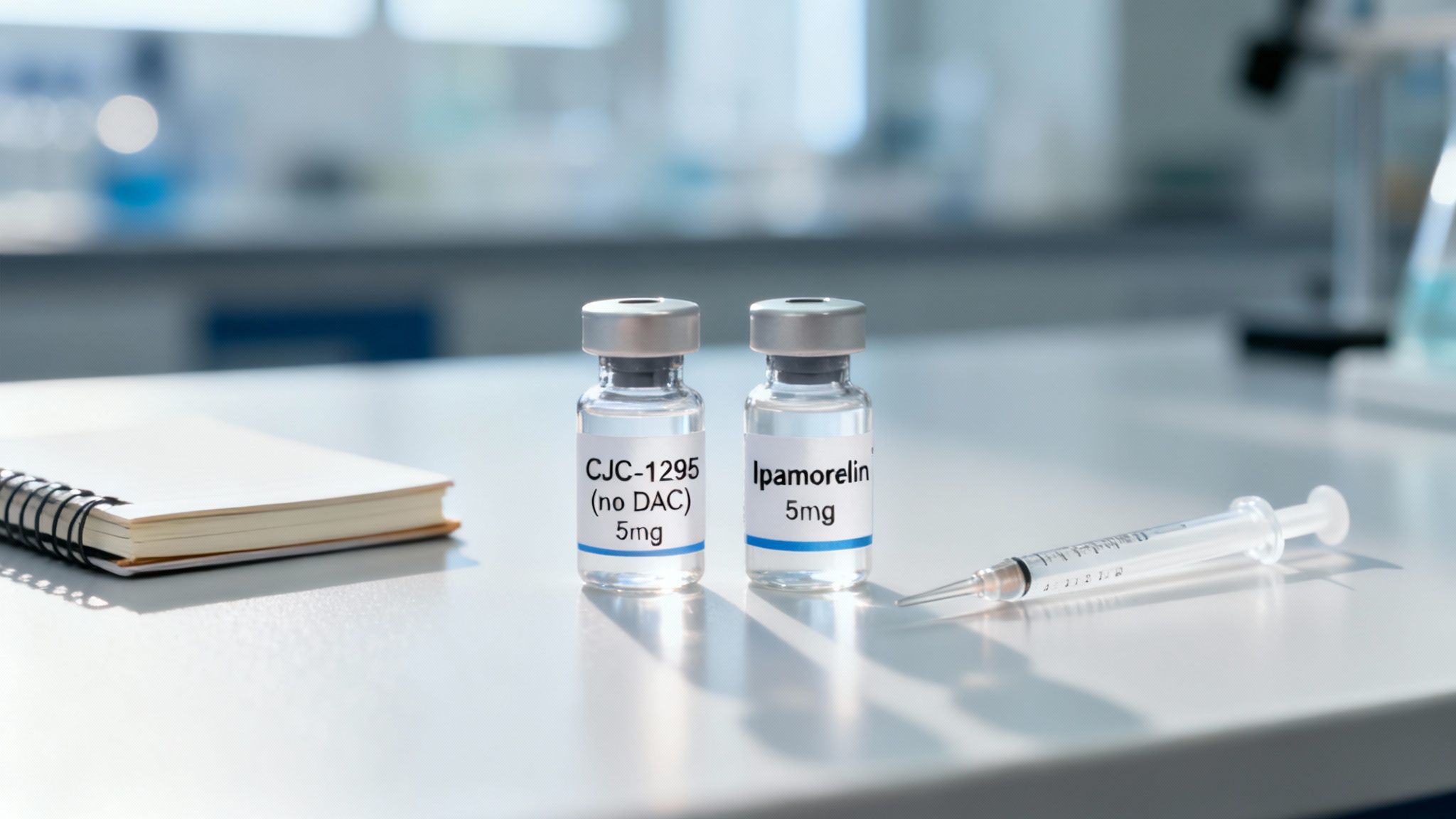
The CJC-1295 and Ipamorelin blend is a powerful pairing of two synthetic peptides that have become mainstays in scientific research. Think of it as a two-pronged strategy for studying the body’s growth hormone (GH) pathways. It combines a Growth Hormone Releasing Hormone (GHRH) analog with a Growth Hormone Secretagogue (GHS), creating a much more potent and physiologically natural response than either compound could on its own.
It's critical to remember that this blend is a research chemical. Its use is strictly limited to in vitro laboratory work (like cell cultures) or preclinical in vivo studies in animal models. This substance is not for human or veterinary use and is not an FDA-approved drug. Adhering to this distinction is fundamental for maintaining ethical research standards and regulatory compliance.
The Two Components Explained
To really grasp how the blend works, you need to look at its two individual parts. Each peptide has a distinct job, but they work together to stimulate the pituitary gland—the command center for growth hormone.
-
CJC-1295 (No DAC): This is a modified, shorter-acting version of GHRH. Its primary role is to tell the pituitary gland to release a wave of growth hormone. The "No DAC" specification is key; it signifies a half-life of around 30 minutes, which allows for a sharp, defined GH pulse that closely mimics the body's natural release patterns.
-
Ipamorelin: This peptide is a highly selective GHS. It operates on a different pathway, acting like the hormone ghrelin to amplify the GH signal that CJC-1295 initiates. Its selectivity is a major point of interest for researchers because it boosts GH without a significant knock-on effect on other hormones, like the stress hormone cortisol.
The real magic of this combination lies in its synergy. Pairing a GHRH analog like CJC-1295 with a GHS like Ipamorelin creates a bigger, more naturalistic pulse of growth hormone than you could ever get by using either one alone.
To provide a clearer picture, here’s a quick-reference table summarizing the key properties of each component in the blend.
Key Properties Of The CJC-1295 And Ipamorelin Blend
| Property | CJC-1295 (No DAC) | Ipamorelin |
|---|---|---|
| Peptide Class | GHRH Analog | Growth Hormone Secretagogue (GHS) |
| Molecular Formula | C152H252N44O42 | C38H49N9O5 |
| Molecular Weight | ~3367.9 Da | ~711.9 Da |
| Half-Life | Approx. 30 minutes | Approx. 2 hours |
| Primary Mechanism | Binds to GHRH receptors to stimulate GH release | Binds to ghrelin/GHS receptors to amplify GH release |
This table helps illustrate why these two peptides are so complementary in research applications.
Why The 5/5mg Blend Matters
The cjc-1295 ipamorelin blend 5/5mg dosage has become a standard in the research community for good reason. This specific 1:1 ratio, totaling 10mg of high-purity (≥99%) powder, gives scientists a consistent and balanced tool. When you have an equal measure of the "signal" (CJC-1295) and the "amplifier" (Ipamorelin), you can conduct experiments with a high degree of confidence that your results will be repeatable.
This precise formulation is essential for accurately investigating the complex feedback loops and downstream effects of the GH axis. You can find more detailed chemical properties and lot-specific data on research-grade blends from certified suppliers.
How These Two Peptides Work Together

To really grasp what makes the CJC-1295 Ipamorelin blend 5/5mg so compelling for research, you have to see the two components as a team. Each one has a specific job, but they’re designed to work together perfectly.
Think of it this way: your pituitary gland is like a reservoir holding a supply of growth hormone (GH). CJC-1295’s job is to open the floodgates, while Ipamorelin’s job is to ensure the resulting wave is as strong and clean as possible.
This powerful interplay is why the blend is so interesting to scientists. By activating two distinct but complementary pathways, the combination triggers a much more significant and controlled GH release in lab models than either peptide could ever manage on its own. It's a textbook case of synergy, where one plus one equals three.
CJC-1295: The GHRH Signal
First, we have CJC-1295 (without DAC). This peptide is a Growth Hormone Releasing Hormone (GHRH) analog. Simply put, its entire function is to mimic the body's natural GHRH—the messenger that tells the pituitary gland, "Okay, it's time to release a pulse of growth hormone."
The version used in this blend is engineered for a very specific, short duration of action. With a half-life of only about 30 minutes, it creates a sharp, powerful pulse of GH release that closely resembles the body's own natural rhythm. This isn't a slow, constant trickle; it's a clean, potent signal that gets the job done and then quickly clears out, allowing the system to reset.
Ipamorelin: The GH Amplifier
Once CJC-1295 has sent the "go" signal, Ipamorelin steps in to turn up the volume. Ipamorelin is a Growth Hormone Secretagogue (GHS), and it works through a completely different mechanism by mimicking a hormone called ghrelin.
In a research setting, this accomplishes two critical things:
- It magnifies the amount of GH released during the pulse that CJC-1295 started.
- It suppresses somatostatin, a different hormone that acts as the emergency brake on GH release.
So, while CJC-1295 is pushing the accelerator, Ipamorelin is disabling the brakes. This one-two punch ensures the GH pulse is as robust as it can be. If you want to dive deeper into its effects, we break down what researchers have observed in our guide on Ipamorelin before and after results.
What makes Ipamorelin particularly valuable for research is its selectivity. Unlike older GHS compounds, it stimulates GH release without causing a significant spillover effect on other hormones like cortisol. This precision allows researchers to isolate the effects of GH with much greater accuracy.
The core concept is synergy. CJC-1295 initiates a naturalistic GH pulse by acting as a GHRH analog, while Ipamorelin amplifies that same pulse by acting as a ghrelin mimetic and inhibiting somatostatin. Together, they create a stronger, more defined GH release.
This precisely timed interaction is what makes the blend so effective for study. The short 30-minute action of CJC-1295 creates a discrete GH pulse, while Ipamorelin's slightly longer two-hour half-life keeps the release window open without over-stimulating the receptors. This gives scientists a fantastic model for studying the downstream effects of a powerful yet physiologically controlled GH spike.
Understanding The Difference Between DAC And No DAC
When you're working with research peptides, one of the most critical distinctions to grasp is the one between CJC-1295 with DAC and CJC-1295 without DAC. This isn't just a tiny variation—it’s a fundamental difference that completely changes how the peptide behaves and dictates its use in experiments. Getting this wrong can easily derail an entire study.
The crucial element here is a small but mighty addition called the Drug Affinity Complex (DAC). You can think of DAC as a kind of molecular anchor. This chemical modification allows the CJC-1295 peptide to grab onto albumin, a common protein circulating in the bloodstream. By binding to albumin, the peptide is shielded from the enzymes that would normally break it down quickly.
This protection has a massive impact on its half-life. The version of CJC-1295 without DAC is gone from the system in about 30 minutes. But the version with DAC? It can stick around and remain active for up to eight days. This transforms the peptide from a rapid signaling molecule into a very long-acting agent.
The Pulsatile Release of "No DAC"
The specific type of CJC-1295 used in the CJC-1295/Ipamorelin 5/5mg blend is the "No DAC" variant, and for good reason. Its short 30-minute half-life isn't a bug; it's a feature. It’s engineered to create a sharp, well-defined pulse of Growth Hormone (GH) release from the pituitary gland.
This pulsatile action is key because it closely mimics the body's natural physiological rhythm. The pituitary gland doesn’t just leak out GH all day long. It releases it in distinct waves, mostly during deep sleep or after intense physical stress. For any research focused on studying the effects of these natural bursts, CJC-1295 (No DAC) is the right tool for the job. It delivers its signal, triggers the desired response, and then clears out, letting the system reset for the next pulse.
The Sustained "Bleed" of DAC
In complete contrast, CJC-1295 with DAC creates a totally different biological scenario. Because it stays latched onto albumin and circulates for days on end, it provides constant, low-level stimulation to the pituitary. This is often described as a "GH bleed" effect.
Instead of causing sharp spikes, it leads to a sustained, unnatural elevation of baseline GH levels. This is a non-physiological state, but it’s incredibly useful for studies looking at the effects of chronic GH elevation rather than pulsatile signaling. While this has its own set of important research applications, it’s a world away from the goals of a No DAC blend. For those whose research requires this long-acting form, you can find more details on the unique properties of CJC-1295 with DAC 5mg and its experimental uses.
To really nail down the differences, a side-by-side comparison makes it perfectly clear.
Comparing CJC-1295 With DAC vs No DAC
This table breaks down the functional and structural differences between the two, which is essential for proper experimental design.
| Characteristic | CJC-1295 (No DAC) | CJC-1295 (With DAC) |
|---|---|---|
| Half-Life | Approximately 30 minutes | Up to 8 days |
| GH Release Pattern | Creates a sharp, pulsatile GH release, mimicking natural rhythms. | Creates a sustained, low-level "bleed" of GH. |
| Primary Use in Blends | Paired with Ipamorelin to create strong, physiological pulses. | Typically used alone for long-term GH elevation studies. |
| Experimental Goal | To study the effects of distinct, powerful GH spikes. | To study the effects of chronic, sustained GH exposure. |
The takeaway is simple: "No DAC" is for mimicking natural, pulsatile GH release, making it the ideal partner for Ipamorelin in a synergistic blend. "With DAC" is for creating a long-lasting, continuous elevation of GH, a fundamentally different experimental model.
Knowing this difference is non-negotiable for designing a sound study. If your experiment is set up to investigate the downstream effects of a naturalistic GH pulse, using the DAC version would produce misleading, if not entirely irrelevant, data. The 5/5mg blend is formulated specifically with the No DAC version to harness the power of that natural pulsatility.
A Practical Guide to Reconstitution and Dosage Calculation
Getting your hands on lyophilized peptides is just the start. The real key to reliable, repeatable research data lies in how you handle them from that point on. Transforming the freeze-dried powder into a liquid solution—a process called reconstitution—is where precision really counts. It demands sterile technique and a solid grasp of the math.
This guide will walk you through everything you need to know to prepare your cjc-1295 ipamorelin blend 5/5mg dosage accurately for any lab application.
First things first, let's get your supplies in order. Working in a sterile environment is crucial to prevent contamination, which can easily degrade the peptides and throw off your results.
- Bacteriostatic Water: This isn't just any sterile water. It contains 0.9% benzyl alcohol, which acts as a preservative to keep bacterial growth at bay.
- Sterile Syringes: You’ll want a larger one for the initial reconstitution and a separate U-100 insulin syringe for measuring out precise microgram (mcg) doses.
- Alcohol Prep Pads: Essential for sterilizing the vial stoppers before you puncture them.
Proper sterile procedure is absolutely non-negotiable. For a deeper dive into best practices, our detailed article explains how to reconstitute peptides safely and effectively.
Step-by-Step Reconstitution Process
Let’s work with a common 5/5mg blend vial. Inside, you have a total of 10mg of peptide powder—5mg CJC-1295 and 5mg Ipamorelin. Our goal is to dissolve this powder into a solution with a known concentration, making it simple to calculate specific doses later.
- Prep Your Vials: Wipe the rubber stoppers on both your peptide vial and the bacteriostatic water with an alcohol prep pad. Let them air dry completely.
- Draw the Diluent: Using a sterile syringe, pull back your desired amount of bacteriostatic water. For this example, we’ll use 2mL.
- Add to the Peptide Vial: This is a delicate step. Gently inject the 2mL of water into the peptide vial, angling the needle so the stream runs down the inside of the glass. Never spray the water directly onto the powder—the force can damage the fragile peptide molecules.
- Mix Gently: Shaking is a big no-no. Instead, gently swirl the vial or roll it between your palms until all the powder is dissolved. You should be left with a perfectly clear solution.
Calculating the Final Concentration
With the peptide reconstituted, the next step is figuring out the exact concentration of your solution. Luckily, the math is pretty simple.
Formula: Total Peptide Amount (mg) / Volume of Diluent (mL) = Concentration (mg/mL)
Let’s plug in the numbers from our example:
- 10mg of total peptides / 2mL of bacteriostatic water = 5mg/mL
This tells us that every 1mL of your solution now contains 5mg of the peptide blend. Because it's a 1:1 blend, that breaks down to 2.5mg of CJC-1295 and 2.5mg of Ipamorelin per milliliter.
Most lab protocols measure doses in micrograms (mcg), so let's convert that for easier use:
- 5mg/mL is the same as 5000mcg/mL.
- This means you have 2500mcg of CJC-1295 and 2500mcg of Ipamorelin in every mL.
The diagram below shows the very different GH release profiles of CJC-1295 without DAC (which creates sharp, natural-like pulses) versus the version with DAC (which creates a sustained, prolonged release). This is a critical distinction when designing an experiment.
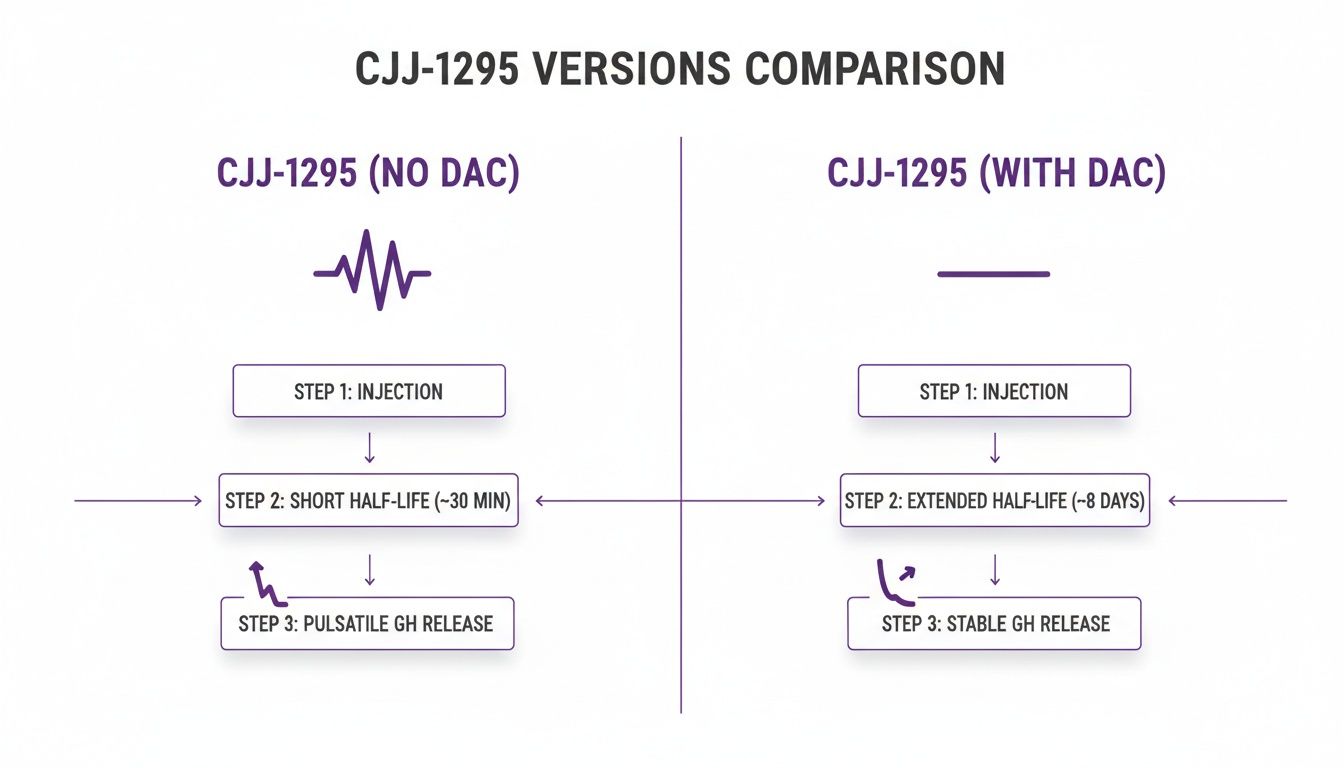
This visual makes it clear why the "No-DAC" version is the go-to for blends that aim to mimic the body's natural, pulsatile GH secretion in research models.
Measuring Precise Doses With an Insulin Syringe
A standard U-100 insulin syringe is the perfect tool for the job. It’s marked in units, and the math is easy: 100 units equal exactly 1mL.
Imagine your research protocol requires a 200mcg dose of the total blend (100mcg of CJC-1295 and 100mcg of Ipamorelin). Here's how you'd figure out how much to draw into the syringe:
- Find the Dose per Unit: First, we need to know how many micrograms are in a single unit on your syringe.
- 5000mcg/mL / 100 units/mL = 50mcg per unit
- Calculate the Units for Your Dose: Now, just divide your target dose by the amount per unit.
- 200mcg (your target) / 50mcg per unit = 4 units
It’s that simple. To get a 200mcg dose of the blend, you would just draw the solution up to the 4-unit mark on the insulin syringe. Nailing this calculation is vital for ensuring your results are consistent from one experiment to the next.
Safe Handling And Storage Protocols For Your Lab
When you're working with a CJC-1295 Ipamorelin blend 5/5mg, getting the handling and storage right isn't just a suggestion—it’s absolutely fundamental to the integrity of your research. Peptides are complex, delicate molecules. Think of them like intricate biological machinery that can be easily damaged. Heat, light, and even excessive shaking can break down their structure, making your data unreliable and your experiments a waste of time.
The moment your lyophilized (freeze-dried) peptide arrives, its stability is in your hands. In its powdered form, the blend is essentially in a state of suspended animation, with all its potential locked away until you're ready. This is where your long-term storage strategy comes into play.
Best Practices For Long-Term Storage
The freeze-dried powder is surprisingly resilient, but only if you store it correctly. To keep it potent for future experiments and get the most out of your purchase, stick to these core principles.
- Go Deep Freeze: The sweet spot for long-term storage is between -20°C and -80°C (-4°F and -112°F). A standard lab freezer will do the job perfectly.
- Keep It In The Dark: Light is the enemy of many peptides. Always store the vial in its original box or a similar light-proof container to protect it from degradation caused by lab lighting.
- Stability is Everything: Don't store the vial in the freezer door. The temperature swings every time someone opens it. A stable, consistently cold spot is what you need to preserve the peptide's structure for months or even years.
Nailing these steps means that whenever you start a new experiment, you can be confident the blend is just as potent as the day it was made.
Short-Term Storage After Reconstitution
Once you add bacteriostatic water and reconstitute the powder, the game changes completely. The liquid solution is far more fragile, and a new set of rules applies.
Once in liquid form, the peptide blend is active and much more vulnerable to breaking down. Refrigerated storage becomes non-negotiable to maintain its integrity, which typically lasts no more than 30 days after you've mixed it.
The reconstituted blend needs a new home: a refrigerator set between 2°C and 8°C (36°F and 46°F). Whatever you do, never freeze the liquid solution. The freeze-thaw process is brutal on peptide chains, causing them to fracture and become useless. Keep the vial standing upright and handle it gently to prevent agitation.
Upholding The Research Use Only Mandate
Safe handling isn't just about temperature and light; it's also about adhering to the product's intended purpose. Every vial of CJC-1295 and Ipamorelin is sold strictly for Research Use Only (RUO). This isn't just fine print—it's a critical legal and ethical boundary.
The RUO designation makes it clear: this compound is for in vitro laboratory work and preclinical animal models only. It is not an approved drug for human or veterinary use. For any lab studying metabolic pathways or muscle physiology, working with third-party tested, RUO-compliant products is the only way to ensure ethical standards and reproducible results. Modern solid-phase peptide synthesis allows suppliers to consistently hit purities over 99%, which is crucial for minimizing variables in your experiments. You can learn more about how purity and compliance are verified for these research blends.
By respecting the RUO mandate, researchers protect themselves, operate within the legal framework of scientific discovery, and contribute responsibly to their field.
Putting the Blend to the Test: Example Research Designs
Knowing the theory is one thing, but seeing how it works in a real lab setting is where things get interesting. Let’s walk through a couple of hypothetical research scenarios to show how you might use a CJC-1295/Ipamorelin 5/5 mg blend to answer specific scientific questions in endocrinology, metabolism, or cell biology.
Think of these as frameworks—starting points for designing your own rigorous experiments. They’re designed to bridge the gap between textbook knowledge and practical application.
These peptide combinations are getting a lot of attention in research, and for good reason. As the global anti-aging ingredients market expands—valued at USD 11.24 billion in 2025 and projected to hit USD 20.26 billion by 2035—the synergy of this blend makes it a powerful tool. In markets like the U.S., peptide research is a huge part of this growth. You can explore more about the role of peptides in the growing anti-aging market to understand the bigger picture.
Scenario 1: In Vitro Pituitary Cell Culture Study
One of the cleanest ways to see this blend in action is with an in vitro study. Imagine you have primary pituitary cells, maybe from a rat model, growing in culture dishes. This setup lets you strip away all the other biological noise and focus only on how the pituitary cells respond.
The main goal here would be to measure how much Growth Hormone (GH) the cells release, and how quickly they do it, when exposed to the peptide blend. By setting up different culture plates with varying concentrations of the blend, you could map out a full dose-response curve. You’d even be able to pinpoint the saturation point—the dose where adding more peptide doesn't get you any more GH secretion.
Example Dosage Calculation:
- Vial: 10 mg total peptides (5 mg CJC-1295 / 5 mg Ipamorelin) reconstituted in 2 mL bacteriostatic water.
- Concentration: This gives you 5000 mcg/mL total peptides (2500 mcg/mL of each).
- Objective: Apply a 10 mcg total dose to a single cell culture well.
- Calculation:
- First, figure out the volume you need: (10 mcg desired dose) / (5000 mcg/mL concentration) = 0.002 mL.
- That tiny volume is impossible to measure accurately with standard lab equipment. The solution? A serial dilution. You'd create a less concentrated stock solution (say, 100 mcg/mL) that allows for precise, measurable dosing into the cell culture media.
For this kind of study, you’d likely measure GH levels using an ELISA assay at different time points after adding the peptides (e.g., 15, 30, 60, and 120 minutes) to really understand the pulse dynamics.
Scenario 2: Preclinical In Vivo Metabolic Study
Now let's take it from the petri dish to a living system. A preclinical in vivo study, perhaps in a mouse model, would let you see the blend's systemic effects on metabolic health over time.
For instance, you could investigate how a consistent administration protocol affects body composition, glucose tolerance, or insulin sensitivity. You'd probably set up two groups of mice: a control group getting a simple saline solution and a test group receiving the CJC-1295/Ipamorelin blend.
This kind of preclinical model is invaluable. It helps us see how a controlled, pulsatile release of GH can influence metabolism across the entire body, bridging the gap between what happens in a single cell and what could happen in a whole organism.
Example Dosage Calculation:
- Animal Model: A standard 30-gram lab mouse.
- Protocol Dose: A typical starting point for rodent studies is around 10 mcg/kg.
- Calculation:
- First, convert the mouse’s weight to kilograms: 30g = 0.03 kg.
- Then, calculate the dose: (10 mcg/kg) * (0.03 kg) = 0.3 mcg of the total blend.
- Administration: Just like in the in vitro example, you would need to perform a serial dilution from your main vial to accurately draw up such a tiny microgram dose for injection.
Key things you’d measure in this study might include:
- Weekly body weight and body composition (fat vs. lean mass) using a tool like a DEXA scan.
- An oral glucose tolerance test (OGTT) at the start and end of the study to see how glucose metabolism has changed.
- Serum IGF-1 levels, which would confirm that the blend is successfully stimulating the GH axis as expected.
These two scenarios are just starting points, but they clearly show how you can design controlled, measurable experiments to explore the powerful and multifaceted effects of the CJC-1295 and Ipamorelin blend.
Frequently Asked Questions
When you're deep in the weeds of peptide research, a few common questions always seem to pop up. Let's clear up some of the most frequent queries about the CJC-1295 and Ipamorelin 5/5mg blend to help you dial in your experimental design.
What’s the Real Difference Between CJC-1295 With DAC vs. No DAC in a Blend?
It all comes down to the kind of growth hormone (GH) release you want to investigate. Think of it this way: the blend with CJC-1295 (No DAC) is designed to study the effects of a sharp, powerful pulse of GH. This approach more closely mimics the body's natural, rhythmic release, creating distinct peaks and troughs in hormone levels.
On the other hand, using a blend with CJC-1295 that includes DAC is for an entirely different experimental model. This version produces a long, sustained elevation of GH levels—less like a natural pulse and more like a steady, continuous "bleed." The choice between them fundamentally changes the physiological conditions you're studying.
How Do I Figure Out the Dose for Each Peptide in a 5/5mg Vial?
It's simpler than it looks. In a 5/5mg blend, each peptide makes up half of the total. So, if you have a 10mg vial (5mg of CJC-1295 and 5mg of Ipamorelin) and you reconstitute it with 2mL of bacteriostatic water, you don't just have one concentration.
You actually have 2.5mg (2500mcg) of CJC-1295 and 2.5mg (2500mcg) of Ipamorelin in each milliliter of your solution.
So, let's say your protocol calls for a 100mcg dose of each peptide. You'd need a total of 200mcg from your mixed solution. With a total concentration of 5000mcg/mL (which works out to 50mcg per unit on a standard U-100 syringe), you would draw up 4 units. Always base your math on your specific reconstitution volume.
A quick pro-tip for any researcher: precision is everything. The validity and repeatability of your results hinge on getting this step right. Always double-check your math before proceeding—it's a cornerstone of good lab practice.
Why Is Bacteriostatic Water So Important for Reconstitution?
Bacteriostatic water is a non-negotiable part of the process. It contains 0.9% benzyl alcohol, which acts as a preservative to stop bacteria from growing in the vial. This is absolutely critical for maintaining the sterility and stability of your peptide solution, especially if you plan to access the vial multiple times for various experiments.
If you were to use regular sterile water, you'd be opening the door to contamination. Any contamination can quickly degrade the peptide, compromise its molecular structure, and ultimately make your research findings completely unreliable.
For researchers who demand high-purity, third-party tested materials for their laboratory work, Bullit Peptides provides a full range of compounds designed for consistent, verifiable results. You can find our research-grade CJC-1295/Ipamorelin blends and other peptides on our website.