Let's be clear: you're not looking for quick fixes or shady shortcuts. You're here to understand the machinery of your own body and how to tune it for peak performance. The truth is, the most powerful tools for boosting growth hormone are already at your disposal. They boil down to a powerful trifecta: intense training, smart nutrition, and restorative sleep.
When you get these three right, they create a synergistic effect, signaling your body to ramp up its own natural production of this vital hormone.
Your Guide to Naturally Boosting Growth Hormone
This is your no-fluff guide to maximizing Human Growth Hormone (HGH) the right way. We're going to break down the science-backed methods for using your body's own systems to build more muscle, burn stubborn fat, and dramatically improve recovery. Forget the risks of synthetics—this is about mastering your physiology.
This approach isn't just for elite athletes; it's for anyone serious about getting a real, sustainable edge. We’ll explore the exact methods that top performers and savvy biohackers are using right now to optimize what their bodies are already designed to do.
What We're Covering
Instead of just throwing theory at you, we're building a complete toolkit with actionable strategies you can implement immediately.
Training That Works: We’ll pinpoint the specific workout protocols, like high-intensity resistance training and sprint intervals, that are proven to trigger the biggest HGH spikes.
Fueling for Growth: You'll learn how to manipulate your diet—especially with tools like intermittent fasting—to keep insulin low, creating the perfect environment for HGH to thrive.
The Power of Sleep: Deep sleep is when your body does its best work, releasing its largest pulse of HGH. We'll cover techniques to ensure you're getting the high-quality rest needed for this to happen.
Smart Supplementation: Finally, we’ll look at a handful of evidence-based supplements that can give you an extra edge, supporting your body’s natural production without the guesswork.
The focus here is on empowering you to achieve real results with the tools you already have. While we'll touch on research compounds for a complete picture, the core of this guide is about mastering natural optimization.
Think of it as making your body work smarter, not just harder. These aren't temporary hacks. They are foundational habits that build on each other over time, leading to profound improvements in your physique, energy, and overall vitality. By the end, you'll have a clear blueprint for taking control of your performance.
Understanding Growth Hormone and Your Body
Before you can effectively boost your growth hormone, you have to know the rules of the game. Let's start with the command center: a tiny, pea-sized structure at the base of your brain called the pituitary gland.
This isn't a leaky faucet that drips out HGH all day. Instead, your pituitary gland unleashes it in powerful, strategic bursts called pulses. These pulses aren't random—they're your body's response to specific triggers, happening most intensely during deep sleep and right after a grueling workout. It’s this pulsatile rhythm that gives HGH its power.
The Core Functions of Growth Hormone
So, what happens when one of these pulses hits your bloodstream? HGH gets to work, acting as a master signal for growth and repair.
Here's what it's telling your body to do:
- Rebuild and Fortify Muscle: HGH is a cornerstone of protein synthesis and cell repair. After you tear down muscle fibers in the gym, HGH is what helps build them back stronger and more resilient than before.
- Torch Body Fat: It directly targets fat cells, signaling them to release stored fatty acids into the bloodstream to be burned for energy. This process, known as lipolysis, is critical for getting lean.
- Strengthen Your Frame: HGH is also a key player in regulating bone metabolism, helping you build and maintain dense, strong bones for life.
This is the real-world biology behind your performance goals. Once you grasp these fundamentals, you can start making them work for you. If you want to go deeper, you can learn more about the direct connection between growth hormone and muscle growth in our full-length article.
What Causes HGH Levels to Decline
Your body's HGH production peaks in your late teens and starts a slow, steady decline around your 30s. But age is only part of the story. Modern lifestyle habits can absolutely crush your HGH output, putting a serious brake on your progress.
The most significant modern-day HGH antagonist is chronically high insulin. When you consume sugary foods or refined carbohydrates, your blood sugar spikes, triggering a large release of insulin from your pancreas. This insulin spike effectively shuts down HGH secretion.
Beyond diet, a few other key offenders are likely holding you back:
- High Body Fat: Excess body fat, particularly the visceral fat around your organs, is a well-known HGH suppressant. The leaner you are, the better your hormonal environment.
- Poor Sleep Habits: The biggest and most important HGH pulse of the day happens during deep sleep. If you're not getting enough quality sleep, you're missing your single greatest opportunity for natural HGH release.
- A Sedentary Lifestyle: Your body responds to demand. Without the stimulus of intense exercise, your pituitary gland simply doesn't get the signal to ramp up production.
Pinpointing these factors in your own life is the first real step toward optimization. By understanding what's working against you, you can start building a routine that finally gets your body's natural rhythms working for you.
How to Train for a Massive HGH Spike
Let's get one thing straight: just showing up at the gym and going through the motions won't cut it. If you're serious about naturally boosting your growth hormone, your training needs to be intentional and intense. We’re talking about creating a state of controlled metabolic stress—the specific signal that tells your body to flood your system with HGH.
Forget about those long, slow jogs or half-hearted sets. We're going to reprogram your workouts to turn them into powerful hormone-optimizing events. The science is clear: the right kind of high-intensity exercise is one of the most effective ways to elevate HGH. As research has shown, specific resistance and aerobic protocols can directly amplify HGH secretion, giving you an anabolic edge without touching synthetic compounds. You can see the evidence for how exercise drives HGH on FoundationFlorida.com for a deeper dive.
The 'Burn' That Builds: Lifting for Lactate
When you're lifting, that deep, searing burn you feel in your muscles isn't just a sign you're working hard—it's the trigger. That sensation is caused by lactate, and its accumulation is precisely what we want for a massive HGH release.
To get there, you need to build your routine around big, compound movements. These are the heavy hitters that recruit huge amounts of muscle fiber and create the biggest metabolic demand.
Your bread and butter should be lifts like:
- Squats: The undisputed king for a reason.
- Deadlifts: A true test of total-body strength.
- Bench Presses: The foundational upper-body push.
- Overhead Presses: For building powerful, broad shoulders.
- Rows: The key to a thick, strong back.
Now, here’s how you structure it. We're not training like a powerlifter chasing a one-rep max. We're training for metabolic fatigue to maximize that lactate burn.
My Go-To Protocol: Stick to a rep range of 10-12 repetitions. This is the sweet spot. Then, keep your rest periods brutally short—just 60 to 75 seconds between sets. This prevents your body from fully recovering and keeps the metabolic stress incredibly high.
Imagine doing 4-5 sets of heavy barbell squats this way. By the end, your legs will be on fire, you'll be breathing hard, and you’ll know you've flipped the HGH switch.
Forget Jogging: Why Sprints Are Your HGH Superweapon
When it comes to cardio for HGH, it's time to ditch the treadmill marathon. Steady-state cardio is great for your heart, but it does next to nothing for your growth hormone levels compared to high-intensity work.
The clear winner is High-Intensity Interval Training (HIIT).
HIIT is all about alternating between brief, absolutely all-out sprints and short recovery periods. This method repeatedly shoves you past your lactate threshold, triggering a huge HGH release that can stay elevated for hours after you've left the gym.
The best part? It's incredibly efficient and you can do it almost anywhere.
Here’s a Killer HIIT Routine for the Assault Bike:
This is a personal favorite for how brutally effective it is.
- Warm-up: Start with 5 minutes of easy pedaling to get the blood flowing.
- The Work: Go for a 30-second, all-out sprint. I mean everything you have.
- Active Recovery: Follow it immediately with 90 seconds of slow, easy pedaling to catch your breath.
- Rinse and Repeat: Keep this cycle going for a total of 20 minutes.
- Cool-down: Finish with 5 more minutes of light cycling.
That 20-minute session will do more for your HGH than 45 minutes of monotonous jogging. You can easily adapt this sprint-recover model to a rower, a treadmill on an incline, or even bodyweight moves like burpees. Just remember, the magic is in the intensity of those sprints—you have to be willing to go to a very uncomfortable place for 30 seconds at a time.
Nail Your Nutrition to Maximize Growth Hormone
You can absolutely crush it in the gym, but if your diet is working against you, you're leaving huge gains on the table. What you eat—and just as crucially, when you eat—is one of the most powerful tools you have for influencing your body's hormonal environment.
It all boils down to a simple, seesaw-like relationship: high insulin kills HGH release. When one is up, the other is down. This gives us a clear mission: get a handle on your insulin, and you'll unlock your body's natural HGH potential.
The Insulin-HGH Showdown
The biggest saboteur of your natural HGH production is high blood sugar, which forces your pancreas to pump out insulin. If you're serious about this, sugary foods, refined carbs like white bread and pasta, and especially sugary drinks have got to go.
But it’s not just about what you eat; timing is everything. A carb-heavy meal before bed or right before a workout will effectively slam the brakes on the two biggest natural HGH pulses you get all day.
- Pre-Workout: That pre-training sugar rush? It's directly suppressing the very HGH surge you're about to work so hard for.
- Pre-Sleep: A late-night carb snack is even worse. It can cripple the massive HGH pulse that happens in deep sleep, robbing you of your most critical window for recovery and growth.
Instead, build your meals around quality protein, healthy fats, and fiber-rich vegetables. This keeps your blood sugar stable and gives your body the exact building blocks it needs to repair and grow.
Unleash HGH with Intermittent Fasting
Beyond cleaning up your diet, the periods when you don't eat might be even more powerful. Intermittent fasting (IF) is one of the most reliable, science-backed ways to send your growth hormone levels soaring. By simply extending the time you go without food, you keep insulin pinned to the floor, creating the perfect environment for HGH to take over.
The research here is staggering. Studies have clocked HGH levels jumping by over 300% after just a three-day fast. One analysis even found that fasting for 37.5 hours boosted baseline GH concentrations by an incredible tenfold as the body switched to burning fat for fuel. It's the polar opposite of insulin's effect; fasting keeps insulin suppressed for hours, letting GH run the show. You can dive deeper into the science behind fasting and HGH on livhospital.com.
The simple flowchart below shows how to perfectly time your training within this fasted state, turning big lifts and sprints into a powerful HGH-triggering protocol.
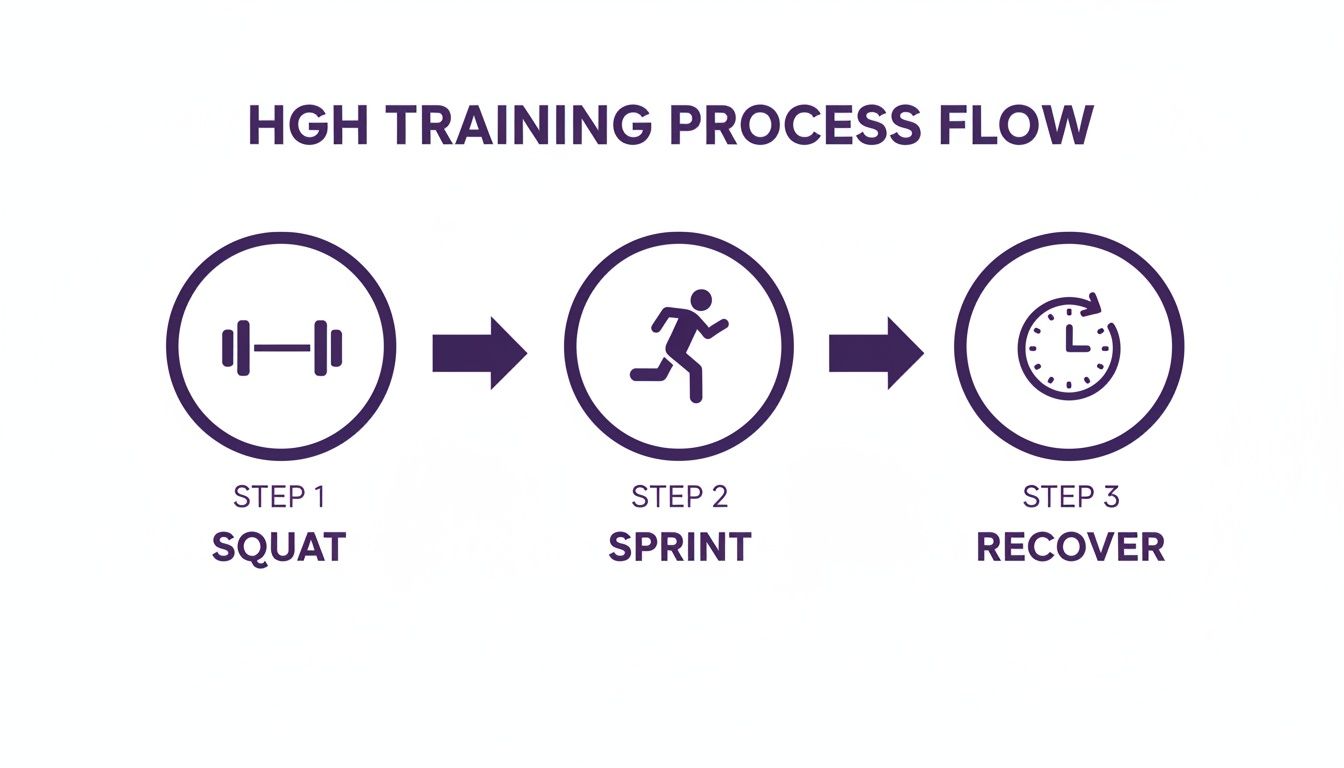
When you perform intense exercise like squats and sprints in a fasted state, you create massive metabolic stress. The recovery phase that follows becomes a supercharged window for hormonal release, amplifying all your hard work.
Intermittent Fasting Protocols for HGH Optimization
Choosing the right fasting schedule is key to making it a sustainable part of your lifestyle. Different protocols can have varying effects and suit different people, so it's worth knowing your options.
| Protocol | Fasting/Eating Window | Potential HGH Impact | Best For |
|---|---|---|---|
| 16/8 Method (Leangains) | 16 hours fasting / 8 hours eating | Moderate to High | Beginners and those who want a consistent daily routine. Great for stacking with daily workouts. |
| Eat-Stop-Eat | Two 24-hour fasts per week | High | Individuals with more fasting experience who can handle a full day without food. |
| The Warrior Diet | 20 hours fasting / 4-hour eating window | Very High | Advanced biohackers and those who prefer one large meal per day. Can be intense. |
| Alternate-Day Fasting (ADF) | Fast every other day | Very High | People looking for aggressive fat loss, but it requires significant discipline and may not be sustainable long-term. |
While longer fasts can produce a more dramatic HGH spike, the 16/8 protocol is often the most practical and effective for long-term consistency, which is what ultimately drives results.
Putting It All Together: Fasting and Training
The most popular and, frankly, most manageable IF method for most guys is the 16/8 protocol. You simply fast for 16 hours and eat all your meals within an 8-hour window. For instance, you could finish your last meal at 8 p.m. and not eat again until noon the next day.
Here's how you create a powerful one-two punch: schedule your workouts toward the end of your fast. Training in a fasted state magnifies the HGH response from the exercise itself.
I’ve had great success with this myself. A typical day might look like this: fast from 8 p.m. to 12 p.m., hit the gym for a heavy leg day at 10:30 a.m., and then break the fast with a huge, protein-packed meal right at noon. You're stacking the HGH spike from fasting right on top of the spike from training—it's an incredible signal for growth.
If you're just starting, those hunger pangs are real. My go-to strategy is to lean on water, black coffee, or unsweetened tea. They do a surprisingly good job of curbing your appetite without breaking your fast. Start with an easier 12-hour fast and slowly push the window as your body gets used to it.
Finally, don't forget the last piece of the puzzle. All that extra HGH creates the potential for growth, but it needs raw materials. Without enough protein in your eating window, your body can't capitalize on the hormonal advantage you've just created. Make sure you’re hitting your protein goals to turn all that effort into real, measurable muscle.
Mastering Sleep for Maximum HGH Production
You can train like a beast and eat like a monk, but if your sleep is a mess, you're leaving a huge amount of growth on the table. Period. While tough workouts and smart nutrition set the stage, your bed is where the real anabolic magic happens.
The single largest, most powerful surge of Human Growth Hormone you get all day happens while you're deep asleep. This isn’t just about resting—it’s the most critical growth window you have. Unfortunately, I've seen it time and time again: guys sabotage their nightly HGH pulse without a clue they're even doing it. "Getting 8 hours" is useless if the quality is garbage. It's time to weaponize your sleep.

Build Your Black-Out Zone
First things first, your bedroom needs to become a sanctuary dedicated to one thing: recovery. This means transforming it into a cool, dark, and silent cave.
Your body’s core temperature has to drop to initiate deep sleep. You can help it along by keeping the room cool, somewhere around 65°F (18°C). Next, wage war on light. Any glow, even from a tiny LED on a charger, can interfere with your sleep cycles. Blackout curtains aren't a luxury; they're a necessity.
Finally, get the noise under control. If city sounds or noisy neighbors are an issue, a white noise machine or a good pair of earplugs are your best friends. Creating this sleep cave is the foundational move for better sleep quality and, as a result, more HGH.
The Modern Trap: Blue Light and Melatonin
Here’s the part where modern life completely derails our ancient biology. The blue light blasting from your phone, TV, and laptop screens is a direct enemy of melatonin, the hormone that tells your brain it's nighttime.
When you're scrolling Instagram in bed, you're sending your brain a powerful signal that it's still high noon. This crushes melatonin production, delays sleep, and robs you of the deep sleep stages where HGH is actually released.
If you do one thing, make it this: set a "digital curfew." I shut down every single screen at least 90 minutes before bed. It’s a simple rule, but the impact on how fast you fall asleep and the quality of that sleep is dramatic.
If you absolutely can't disconnect, get a pair of high-quality blue-light-blocking glasses. They're a simple bio-hack that makes a surprisingly big difference.
Pre-Bed Protocols That Don't Kill Your Gains
What you do in the final hours before bed can make or break your nightly HGH pulse. Pay close attention to these two factors:
Watch Your Food Timing: We already know insulin is the arch-nemesis of HGH. Shoveling down a carb-heavy meal or snack within three hours of bedtime is the fastest way to spike insulin and completely flatten your body's natural HGH release overnight. Finish your last meal well before you hit the sack.
Manage Your Stress: High cortisol is another HGH killer. If you’re stressed out, your body is in a catabolic (breakdown) state, not an anabolic (building) one. Find a wind-down routine that doesn't involve a screen. Read a real book, do some light stretching, or try a 10-minute meditation session. Anything to signal to your body that it's time to chill out and repair.
Dialing in these sleep strategies is a non-negotiable step when learning how to increase growth hormone naturally. For anyone serious about maximizing their potential, better sleep means faster results. As you'll see in our full guide, proper muscle recovery is an essential pillar of growth, and it all begins the moment your head hits the pillow.
Strategic Supplements and Knowing Your Limits
Let's get one thing straight: no supplement on the market can ever replace hard work in the gym, discipline in the kitchen, and deep, restorative sleep. Those are the non-negotiable pillars of your progress. Period.
However, once you have that foundation locked in, a few research-backed compounds can give you a measurable edge. Think of them not as miracle workers, but as strategic amplifiers for the efforts you’re already making.
Research-Backed Compounds for HGH Support
You have to be careful here. The supplement world is flooded with hype, but only a handful of ingredients have solid science behind them for naturally supporting growth hormone.
Here are the ones worth your attention:
GABA (Gamma-Aminobutyric Acid): This is your brain’s primary "off-switch" neurotransmitter, helping you wind down. What's interesting is how it interacts with training. Some compelling studies show that taking GABA before a workout can cause a significant spike in HGH levels post-exercise. It also promotes better sleep, which helps you capitalize on that all-important nightly HGH pulse. The effective dose used in studies is typically around 3 grams.
Arginine & Ornithine: These amino acids are old-school classics in the bodybuilding world for a reason. L-arginine has been shown to boost the HGH response you get from exercise. The effect seems to get even stronger when you pair it with L-ornithine, but be warned—the really high doses needed can sometimes lead to an upset stomach.
Melatonin: Most people see melatonin as just a sleep aid, but that’s only half the story. By helping you get into deeper, more restorative sleep stages, it directly supports the largest natural HGH release you get all day. You don't need a megadose, either. For most people, even small amounts between 0.5 mg and 5 mg are enough to improve sleep quality.
A Serious Word on Research Peptides
Look, if you spend any time in biohacking forums, you're going to hear about research peptides. It's unavoidable. But this is where you need to be extremely careful.
Compounds like CJC-1295 and Ipamorelin are sold for one reason: laboratory research. They are not approved for human use. Their long-term safety profile is a huge question mark. While you can find a ton of information on various growth hormone peptides, it's critical to understand this is purely for educational purposes within a research context.
Disclaimer: This guide is about one thing: maximizing your potential with natural, legal, and lifestyle-based methods. Using research-only compounds is a completely different ballgame and comes with risks we don't fully understand yet.
When to Wave the White Flag and See a Doctor
Biohacking and self-optimization are powerful, but they have their limits. If you're doing absolutely everything right—your training is intense, your diet is dialed in, and you're getting 8 hours of quality sleep—but you're still hitting a wall, it’s time to get a professional opinion.
Persistent fatigue, muscle that won't grow, and body fat that won't budge could be signs of something more. Don't try to self-diagnose based on a blog post. The symptoms of low HGH can easily be mistaken for low testosterone, thyroid problems, or a dozen other things.
The only way to know for sure is to see a doctor and get a comprehensive blood panel. They can give you a real diagnosis and, if necessary, guide you toward a legitimate and safe treatment plan. Don't guess with your health—it’s the most important asset you’ll ever have.
Frequently Asked Questions About Natural HGH
Let's cut through the noise. When you start digging into naturally boosting growth hormone, a lot of questions come up. Here are the straight answers to the most common things people ask, based on real-world experience and solid science.
How Quickly Will I See Results?
This isn't an overnight fix, and anyone telling you otherwise is selling something. The good news is you'll start feeling the difference long before you see it in the mirror.
Within the first few weeks, most guys notice a significant shift in a few key areas:
- Better sleep: You'll find yourself sleeping deeper and waking up feeling genuinely rested.
- Higher energy: That mid-afternoon slump starts to disappear, replaced by more consistent, stable energy.
- Faster recovery: You'll bounce back from tough workouts quicker, with less muscle soreness holding you back.
As for visible changes—like more muscle definition or a drop in body fat—you need to give it time. Stay consistent with your training, diet, and sleep, and you can expect to see noticeable physical results after about two to three months.
Is It Safe to Combine Heavy Lifting with Intermittent Fasting?
Not only is it safe, it’s one of the most powerful stacks you can use to naturally spike HGH. The trick is all in the timing. You need to line up your workout and your meals to get the best of both worlds.
A killer strategy is to schedule your lifting session toward the end of your fast. For instance, if you're doing a 16/8 fast and your eating window opens at noon, hitting the weights around 10:30 AM is perfect. This lets you stack the HGH surge from your workout on top of the high levels you already have from fasting.
Then, you break your fast right after your session with a protein-heavy meal. This immediately feeds your muscles and kicks recovery into high gear.
Are There Risks to High Natural HGH Levels?
This is a crucial point that gets confused all the time. The methods we’re talking about are designed to optimize your body's own natural, pulsing release of HGH. When your body produces it, it operates within a sophisticated system of checks and balances. These healthy, internally-driven elevations are not the source of the horror stories you might have heard.
The dangers associated with "high HGH" almost always refer to abusing synthetic, injectable growth hormone. Pumping your body full of external hormones throws your natural systems out of whack and can lead to serious problems like joint pain, insulin resistance, and even increase the risk for certain diseases. Boosting your own production is the safe and smart way to go.
Should I Focus More on Diet or Exercise for HGH?
Trying to choose between diet and exercise is like asking if you need the fuel or the spark to start a fire. You need both. They work together, and you can't truly maximize your HGH without mastering all the key pillars.
Here’s a simple way to think about it:
- Intense Exercise: This is the powerful stimulus. It's the signal that tells your body to release a potent pulse of HGH.
- Smart Nutrition & Fasting: This creates the ideal hormonal environment. By keeping insulin low, you clear the way for HGH to do its job without interference.
- Deep Sleep: This is when the magic really happens. The vast majority of your HGH is released while you sleep, fueling all the repair and growth you've earned.
Focusing on just one is a recipe for frustration. To get the results you're after, you have to nail all three.