A peptide calculator app is a researcher's best friend, plain and simple. It takes the high-stakes guesswork out of handling peptides, instantly turning the numbers on your vial—mass, diluent volume, and target dose—into precise measurements. It’s the safety net that prevents those small, costly errors that can invalidate weeks of hard work.
Why Accurate Calculations Matter in Modern Research
Picture this: you're holding a small vial of lyophilized peptide. It’s just a bit of white powder, but it holds a ton of scientific potential. You know that one tiny slip-up in your calculations can torpedo the entire experiment, wasting precious time, funding, and materials. This isn't a hypothetical; it's a daily reality in labs everywhere. Precision isn't just a goal—it's the bedrock of reproducible science.
For years, we've relied on manual calculations for reconstitution and dosing, and let's be honest, it's always been a weak link. A misplaced decimal or a fumbled unit conversion can lead to the wrong concentration, compromising your study right from the start. This is exactly where a good peptide calculator app becomes a non-negotiable part of your toolkit.
The High Cost of Small Errors
With peptide research absolutely exploding, these tools have become must-haves for everyone from academic scientists to citizen biohackers. It's no wonder, really. The global peptide therapeutics market jumped from $40.69 billion in 2022 and is on track to hit $68.4 billion by 2031, growing at a steady 5.94% CAGR. That boom means more labs are handling more peptides, and the need for precision has never been greater. A minor miscalculation isn't just a mistake; it's a potential dead end for an experiment.
These apps give researchers the confidence to move forward, knowing their foundational measurements are spot-on. Getting the numbers right is also a huge factor in maintaining peptide stability, since a botched reconstitution can degrade your compounds before you even use them.
A peptide calculator app turns a complex, error-prone task into a simple, reliable process. Think of it as a digital safeguard, making sure the numbers guiding your research are consistently accurate.
Calculations at Your Fingertips
So, what exactly do these apps do? A solid peptide calculator handles several key calculations that solve the common headaches researchers face every day. From turning that vial of powder into a usable solution to making sure every dose is perfect, these tools are built to make your workflow smoother.
Here's a quick look at the core calculations these apps perform and why they are so important for your work.
Key Peptide Calculations at a Glance
| Calculation Type | What It Solves | Why It Matters for Research |
|---|---|---|
| Reconstitution Volume | Figures out how much diluent (like bacteriostatic water) to add to your powdered peptide to hit a specific concentration. | This creates a stock solution you can trust. It's the foundation for every single experiment that follows. |
| Dosing Volume | Calculates the exact volume to draw from your reconstituted solution to get the dose you need (in mcg or mg). | This guarantees that every subject or sample gets the precise amount your protocol demands, ensuring consistency. |
| Unit Conversion | Instantly switches between different units like mg, mcg, mL, and International Units (IU) without you lifting a finger. | This completely sidesteps manual conversion errors and simplifies protocols that mix units, saving time and cutting down on risk. |
Essentially, these calculations are the bread and butter of peptide handling, and having an app to manage them frees you up to focus on the science itself.
Understanding Core Peptide Reconstitution and Dosing
When you’re working with peptides, it all starts with one crucial step: turning that stable, lyophilized powder in the vial into a usable liquid solution. This is called reconstitution, and it's the point where precision matters most. If you get this wrong, every single measurement you take afterward will be off. Your whole experiment could be compromised before you even draw the first dose.
Think of it like being a chemist mixing a sensitive compound. You start with a known amount of solid material (the peptide) and need to add a very specific volume of solvent (the diluent) to create a solution of an exact concentration. You can't just guess. The success of everything that follows depends on getting that initial ratio right. A good peptide calculator app is your digital scale and graduated cylinder, all in one, making sure that ratio is perfect.
Calculating the right amount of diluent to add is the first and most fundamental job these apps do. It's the bedrock for every other dosing calculation you'll perform.
This flow shows how a calculator turns the initial risk of a miscalculation into confidence for the rest of your work.
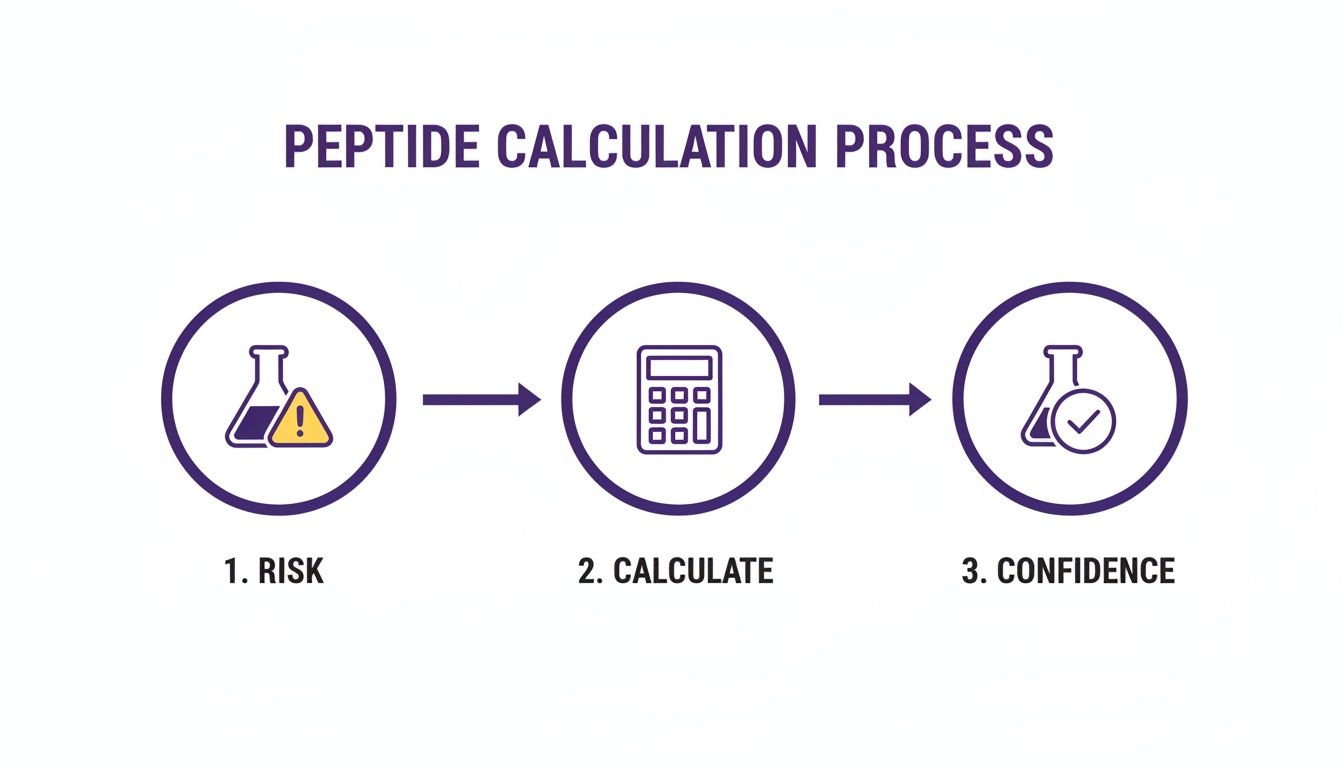
By handling the math, these tools take human error out of the equation right from the start. This lets researchers move forward with solid, validated measurements and a lot more certainty in their results.
From Mass to Molarity: The Language of Dosing
Once your peptide solution is mixed, the next step is to measure out a precise dose. Research protocols don't ask for a "drop" or a "smidgen" of peptide; they demand specific amounts, usually in milligrams (mg) or micrograms (mcg). This is where a peptide calculator app becomes indispensable, translating your target dose into a real-world volume you can actually measure.
The app runs a simple but critical conversion. It takes the known concentration of your solution (for example, 5 mg of peptide in 1 mL of diluent) and tells you exactly how much liquid to draw into a syringe to get the dose you need. If your protocol calls for a 500 mcg dose, the calculator instantly spits out the exact volume in milliliters (mL) or syringe units required to hit that target.
The real value of a peptide calculator app is its ability to connect scientific requirements with practical actions. It closes the gap between the theoretical dose on paper and the physical volume you pull into a syringe.
This simple function removes the tedious manual math and, more importantly, the risk of a misplaced decimal point—a tiny slip-up that could easily cause a ten-fold overdose or underdose.
The Inputs You Need to Provide
To give you the right answers, a peptide calculator needs a few key pieces of information from you. The old saying "garbage in, garbage out" absolutely applies here; the quality of the output depends entirely on the accuracy of your input.
You’ll generally need to provide:
- Total Peptide Amount: The mass of the powder in the vial, usually stated in milligrams (mg).
- Diluent Volume: The amount of liquid (like bacteriostatic water) you will add to the vial, typically measured in milliliters (mL).
- Desired Dose: The specific amount of peptide you plan to administer, often in micrograms (mcg).
With just these three numbers, the app can calculate the precise volume to draw for each administration. If you want a more hands-on look at this process, our guide on how to reconstitute peptides walks you through it step-by-step.
Why This Matters in Modern Research
The need for these digital tools has grown right alongside the explosion in peptide research. Apps like Peptides Calculator on the Apple App Store have become go-to resources, offering free logging of reconstitution data—total peptide, diluent volume, and dosing schedules. The app's popularity, reflected in its 26.8 MB download size across iPhone, iPad, and Mac, shows a clear demand.
This demand really took off after 2020, as peptide studies for healing and anti-aging began surging by 25% annually. Much of this growth was driven by research into weight loss and regeneration, where precise dosing is non-negotiable and mistakes in diluting a 5mg vial with 10ml of bacteriostatic water can't happen. By automating the math, a peptide calculator app helps researchers maintain consistency and accuracy, especially in long-term or complex studies. It's not just about making life easier; it's about protecting the integrity of the scientific process itself.
Putting Theory into Practice with Worked Examples
Knowing the theory is one thing, but getting your hands dirty is where real understanding happens. Let's walk through two of the most common scenarios you'll face in the lab, using the popular research peptide BPC-157 as our example. This is where a peptide calculator app goes from being a neat idea to an indispensable tool.
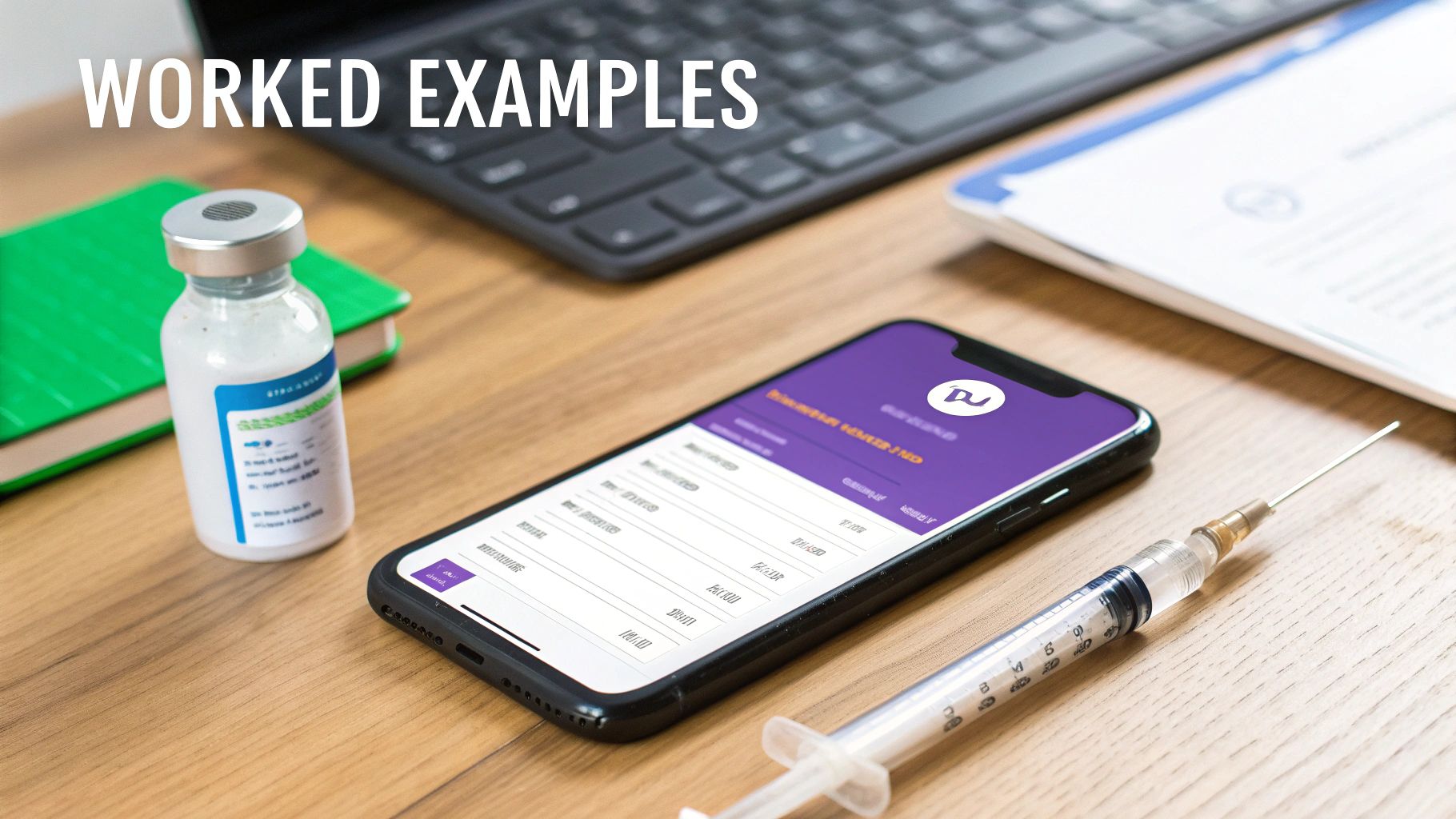
We'll cover the two absolute essentials: reconstituting a new vial and pulling a precise dose. By seeing the process from start to finish—the inputs, the app's output, and the simple math behind it all—you'll get a feel for just how much these apps streamline your workflow and prevent costly errors.
Example 1: Reconstituting a Vial of BPC-157
Okay, so a new vial of lyophilized (freeze-dried) BPC-157 just arrived. Your first job is to turn that powder into a liquid stock solution. The key is to create a solution with a concentration that's easy to work with for dosing later on. A nice round number like 2 milligrams per milliliter (2 mg/mL) is a great target.
Here’s what you know:
- Peptide: BPC-157
- Total Amount in Vial: 5 mg
- Target Concentration: 2 mg/mL
The million-dollar question is: How much bacteriostatic water do you need to add to get that exact concentration? This is precisely what a peptide calculator is built for.
You'd pop open the app and plug in two numbers:
- Total Peptide Mass: 5 mg
- Desired Concentration: 2 mg/mL
The app does the heavy lifting and gives you the answer instantly.
Calculator Output: Add 2.5 mL of diluent.
That's it. Adding exactly 2.5 mL of water guarantees that every single milliliter of your new solution contains 2 mg of BPC-157. You've just made a reliable stock solution without having to second-guess your own math.
The Formula Behind the Magic
It’s always good practice to understand what's happening under the hood. The calculation is surprisingly simple:
Total Peptide Mass (mg) / Target Concentration (mg/mL) = Required Diluent Volume (mL)
Let's plug in our numbers to double-check:
5 mg / 2 mg/mL = 2.5 mL
The app just automates this step, giving you a fast, reliable answer so you can move on with your work.
Example 2: Calculating a Precise Dose
Now that your BPC-157 is mixed, it's time to prepare a dose for an experiment. Let's say your protocol calls for a single administration of 250 micrograms (mcg). How much of that solution you just made do you need to draw into a syringe?
You'll use the same peptide calculator app, just a different function. You already know your solution's strength from the last step.
Here’s what you'll input:
- Solution Concentration: 2 mg/mL (which is the same as 2000 mcg/mL)
- Desired Dose: 250 mcg
The app crunches the numbers to find the exact volume you need.
Calculator Output: Draw 0.125 mL into the syringe.
Here's a fantastic feature of many good calculators: they often translate that volume into something you can easily measure. On a standard 1 mL insulin syringe, 0.125 mL is equal to 12.5 units. This direct conversion from a scientific dose (mcg) to a practical, physical measurement (syringe units) is a game-changer for preventing measurement mistakes.
The Dosing Formula
The math here is just as straightforward. You're just figuring out what volume of liquid contains your target amount of peptide.
Desired Dose (mcg) / Solution Concentration (mcg/mL) = Volume to Draw (mL)
First, you have to make sure your units match. Since the dose is in micrograms (mcg), you need to convert your concentration to mcg as well: 2 mg/mL = 2000 mcg/mL.
Now, the calculation is easy:
250 mcg / 2000 mcg/mL = 0.125 mL
These two examples show that a peptide calculator app is far more than a simple convenience. It’s a vital tool for ensuring scientific precision, handling the tedious but critical math so you can focus on the research itself, confident that your preparations are spot-on.
Choosing the Right Peptide Calculator App
Finding the right peptide calculator app can feel like a chore, but it's a decision that really matters. The simple, free tool that works for a solo biohacker just won’t cut it in a professional research lab where every calculation needs to be documented and defensible. It's about more than just getting the math right.
A good app should feel like a natural extension of your workflow. You want something that's quick and intuitive for those on-the-fly calculations but also robust enough to handle complex, multi-step protocols without a hitch. The goal is to find a tool that matches the rigor and compliance needs of your specific work.

Essential Features Checklist
When you're vetting a peptide calculator app, there are a few non-negotiable features you need to look for. These are the fundamentals that prevent frustrating mistakes and make your life in the lab easier. Get these basics right before you even think about the fancy extras.
Here’s what should be on your checklist:
- Flexible Unit Handling: The app has to seamlessly switch between common units—milligrams (mg), micrograms (mcg), milliliters (mL), and even International Units (IU). A tool that does this for you eliminates the risk of manual conversion errors, which are one of the most common ways experiments go wrong.
- Variable Syringe Support: Not everyone uses a standard U-100 insulin syringe. A solid calculator lets you specify your equipment, whether it’s a U-40, U-50, or U-100 syringe, and gives you the dose in the correct “tick marks” or units for that specific device.
- Calculation Logs: Being able to save and look back at your calculations is critical for traceability. Think of it as your digital paper trail. It lets you double-check your work or quickly recall how you reconstituted a specific vial weeks ago.
If an app nails these core functions, you know it’s a practical and reliable tool for any research setting.
Advanced Capabilities for Professional Labs
In more demanding environments like a university lab or a biotech R&D department, the basics are just the starting point. Professional-grade apps are built with data management, collaboration, and compliance in mind. This is what truly separates a simple calculator from a serious lab instrument.
The real power of a professional peptide calculator app isn't just in doing the math—it's in creating a traceable, shareable, and secure record of your work. It’s about being able to prove you did it right.
For more rigorous research, look for these advanced features:
- Data Export Options: Exporting calculation logs to CSV or PDF is a must for keeping detailed lab notebooks and pulling data for reports. It makes archiving and sharing your work so much cleaner.
- Offline Functionality: Let's be real, lab Wi-Fi can be spotty. An app that works completely offline means you're never stuck waiting for a connection to run a critical calculation.
- Cloud Sync and Team Sharing: In a team setting, being able to sync protocols and logs across multiple devices is a game-changer. It keeps everyone on the same page and ensures consistency across experiments.
Comparing Your Options
So, what’s the real difference between a free app and a professional tool? It almost always comes down to these data management and workflow features. A freebie is fine for a quick, one-off calculation, but a pro-level app is designed to support an entire research project from start to finish.
To make it easier to see the difference, here’s a quick breakdown of what you can generally expect from each type of peptide calculator app.
Comparing Basic vs. Advanced Peptide Calculator Apps
This table highlights the key differences between a standard free tool and a more comprehensive professional application.
| Feature | Basic Free App | Advanced/Pro App |
|---|---|---|
| Core Calculations | Yes (Reconstitution, Dosing) | Yes (Comprehensive and Validated) |
| Unit & Syringe Support | Often Limited (e.g., U-100 only) | Fully Customizable (U-40, U-100, etc.) |
| Calculation History | Maybe (Local device only) | Yes (Detailed, Searchable Logs) |
| Data Export (CSV/PDF) | No | Yes |
| Offline Access | Unlikely | Yes |
| Team Collaboration | No | Yes (Syncing and Sharing) |
Ultimately, the choice comes down to your needs. If you’re doing personal research, a basic app might be all you need. But for any work that demands strict documentation, reproducibility, and teamwork, investing in a professional-grade peptide calculator app is a smart move that protects your scientific integrity.
Weaving a Calculator into Your Lab Workflow
A great tool is useless if it just sits in the toolbox. To get the real benefits of a peptide calculator app—the kind that boosts accuracy and saves time—it needs to become a reflex, a natural part of your lab's daily rhythm. This is about more than just downloading an app; it’s about fundamentally building a smarter, more reliable research process.
The first move is standardization. When everyone on the team uses the same validated calculator, you instantly squash a huge source of experimental error: the "human factor" of manual math. Suddenly, a 250 mcg dose figured out by one person is identical to another's. You've created a single source of truth for your entire project.
This kind of consistency is the foundation of good, reproducible science. It means that whether you're mixing up a fresh vial or prepping a daily dose, the math behind it is always done the exact same way. Every single time.
Establishing a Digital Audit Trail
One of the biggest wins of using a professional-grade peptide calculator app is the automatic digital paper trail it creates. The best apps come with features like calculation logs and data export, which are absolutely critical for keeping clean records and satisfying any compliance requirements.
Think of each calculation log as an automatic entry in your lab notebook. It grabs all the important details without you having to lift a finger:
- The exact date and time the calculation was done.
- The total peptide mass and diluent volume for reconstitution.
- The final target dose and the precise volume it requires.
- Which user ran the calculation (on apps that support teams).
This log becomes your best friend during quality control (QC) checks or when you're trying to figure out why an experiment went sideways. It’s also hard evidence that you followed procedure, which is invaluable for audits or peer reviews. Being able to export this data as a CSV or PDF makes archiving and reporting a breeze, turning the app into a legitimate lab instrument.
Building Smarter Standard Operating Procedures
To really lock a peptide calculator app into your workflow, it needs to be written directly into your lab’s Standard Operating Procedures (SOPs). Your SOPs are the playbook, the step-by-step instructions your team follows for every routine task. By requiring the app’s use in these documents, you make it official.
For instance, your SOP for peptide reconstitution might now look something like this:
- Confirm the peptide mass (mg) listed on the vial’s certificate of analysis.
- Open the approved peptide calculator app to find the correct diluent volume for your target concentration.
- Input the peptide mass and target concentration into the app.
- Carefully reconstitute the vial using the exact volume of bacteriostatic water calculated by the app.
- Save the calculation in the app’s log and attach an export to the project’s digital notebook.
When you write a calculator into your SOPs, you're doing more than just double-checking the math. You're building a culture of precision and accountability. A helpful tool becomes a non-negotiable checkpoint for scientific rigor.
This systematic approach eliminates guesswork and stops people from doing calculations on the back of a napkin. It forces everyone to follow the same validated process, which is non-negotiable for long-term studies where consistency is everything. If you're looking for inspiration on building out your own guidelines, you can find a variety of established lab protocols that show how digital tools fit in. By embedding a calculator directly into these core documents, you make accuracy the default setting for your entire lab.
Answering Your Top Questions About Peptide Calculators
As peptide research grows, so do the questions about the tools we rely on. A good peptide calculator app can be a researcher's best friend, but like any tool, you need to know how to use it right—and understand its limits—to get reliable results. Let's tackle some of the most common questions I hear from researchers, from newcomers to seasoned pros.
We'll clear up concerns about reliability, what peptides you can use them for, and why a dedicated app is often a smarter choice than a simple spreadsheet. These are the practical insights you need to make a calculator a trusted part of your lab work.
Are Peptide Calculator Apps Reliable for Serious Research?
Absolutely, as long as you feed them accurate information. Think of a reputable peptide calculator app as a perfect calculator; it will execute the math flawlessly every single time. The reliability of the answer it gives you depends entirely on the quality of the numbers you put in—things like the exact peptide mass and the volume of your diluent.
For any serious research, I always recommend a simple sanity check. The first time you use a new app, run one calculation by hand to make sure its logic aligns with yours. Once you've confirmed that, the app becomes an incredible asset for minimizing human error, especially when you're dealing with complex dilution series or repetitive dosing schedules.
The real value of a good app lies in its consistency. It performs the same calculation the same way every single time, eliminating the variability that can creep in with manual math.
On top of that, many professional-grade apps come with features like calculation logs. This creates a clear, traceable record of your work, which is fantastic for documentation and essential for maintaining strict scientific protocols and quality control.
Can I Use These Apps for Any Type of Peptide?
For the most part, yes. The fundamental math for reconstitution—dissolving a known mass of powder into a specific volume of liquid—is the same for almost all lyophilized peptides. The basic inputs an app needs (total mass, diluent volume, desired dose) are pretty much universal.
However, and this is critical, the app is a math tool, not a chemist. You must always go back to the peptide's specific data sheet for the information that truly matters.
This includes essential details like:
- Solubility: Some peptides won't dissolve in standard bacteriostatic water and need something specific, like acetic acid or DMSO. The data sheet will tell you.
- Stability: Once you reconstitute a peptide, how should you store it, and for how long? The data sheet has the answer.
- Handling Instructions: Certain compounds might require special handling that a calculator app would have no way of knowing.
The calculator gets the numbers right, but the science—the chemical compatibility and handling—has to come straight from the manufacturer's official guidelines.
What Is the Difference Between MCG and IU Dosing Units?
This is a huge and incredibly important distinction. Get this wrong, and your entire experiment could be off.
A microgram (mcg) is a unit of mass. It's simple and direct: one-millionth of a gram. It tells you exactly how much physical "stuff" you have. Nearly all synthetic peptides used in research are measured and dosed by mass.
An International Unit (IU), on the other hand, is a measure of biological activity. It's a unit of effect, not mass. The relationship between mass (mcg) and activity (IU) is completely unique to each substance and is set by international agreement based on complex biological tests.
For instance, 1 IU of one hormone might be equal to 0.5 mcg, while 1 IU of another could be 10 mcg. There's no single conversion factor. While most peptide calculators are built around mass-based units (mcg, mg), some of the more advanced ones can handle IU conversions, but only if you provide the specific ratio for your compound. Always double-check your research protocols to confirm which unit you should be using.
Why Use an App Instead of a Simple Spreadsheet?
Look, a spreadsheet can definitely do the math. I've built plenty of them myself over the years. But a dedicated peptide calculator app is built from the ground up for the lab workflow, and that gives it some serious advantages.
First off, it’s fast and convenient, putting accurate calculations right in your hand at the lab bench. Second, a good app is designed to prevent mistakes. Having clearly labeled fields like "Vial Mass" or "Diluent Volume" is far safer than hoping you clicked on the right cell in a complex spreadsheet formula.
Finally, a quality app brings lab-specific features to the table that a spreadsheet just can't match, like:
- Visual guides for different syringe types (U-40, U-100).
- Saved logs to help you track multiple reconstituted vials at once.
- The ability to quickly switch between calculating for reconstitution and for dosing.
A well-designed app doesn't just give you a number; it makes the entire process, from vial to syringe, smoother, faster, and far more consistent.
At Bullit Peptides, we are committed to supporting rigorous and accurate research. Our extensive catalog of high-purity, third-party tested peptides provides the reliable foundation your work demands. Explore our products and resources to advance your next project with confidence.
Learn more at https://bullitpeptides.com
Article created using Outrank