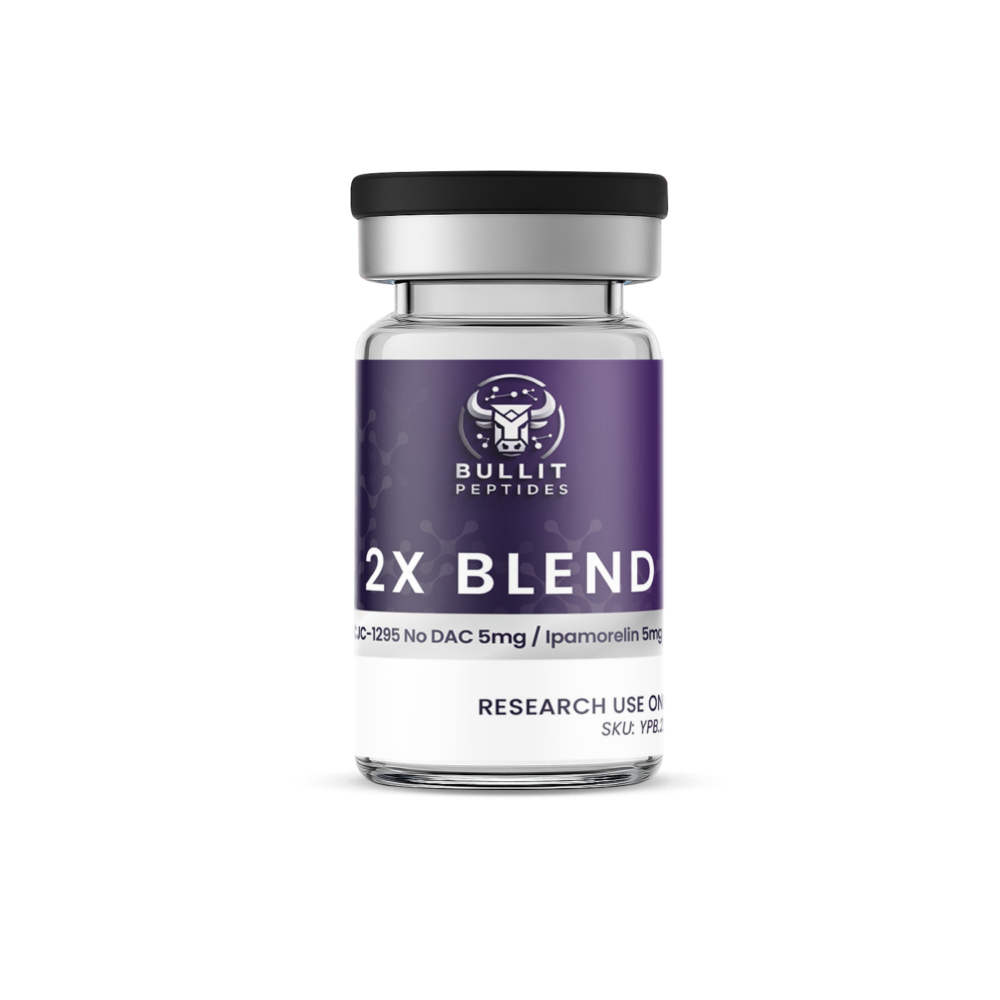
 2X Blend CJC-1295 Without DAC (5mg) / Ipamorelin (5mg)
RT
Price range: $160.00 through $290.00
Description
A single-component research material supplied for controlled research environments. Suitable for studies involving receptor–related pathway characterization and method development in model systems.
Composition
RT
• Appearance: Lyophilized powder in a sealed research vial
Research Focus (non-clinical)
• Peptide identity and purity assessment via HPLC/LC-MS
• Assay development and calibration for quantitative analysis of receptor–related models
• Chromatographic method optimization for impurity profiling and peak resolution
• Stability characterization of a lyophilized peptide under laboratory storage conditions
For qualified research professionals and institutional laboratories. Not for human use.
Documentation & Quality Assurance
Each lot is sourced through our verified global supply chain with emphasis on traceability and quality control. We work diligently to obtain and maintain third-party analytical reports (HPLC/LC-MS) and Certificates of Analysis for each batch, as part of our ongoing quality process. These documents are reviewed internally and displayed as they become available. Independent third-party testing is also performed on select lots to confirm identity, purity, and alignment with our internal specifications.
Important Notice
This product is intended for laboratory research use only. It is not intended for human or veterinary use, and must not be used for diagnostic, therapeutic, or clinical purposes.
This material is not a drug, medical device, or dietary supplement, and has not been evaluated by the U.S. Food and Drug Administration.
Quality & Manufacturing
All materials are sourced from carefully vetted domestic and international manufacturing partners who follow quality systems consistent with ISO and cGMP principles. Each supplier is reviewed for reliability, documentation integrity, and transparency in testing.
We require a verified purity of 99% or higher and perform independent third-party spot testing to confirm that select lots meet our internal standards for identity, purity, and composition. Where available, endotoxin testing results are included on Certificates of Analysis to verify laboratory purity; their inclusion is for research quality assessment only and does not imply suitability for human or veterinary use.
All research materials are sealed for integrity and packaged for stability during storage and transport from manufacturing through final delivery.
Additional information
| Weight | 0.2 lbs |
|---|---|
| Dosage | 10mg, 20mg, 30mg, 40mg, 50mg |
Storage Instructions
All our research peptides are manufactured using a lyophilization (freeze-drying) process. This method is designed to maintain product integrity and allows vials to remain stable during shipping for approximately 3–4 months.
Once a vial is reconstituted with bacteriostatic water, it should be stored in the refrigerator to help maintain stability. Under these conditions, reconstituted material is generally considered stable for up to 30 days.
Lyophilization is a dehydration technique in which compounds are frozen and then exposed to low pressure. This causes the water in the vial to sublimate directly from solid to gas, leaving behind a stable, crystalline white structure. This powder can be kept at room temperature until reconstitution.
Upon receipt, products should be stored away from heat and light. For short-term use, refrigeration at approximately 4°C (39°F) is suitable. For long-term storage (several months to years), vials may be placed in a freezer at approximately -80°C (-112°F). Freezing is the preferred method for preserving product stability over extended periods.
⚠️ Important Notice: These products are intended for research use only. Not for human consumption.
Certificate of Analysis
Every batch undergoes rigorous third-party laboratory testing to verify identity, purity (≥98%), and quality before release.
Research Use Only
These studies reference research-grade peptides for laboratory and scientific investigation only. Not for human consumption. Not intended to diagnose, treat, cure, or prevent any disease.
Published Scientific Research
Peer-reviewed laboratory research investigating research peptides from leading scientific databases
Peptide Binder to Glypican-3 as a Theranostic Agent for Hepatocellular Carcinoma.
RAYZ-8009 showed high binding affinity to GPC3 protein of human, mouse, canine, and cynomolgus monkey origins and no binding to other glypican family members. Biodistribution study of Lu-RAYZ-8009 showed sustained tumor uptake and fast renal clearance, with minimal or no uptake in other normal tissues.
View Full StudyTumor cell-intrinsic MELK enhanced CCL2-dependent immunosuppression to exacerbate hepatocarcinogenesis and confer resistance of HCC to radiotherapy.
Here we focused on elucidating the functional consequences of Maternal embryonic leucine zipper kinase (MELK) in the tumorigenesis, progression and metastasis of HCC, and exploring the effect of MELK on immune cell regulation in the TME, meanwhile clarifying the corresponding signaling networks. Luciferase assays, RNA sequencing, immunopurification-mass spectrometry (IP-MS) and coimmunoprecipitation (CoIP) were applied to explore the upstream regulators, downstream essential molecules and corresponding mechanisms of MELK in HCC.
View Full StudyMelanoma Derived Exosomes Amplify Radiotherapy Induced Abscopal Effect via IRF7/I-IFN Axis in Macrophages.
However, the detailed underlying mechanisms remain largely unknown. Single-cell RNA sequencing, immunofluorescence, and flow cytometry are performed to explore the regulation of tumor microenvironment (TME) by RT.
View Full StudyLILRB2 inhibition enhances radiation sensitivity in non-small cell lung cancer by attenuating radiation-induced senescence.
This study examines the role of lymphocyte immunoglobulin-like receptor B2 (LILRB2) in modulating RT-induced senescence and radiosensitivity in NSCLC. Through methodologies including irradiation, lentivirus transfection, and various molecular assays, we assessed LILRB2's expression and its impact on cellular senescence levels and tumor cell behaviors.
View Full StudyDiscovery of a novel dual-targeting D-peptide to block CD24/Siglec-10 and PD-1/PD-L1 interaction and synergize with radiotherapy for cancer immunotherapy.
BACKGROUND: Aside from immune checkpoint inhibitors targeting programmed cell death protein 1 (PD-1) and programmed death ligand 1 (PD-L1), intervention of CD47/Sirpα mediated 'don't eat me' signal between macrophage and tumor cell is considered as a promising therapeutic approach for cancer immunotherapy. Compared with CD47, the novel immune checkpoint CD24/Siglec-10 can also deliver 'don't eat me' signal and CD24 shows much lower expression level in normal tissue which might avoid unwanted si
View Full StudyChallenges for the application of EGFR-targeting peptide GE11 in tumor diagnosis and treatment.
Abnormal regulation of cell signaling pathways on cell survival, proliferation and migration contributes to the development of malignant tumors. Among them, epidermal growth factor receptor (EGFR) is one of the most important biomarkers in many types of malignant solid tumors.
View Full StudyRelated products
-
-
-
Epitalon
Price range: $100.00 through $150.00Select options This product has multiple variants. The options may be chosen on the product page