
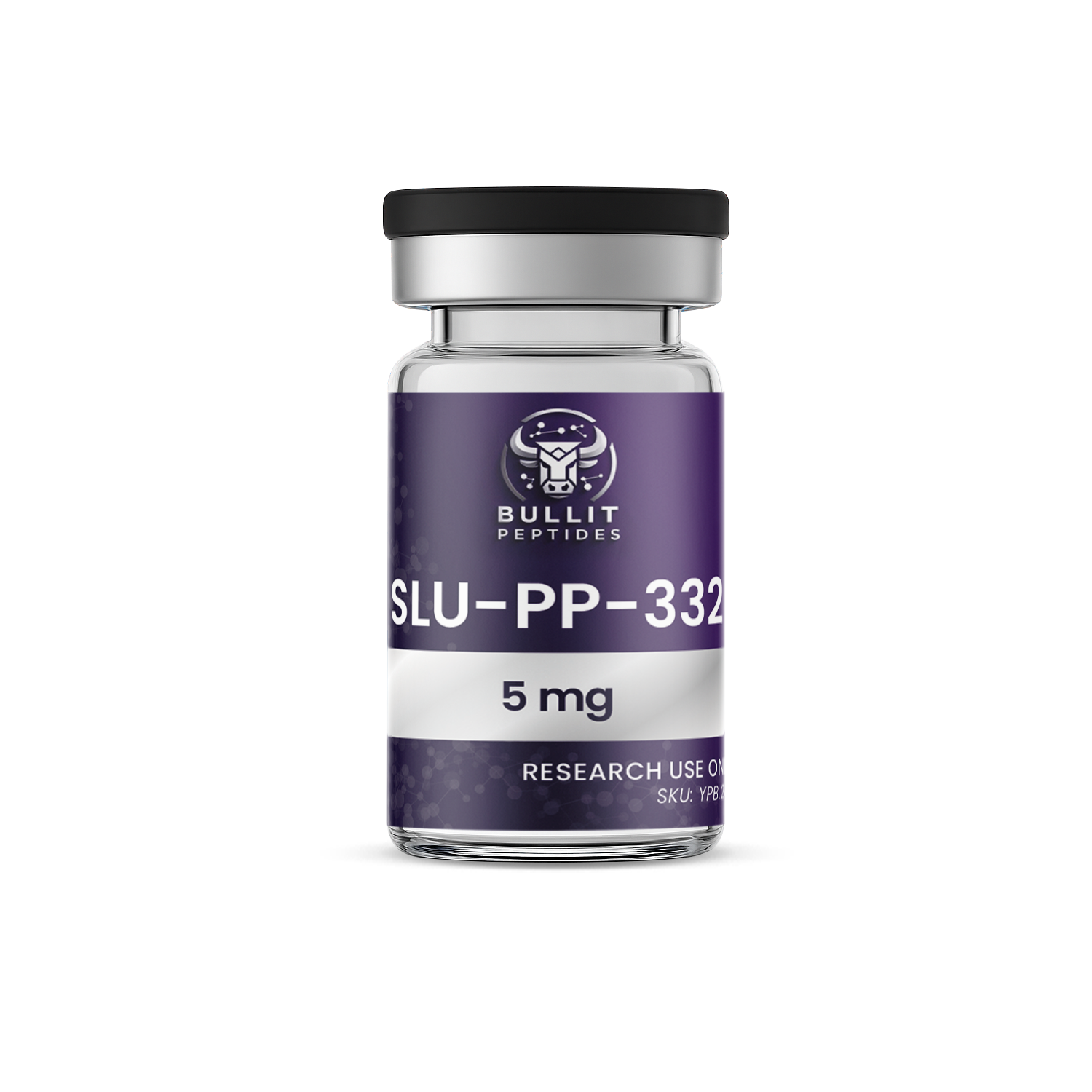
SLU-PP-332 (5mg)
$110.00
Description
A single-component research material supplied for controlled research environments. Formulated for advanced studies examining metabolic regulation, mitochondrial activity, and peptide signaling pathways in model systems.
Composition
• SLU-PP-332
• Appearance: Lyophilized powder in a sealed research vial
Research Focus (non-clinical)
• Evaluation of peptide impact on PGC-1α signaling and mitochondrial biogenesis
• Studies investigating potential roles in skeletal muscle metabolism models
• Development of in-vitro and in-vivo assays for metabolic pathway mapping
• Stability and solubility testing of SLU-PP-332 under various laboratory conditions
For qualified research professionals and institutional laboratories. Not for human use.
Documentation & Quality Assurance
Each lot is sourced through our verified global supply chain with emphasis on traceability and quality control. We work diligently to obtain and maintain third-party analytical reports (HPLC/LC-MS) and Certificates of Analysis for each batch, as part of our ongoing quality process. These documents are reviewed internally and displayed as they become available. Independent third-party testing is also performed on select lots to confirm identity, purity, and alignment with our internal specifications.
Important Notice
This product is intended for laboratory research use only. It is not intended for human or veterinary use, and must not be used for diagnostic, therapeutic, or clinical purposes.
This material is not a drug, medical device, or dietary supplement, and has not been evaluated by the U.S. Food and Drug Administration.
Quality & Manufacturing
All materials are sourced from carefully vetted domestic and international manufacturing partners who follow quality systems consistent with ISO and cGMP principles. Each supplier is reviewed for reliability, documentation integrity, and transparency in testing.
We require a verified purity of 99% or higher and perform independent third-party spot testing to confirm that select lots meet our internal standards for identity, purity, and composition. Where available, endotoxin testing results are included on Certificates of Analysis to verify laboratory purity; their inclusion is for research quality assessment only and does not imply suitability for human or veterinary use.
All research materials are sealed for integrity and packaged for stability during storage and transport from manufacturing through final delivery.
Additional information
| Weight | 0.2 lbs |
|---|
Storage Instructions
All our research peptides are manufactured using a lyophilization (freeze-drying) process. This method is designed to maintain product integrity and allows vials to remain stable during shipping for approximately 3–4 months.
Once a vial is reconstituted with bacteriostatic water, it should be stored in the refrigerator to help maintain stability. Under these conditions, reconstituted material is generally considered stable for up to 30 days.
Lyophilization is a dehydration technique in which compounds are frozen and then exposed to low pressure. This causes the water in the vial to sublimate directly from solid to gas, leaving behind a stable, crystalline white structure. This powder can be kept at room temperature until reconstitution.
Upon receipt, products should be stored away from heat and light. For short-term use, refrigeration at approximately 4°C (39°F) is suitable. For long-term storage (several months to years), vials may be placed in a freezer at approximately -80°C (-112°F). Freezing is the preferred method for preserving product stability over extended periods.
⚠️ Important Notice: These products are intended for research use only. Not for human consumption.
Certificate of Analysis
Every batch undergoes rigorous third-party laboratory testing to verify identity, purity (≥98%), and quality before release.
View Certificate of AnalysisResearch Use Only
These studies reference research-grade peptides for laboratory and scientific investigation only. Not for human consumption. Not intended to diagnose, treat, cure, or prevent any disease.
Published Scientific Research
Peer-reviewed laboratory research investigating research peptides from leading scientific databases
Targeting muscle-bone crosstalk with hormone-like peptides: Systems approach reveals RGHGP-mediated suppression of LAMB1-MAPK osteoclastogenesis.
Tissue-specific ligand-receptor and signaling pathway interaction networks were constructed based on dual-tissue transcriptomics sequencing data. Crucial ligands and receptors were identified to provide a foundation for interorgan communication.
View Full StudyDecoding the Heart Failure Peptidome.
BACKGROUND: Peptides such as angiotensin II and brain natriuretic peptide are pivotal in diagnosing and treating heart failure (HF). However, unbiased systematic studies of the peptidome in patients with HF are lacking. Deciphering the plasma peptidome might significantly improve the diagnosis, prognostication, and treatment of patients with HF. METHODS: To systematically explore the low molecular peptidome, we conducted a cross-sectional mass spectrometry analysis from 486 patients with HF and
View Full StudyPeptides: Emerging Candidates for the Prevention and Treatment of Skin Senescence: A Review.
Based on their mechanism of action, they can be classified into signal peptides, carrier peptides, neurotransmitter inhibitor peptides, and enzyme inhibitor peptides. Increasing peptide bioavailability and stability for enhanced delivery to the desired site of action and visible effects have become central points for the latest research due to their promising features.
View Full StudyBioactive peptides in cosmetic formulations: Review of current in vitro and ex vivo evidence.
Their claimed biological activities include signaling to increase collagen and hyaluronic acid production, modulation of pigmentation, maintenance of a healthy skin microbiome, antioxidant activity and cellular defense, immunomodulation, neurotransmitter inhibition, enzyme activity inhibition and trace mineral carriers.
View Full StudyImproved GPCR ligands from nanobody tethering.
Here we develop a new type of conjugate that consists of a nanobody and a peptidic ligand for a G protein-coupled receptor (GPCR), fused via their C-termini. We address activation of parathyroid hormone receptor-1 (PTHR1) and improve the signaling activity and specificity of otherwise poorly active N-terminal peptide fragments of PTH by conjugating them to nanobodies (VHHs) that recognize PTHR1.
View Full StudyNCAM Mimetic Peptides: Potential Therapeutic Target for Neurological Disorders.
Many synthetic peptides have been engineered to mimic these interactions and induce NCAM-downstream signaling pathways. Such NCAM mimetics have displayed neuritogenic and neuroprotective properties, as well as synaptic modulation in vitro and in vivo.
View Full StudyRelated products
-

-
-
GLP-1 S
Price range: $240.00 through $360.00Select options This product has multiple variants. The options may be chosen on the product page