
When you get down to brass tacks, the whole tesamorelin vs sermorelin conversation really boils down to one thing: are you looking for a specialist or a generalist?
Think of Tesamorelin as a precision tool, a highly targeted GHRH analog engineered with one primary goal in mind: tackling visceral fat. On the other hand, Sermorelin is more of a foundational player. It’s a GHRH mimetic that supports broader, more systemic growth hormone optimization, making it a go-to for studies focused on things like recovery and overall wellness.
Understanding the Core Differences
It's easy to lump Tesamorelin and Sermorelin together since they're both Growth Hormone-Releasing Hormone (GHRH) analogs. They both signal the pituitary gland to release more growth hormone, but that’s where the similarities start to fade. Their molecular structures are different, which directly impacts their stability in the body and how they ultimately perform.
Tesamorelin was specifically engineered for potent, sustained action. Sermorelin, in contrast, offers a more natural, pulsatile effect that mimics the body's own rhythm.
This chart really drives home the key distinctions, showing Tesamorelin's targeted approach against Sermorelin's systemic support.
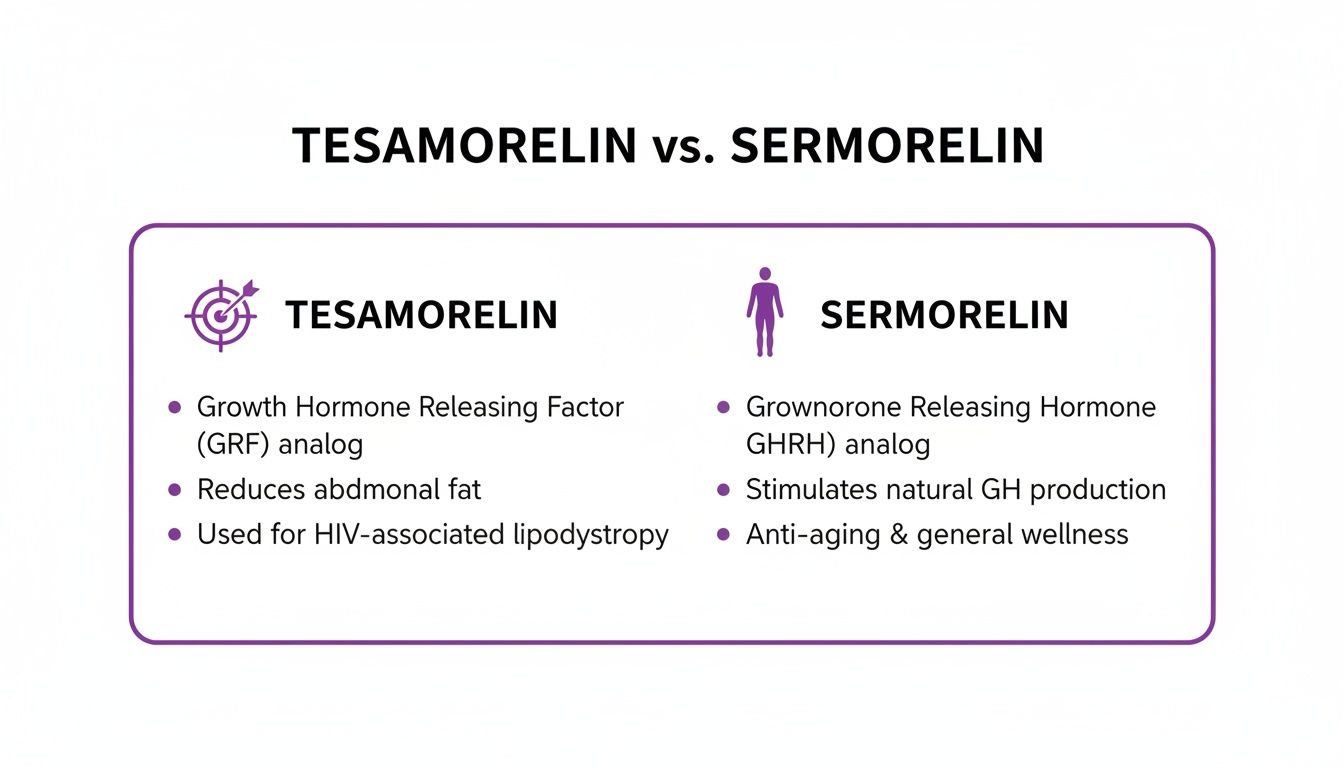
As you can see, the choice isn't about which one is "better" in a vacuum. Tesamorelin is the specialist for hitting specific goals like fat reduction, while Sermorelin is the generalist for building a foundation of wellness and recovery.
Key Comparison Points for Researchers
To select the right compound for your experimental design, you have to dig into these fundamental differences:
- Molecular Structure: Tesamorelin is the larger of the two, a 44-amino acid peptide that has a stabilizing group attached to it. This modification gives it a significantly longer half-life. Sermorelin is a much smaller, 29-amino acid fragment that is essentially a piece of our natural GHRH, which is why it has a shorter half-life.
- Primary Function: The research is crystal clear on this one. Tesamorelin's most well-documented effect is its powerful ability to reduce visceral adipose tissue (VAT). Sermorelin’s effects are much broader and tend to appear more subtly over time, influencing things like sleep quality, recovery, and overall body composition.
- Mechanism of Action: Both trigger GH release, absolutely. But Tesamorelin elicits a stronger, more prolonged pulse of growth hormone. Sermorelin’s action is more biomimetic, encouraging a release pattern that closely follows the body's natural, rhythmic pulsations, especially those that occur during deep sleep.
The decision really comes down to research intent. If your study is laser-focused on metabolic dysfunction and stubborn abdominal fat, Tesamorelin is the obvious choice. But for protocols examining the long-term, systemic benefits of normalized GH patterns, Sermorelin is the superior compound.
Key Differentiators: Tesamorelin vs. Sermorelin
Here’s a quick-reference table to help you see the most critical attributes side-by-side. This gives you the essential context needed to understand the more detailed, scenario-based analysis we'll cover next.
| Attribute | Tesamorelin | Sermorelin |
|---|---|---|
| Primary Research Focus | Targeted visceral fat reduction | General wellness, recovery, anti-aging |
| Amino Acid Length | 44 amino acids | 29 amino acids |
| Biological Half-Life | Longer (approx. 25-40 minutes) | Shorter (approx. 10-20 minutes) |
| GH Release Pattern | Strong, sustained pulse | Biomimetic, pulsatile release |
| Relative Cost | Higher | Lower |
| Common Application | Advanced metabolic & body composition studies | Foundational GH optimization protocols |
This framework sets the stage, but the real art is in applying this knowledge to specific research questions and experimental designs.
How GHRH Peptides Actually Work
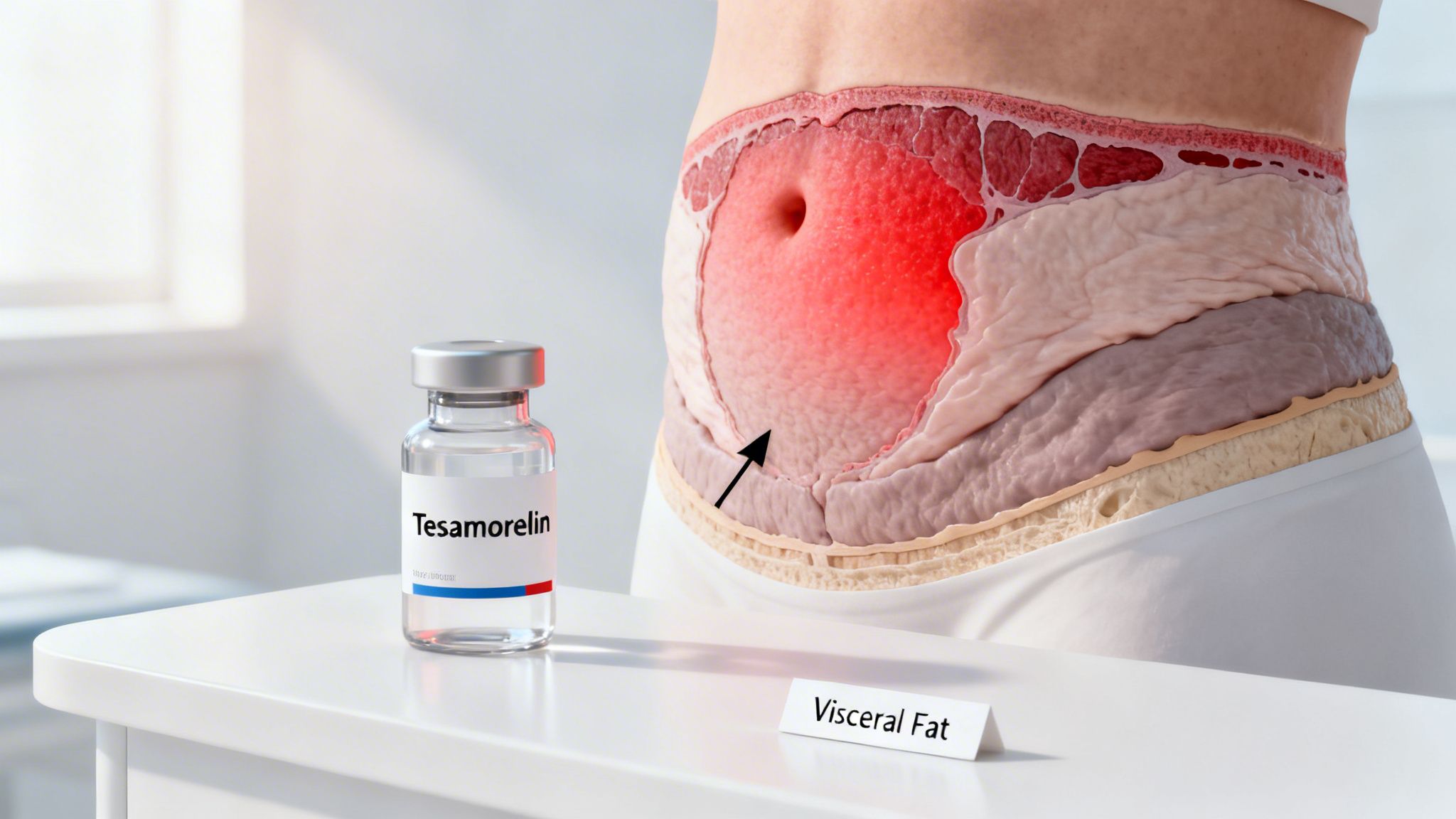
Before we can really get into a meaningful tesamorelin vs sermorelin comparison, we have to pull back the curtain on how your body naturally manages growth hormone. It all comes down to a finely tuned system called the Growth Hormone-Releasing Hormone (GHRH) axis. This isn't just a simple on/off switch; it's a sophisticated signaling network that controls when and how much Growth Hormone (GH) your body produces.
The whole show starts in the hypothalamus, a tiny but critical control tower in your brain. The hypothalamus creates and releases GHRH in a rhythmic, pulsing pattern. This natural pulse is everything—it's how the body maintains a delicate hormonal balance and prevents the system from getting overloaded.
Once GHRH is released, it takes a short trip to the pituitary gland. Think of the pituitary as the "master gland" of your endocrine system. When GHRH arrives and binds to its specific receptors, it’s like a key turning in a lock, signaling the pituitary to fire off a corresponding pulse of GH into your bloodstream.
Where Do Peptides Fit In?
This is precisely where compounds like tesamorelin and sermorelin come into play. Both are known as GHRH analogs, which is a technical way of saying they are synthetic molecules built to mimic your body's own GHRH. They bind to the very same receptors on the pituitary gland, essentially telling it to release your body's stored GH.
But here’s the crucial part: they aren't created equal. The subtle differences in their molecular structure are what lead to their very distinct profiles.
- Sermorelin: This is a 29-amino acid chain, which is essentially the active, functional part of natural GHRH. Because it's so similar to the real thing, its effect is very biomimetic—it triggers a short, sharp pulse of GH that closely follows the body's natural rhythm.
- Tesamorelin: This one is a more robust 44-amino acid molecule. It includes a specific modification that protects it from being broken down by enzymes so quickly. The result? A much longer half-life, which translates into a more sustained and powerful release of GH compared to what you see with sermorelin.
Here's a simple way to think about it: Sermorelin is like flicking a light switch on and off quickly, mimicking the body's natural pulse. Tesamorelin is more like installing a dimmer switch and turning it up for a longer, more intense glow. Both turn on the light (release GH), but the duration and intensity are fundamentally different.
From GH to IGF-1: The Cascade Effect
Once GH hits the bloodstream, its work isn't done. It travels to the liver, where it triggers the production and release of another key player: Insulin-like Growth Factor 1 (IGF-1). This is what we call the downstream effect.
IGF-1 is really the hormone that does most of the heavy lifting. While GH kicks off the process, IGF-1 is the one that delivers the final instructions for things like cell growth, tissue repair, and metabolic regulation. Many of the effects researchers look for—like changes in body composition, cellular regeneration, or fat metabolism—are primarily driven by this conversion of GH to IGF-1.
Understanding this entire axis makes it clear that neither tesamorelin nor sermorelin is growth hormone. They are simply signaling molecules that work upstream to influence your body’s own production. Their effectiveness depends entirely on a healthy, responsive pituitary gland. This is the same mechanism used by other GHRH analogs, and you can dive deeper into a related popular peptide in our guide on what CJC-1295 is. With this foundation, we can now properly compare how these two peptides perform.
Tesamorelin: The Specialist for Targeting Visceral Fat
If sermorelin is the jack-of-all-trades for general GH optimization, tesamorelin is the master of one. In the tesamorelin vs sermorelin comparison, this peptide stands out as a highly specialized tool engineered for a single, powerful purpose: slashing visceral adipose tissue (VAT). This isn't for broad wellness; it's a precision instrument for research protocols where stubborn, deep-set abdominal fat is the primary enemy.
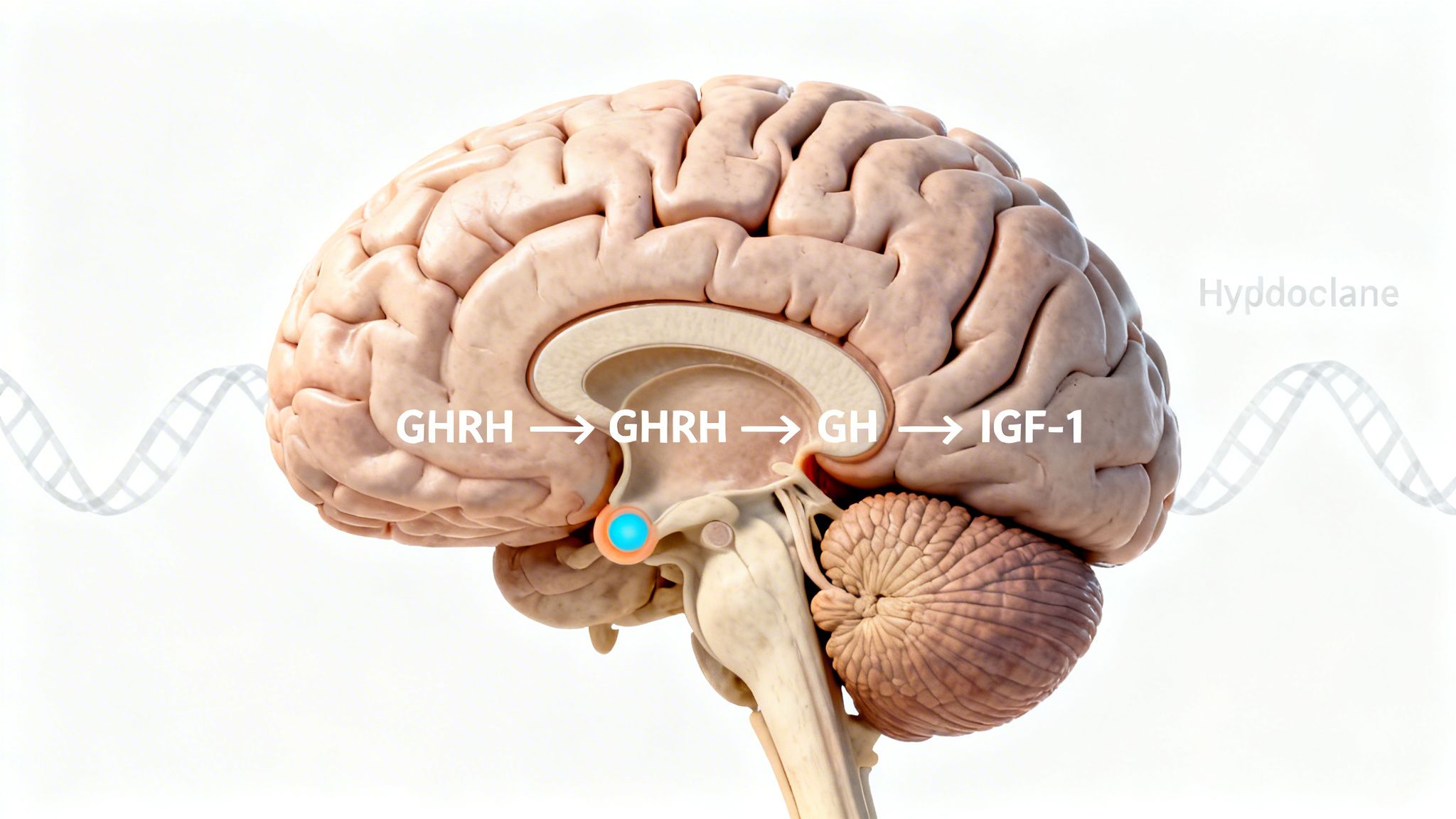
What gives it this unique power? It all comes down to its molecular design. Tesamorelin is a stabilized 44-amino acid GHRH analog, and that structure is no accident. It was deliberately modified to be tougher and more resilient against enzymatic breakdown, which gives it a significantly longer half-life than natural GHRH.
This enhanced stability allows it to send a more potent, sustained signal to the pituitary gland. The result is a much stronger and more prolonged pulse of growth hormone. It's this robust hormonal cascade that supercharges its ability to mobilize and burn through fat, especially the metabolically dangerous fat wrapped around your organs.
Clinically Proven to Melt Stubborn Fat
The most powerful argument for tesamorelin's specialized role comes straight from its clinical track record. It earned FDA approval for treating HIV-associated lipodystrophy, a condition notorious for causing extreme, hard-to-lose abdominal fat. This isn’t a theoretical benefit—it's a real-world, documented application that showcases its focused strength.
During the landmark studies that led to its approval, subjects taking 2mg daily doses saw an average 20% reduction in visceral adipose tissue in just six months. For the average man struggling with belly fat, that could mean losing nearly 10 pounds of pure visceral fat. That's a result far beyond what you'd typically see from diet and exercise alone.
This clinical validation is the key differentiator for tesamorelin. It’s not just about a general GH boost; it’s about triggering a targeted metabolic shift that has a clear, measurable, and profound impact on visceral fat.
This specificity makes tesamorelin the go-to compound for research focused on metabolic syndrome, body composition, and the cardiovascular risks tied to high VAT levels. While many peptides are explored for weight management, tesamorelin's laser-focused action is in a class of its own. You can explore other compounds in our guide on the best peptides for weight loss.
More Than Just a Fat Burner
While its reputation is built on torching visceral fat, the effects of tesamorelin don't stop there. The powerful spike in both GH and, consequently, IGF-1 can trigger a cascade of secondary benefits that are highly valuable in research settings.
Studies have begun to explore its potential to move the needle on other critical health markers, with promising data emerging in several key areas. These secondary research avenues include:
- Cognitive Support: Some investigations suggest tesamorelin may help improve aspects of cognitive function in older adults, likely by promoting neural health and plasticity.
- Cardiovascular Health: By directly attacking visceral fat—a major driver of heart disease risk—tesamorelin is also studied for its ability to improve triglyceride levels and cholesterol profiles.
- Lean Mass Preservation: While it's not a primary muscle-builder, the potent GH release creates a strong anabolic signal that helps protect lean muscle, which is crucial during a fat loss phase.
These added benefits solidify its position as a high-impact research peptide. Yes, tesamorelin comes with a higher price tag, but that cost reflects its specialized, potent, and clinically validated mechanism. It may not be the right tool for every project, but for advanced studies demanding aggressive and targeted visceral fat reduction, its efficacy is undeniable.
Sermorelin: The Foundational GH Optimizer
If Tesamorelin is the surgical strike for visceral fat, then Sermorelin is the foundational support system. In the tesamorelin vs sermorelin conversation, you can think of Sermorelin as the versatile, accessible workhorse for researchers aiming to restore and support systemic wellness. The entire philosophy behind it is different—it’s not about forcing a massive, sustained hormonal spike but gently nudging the body back toward its own natural rhythm.
This peptide is a 29-amino acid chain, which is essentially the active, functional part of our body’s own Growth Hormone-Releasing Hormone (GHRH). Because its structure is so close to the real thing, its action is considered biomimetic. It encourages a pulsatile release of GH that mirrors the natural ebb and flow of the body’s circadian clock, especially those critical pulses that happen during deep, restorative sleep.
A Longstanding and Well-Documented Profile
Sermorelin is no newcomer. It’s been on the research scene for decades, initially used for diagnostic tests to see how well the pituitary gland was functioning. This long history is a huge plus, as it means there’s a solid bedrock of scientific literature for researchers to stand on when designing new experiments.
This extensive track record has shed light on a wide array of potential benefits that go far beyond a single target. Unlike Tesamorelin's laser focus, Sermorelin's effects are studied for their systemic impact on overall health, recovery, and vitality. This makes it the go-to choice for long-term studies exploring the nuances of healthy aging and physiological optimization.
The breadth of its researched effects includes:
- Enhanced Sleep Quality: By promoting GH release that syncs up with natural sleep cycles, it's often studied for its ability to deepen restorative sleep.
- Improved Recovery: A more robust GH pulse can support cellular repair and cut down recovery times between intense physical stressors.
- Better Skin Elasticity: Increased GH and subsequent IGF-1 are linked to collagen synthesis, prompting studies on its effects on skin health.
- Favorable Body Composition Changes: Over time, consistent GH optimization can support a gradual, sustainable shift toward more lean mass and less body fat.
For researchers investigating the cumulative benefits of normalized GH patterns on overall vitality—from sleep to recovery to body composition—Sermorelin offers a sustainable and biomimetic pathway. It supports the system rather than overriding it.
The Advantage of Accessibility and Flexibility
One of Sermorelin's biggest wins in a research setting is simply its accessibility, both in terms of cost and dosing flexibility. A monthly protocol with Sermorelin often runs between $300-$800 for doses of 0.2-1.0mg five days a week. That's a world away from Tesamorelin's $1,500-$2,500 price tag for a rigid, daily 2mg administration. This makes it a far more budget-friendly option for long-term experiments or for biohackers looking to experiment with GH pulses without a crippling financial commitment. For a deeper dive, you can explore a comparison of Tesamorelin vs. Sermorelin that breaks down these economic differences.
This financial practicality opens the door to longer and more extensive studies that would be out of the question with a more expensive compound. And its very short half-life of just 11-12 minutes is a feature, not a bug—it perfectly mimics the body’s natural rhythms. It’s an effective, gentler way to support systemic wellness and encourage moderate lean mass gains without the aggressive intervention seen with more potent GHRH analogs.
Picking the Right Peptide for Your Research Goal
So, how do you decide between Tesamorelin and Sermorelin? It's not about which one is "better" in a vacuum. It's about matching the right tool to the job you need it to do. This is where we get practical and look at specific scenarios to help you design an experiment that gets you the clean, relevant data you're after.
The whole tesamorelin vs sermorelin debate really boils down to one simple question: are you looking for a targeted, powerful intervention, or are you aiming for broader, foundational support? Your answer will point you directly to the right compound.
Scenario One: The Targeted Metabolic Intervention
If your research is laser-focused on aggressively cutting down visceral fat, Tesamorelin is the clear specialist. It's not just another GHRH analog; its unique molecular structure was specifically engineered to trigger a powerful and sustained release of growth hormone. This makes it incredibly effective at breaking down that stubborn visceral adipose tissue (VAT).
Let's say you're designing a study where the main goal is to see a measurable drop in waist circumference and VAT volume over a 12 to 24-week period. Tesamorelin’s sheer potency gives you a huge advantage here. It produces the kind of significant, quantifiable changes that are central to metabolic or cardiovascular research. Yes, it's more expensive, but that cost is justified by its specialized, high-impact performance.
Research Goal: To aggressively reduce visceral adipose tissue and study its downstream effects on metabolic markers like triglycerides and insulin sensitivity in a time-sensitive protocol. The Clear Choice: Tesamorelin.
This makes it the go-to peptide for advanced studies looking at metabolic syndrome or specific body composition changes where VAT is the primary variable you need to manipulate. Its action is direct, strong, and purpose-built for experiments that demand a decisive effect.
Scenario Two: The Foundational Systemic Optimizer
On the other hand, if your work is about exploring the long-term, systemic benefits of healthier GH patterns, Sermorelin is the superior choice. Its action is biomimetic—it mimics the body’s own natural, pulsatile GHRH release. This makes it perfect for research into general wellness, recovery, and the physiological markers of aging.
Picture a longer-term study, maybe six to twelve months, designed to measure the cumulative impact of optimized GH on sleep quality, cognitive function, cellular repair, and overall body composition. Sermorelin’s gentler, rhythmic stimulation supports the body's own systems instead of overpowering them. This approach allows researchers to observe more subtle, holistic improvements over time.
Research Goal: To explore the long-term systemic benefits of normalized GH patterns on sleep, recovery, skin elasticity, and gradual body composition improvements. The Superior Choice: Sermorelin.
Its lower cost and well-established safety profile also make it a much more practical option for these longer protocols. Think of Sermorelin as the foundational tool for researchers who are prioritizing sustainability and systemic balance over a single, acute intervention.
Maximizing Research Outcomes with Synergistic Stacks
The conversation doesn't just stop at choosing one or the other. For more advanced protocols, researchers often "stack" peptides to hit multiple pathways at once and achieve a synergistic effect. But it’s critical to be smart about it. Stacking Tesamorelin and Sermorelin together is completely redundant—they're both GHRH analogs fighting for the same receptors on the pituitary.
A much more logical and effective strategy is to pair a GHRH analog with a Growth Hormone Releasing Peptide (GHRP). And this is an area where Sermorelin really shines, thanks to its flexibility and lower cost.
A classic, highly effective research stack looks like this:
- Sermorelin (GHRH): This acts as the primary signal, telling the pituitary gland how much GH to produce. It lays the groundwork by mimicking a natural GHRH pulse.
- Ipamorelin (GHRP): This peptide works on a completely different receptor (the ghrelin receptor) to amplify Sermorelin's signal. It also suppresses somatostatin, the hormone that puts the brakes on GH release. Essentially, it opens the floodgates for the GH pulse that Sermorelin just initiated.
This one-two punch creates a GH release that is far more powerful and efficient than what either compound could do on its own. It’s a sophisticated strategy for studies aiming to maximize GH optimization while still respecting the body's natural rhythms. This allows you to design highly specific protocols that move well beyond the simple tesamorelin vs sermorelin binary and get you closer to your experimental goals.
Safety Profiles and Proper Handling in Research
When you're working with compounds like tesamorelin and sermorelin, the conversation has to go beyond just what they do. How you handle them and understand their safety nuances is just as critical for legitimate, repeatable research.
Both peptides are generally well-tolerated in lab settings, but they aren't identical. Localized injection site reactions—a bit of redness, itching, or minor swelling—are pretty common for both and usually fade quickly. The real differences show up in systemic effects, which track directly with how each one influences Growth Hormone (GH).
Potential Adverse Effects
Tesamorelin is the more powerful of the two, triggering a stronger and more sustained GH release. That potency means it carries a slightly higher risk of side effects tied to fluid retention, which can sometimes present as joint pain or swelling in the hands and feet. Also, since GH and IGF-1 can play a role in glucose metabolism, any serious research protocol using a potent GHRH analog like tesamorelin should include careful monitoring of blood sugar markers.
Sermorelin, on the other hand, acts more like the body's natural GHRH. Its gentler, more pulsatile effect typically results in a milder side effect profile. Fluid retention can still happen, but it's usually less of an issue. Because it has a shorter half-life, the system isn't dealing with a long, drawn-out GH elevation, which may lessen its impact on insulin sensitivity compared to its more robust counterparts.
The bottom line is simple: the potential for adverse effects is directly tied to the strength and duration of the GH pulse. Tesamorelin’s powerful signal demands more vigilant observation, while Sermorelin’s subtler action offers a lower-risk profile.
Sourcing and Reconstitution Best Practices
Let's be blunt: the single most important factor for both safety and the integrity of your data is the quality of the peptide you're using. Sourcing from a reputable supplier who provides third-party testing is an absolute must. Those tests are your only guarantee of purity and concentration, ensuring your results aren't compromised from the start.
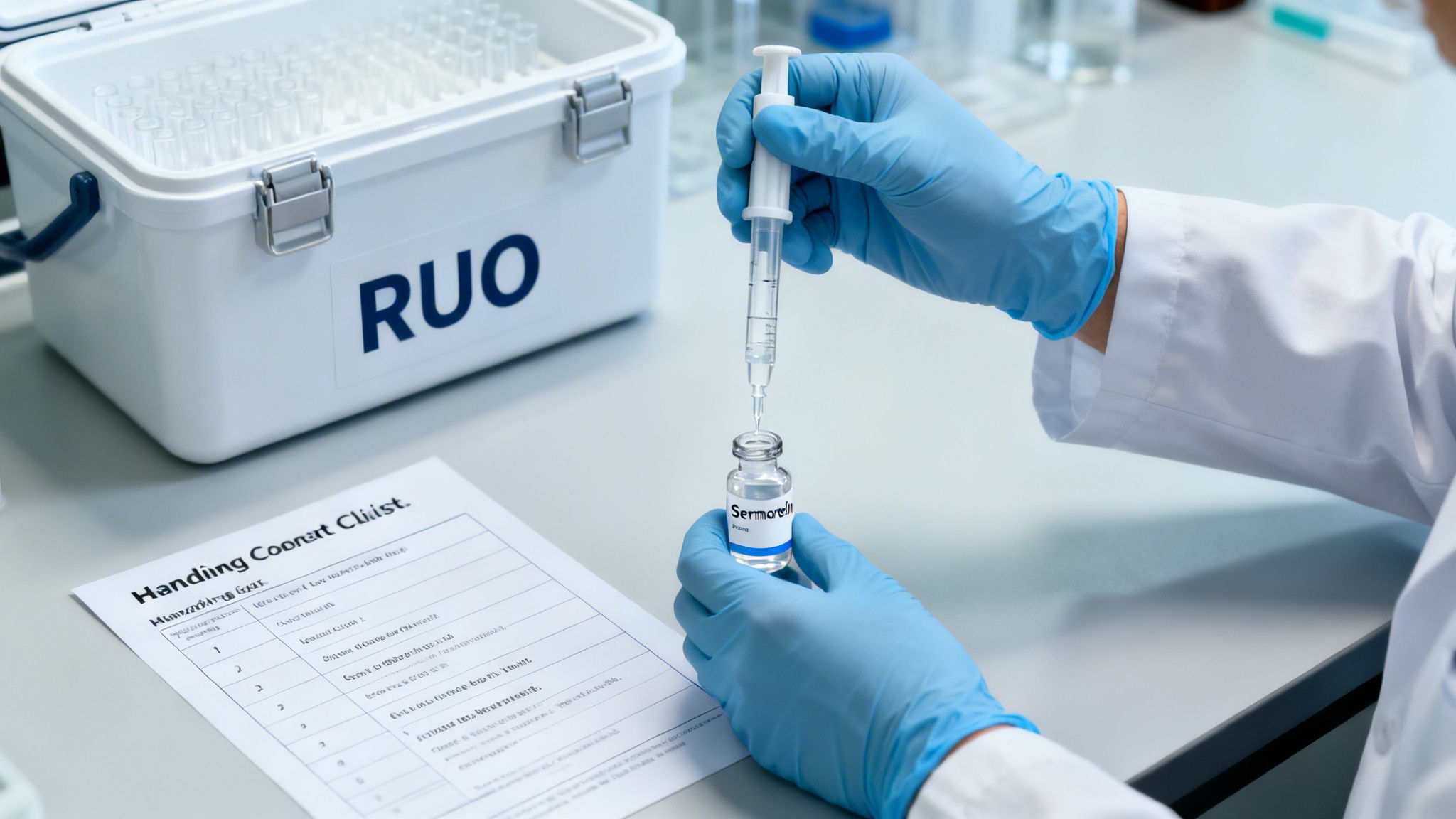
It's also crucial to remember that all legitimate research peptides, tesamorelin and sermorelin included, are sold strictly as Research Use Only (RUO). They are tools for laboratory and in vitro investigation, not for human or veterinary use.
The final piece of the puzzle is proper handling. These peptides arrive as a lyophilized (freeze-dried) powder and need to be carefully reconstituted with bacteriostatic water. Getting the concentration right takes precision. For a complete walkthrough, our guide on how to reconstitute peptides covers the process step-by-step. Once mixed, proper refrigerated storage is non-negotiable to prevent the compound from degrading and to maintain its stability for the duration of your experiment.
Frequently Asked Questions
When diving into the specifics of tesamorelin vs sermorelin, a few key questions always come up. Let's tackle the most common ones head-on to help you sharpen your research focus and experimental design.
Which Peptide Is Better for Muscle Growth: Tesamorelin or Sermorelin?
This is a common misconception. Neither peptide is a direct muscle-builder in the same league as anabolic agents. They work by optimizing the body's growth hormone environment, which can support lean mass, but that's where the similarities end.
Sermorelin is often the go-to for long-term studies aimed at improving body composition and recovery. Its broader, more biomimetic action on GH provides a solid foundation for systemic benefits.
Tesamorelin, on the other hand, is laser-focused on reducing visceral fat. While this can dramatically improve muscle definition and create a leaner physique, any muscle growth is a secondary effect, not the main event. For research centered purely on lean mass and overall systemic health, Sermorelin provides a more direct and foundational approach.
Can You Use Tesamorelin and Sermorelin Together in Research?
In short, it doesn't make much sense. Combining Tesamorelin and Sermorelin isn't a standard or logical research protocol because they're both GHRH analogs. They compete for the exact same receptors in the pituitary gland, making their combined use redundant.
This approach would just drive up research costs and increase the potential for side effects like fluid retention or desensitization, all without adding any real synergistic benefit. A much smarter and more effective protocol pairs a GHRH analog (like Sermorelin) with a GHRP (like Ipamorelin) to hit GH release from two different angles.
How Long Until Research Studies Show Results?
The timeline really depends on what you're measuring. This is one area where the tesamorelin vs sermorelin comparison shows some clear practical differences.
- Tesamorelin: When you're tracking its primary endpoint—visceral fat—you can often measure significant reductions within 3 to 6 months of consistent administration.
- Sermorelin: The effects can be more gradual. Subjective reports of better sleep quality might surface in just a few weeks. However, getting statistically significant data on changes in IGF-1 levels or body composition typically requires a 3 to 6 month timeframe.
Why Is Third-Party Testing Critical for Research Peptides?
For any serious researcher, third-party testing is non-negotiable. It's the only way to be certain about the peptide's purity, identity, and concentration. Without it, you’re flying blind.
Using a product without a verifiable Certificate of Analysis (COA) means you could be working with a contaminated, under-dosed, or completely different compound. This not only invalidates your data but also introduces huge safety risks into your experiment. Reliable COAs are the bedrock of reproducible, credible science.
For researchers who demand the highest standards, Bullit Peptides offers third-party tested, research-grade Tesamorelin and Sermorelin. We ensure your study is built on a foundation of proven quality and accuracy. Check out the complete catalog at https://bullitpeptides.com.