
Peptides are essentially short chains of amino acids that serve as hyper-specific messengers, telling cells exactly what to do. You can think of them as 'biological text messages'—tiny, targeted instructions that can signal a cell to start repairing tissue, manage metabolism, or release a critical hormone. In a research setting, these precise signals are the key to unlocking and studying some of the body's most complex functions.
Understanding How Peptides Work in Research
At their very core, peptides are biological signalers. While proteins are the long, complex amino acid chains that form our body's structural and functional machinery, peptides are much shorter and far more direct. Their small size is a huge advantage, allowing them to travel through systems easily and deliver instructions with stunning accuracy.
This precision is exactly why peptides have become so important in the lab.
Instead of triggering broad, systemic changes, a specific peptide can bind to a single type of cell receptor. It's like having a key that only fits one specific lock in an entire city—that’s the level of interaction a peptide has with its target. This lets scientists isolate and study very precise biological pathways without disturbing everything else.
Primary Areas of Laboratory Investigation
In the lab, these compounds give researchers a controlled way to probe and understand physiological processes. Scientists can use them to essentially turn cellular functions "on" or "off" and then observe the results, which is fundamental for advancing our knowledge in a few key areas.
This visual map breaks down the main branches of modern peptide research.
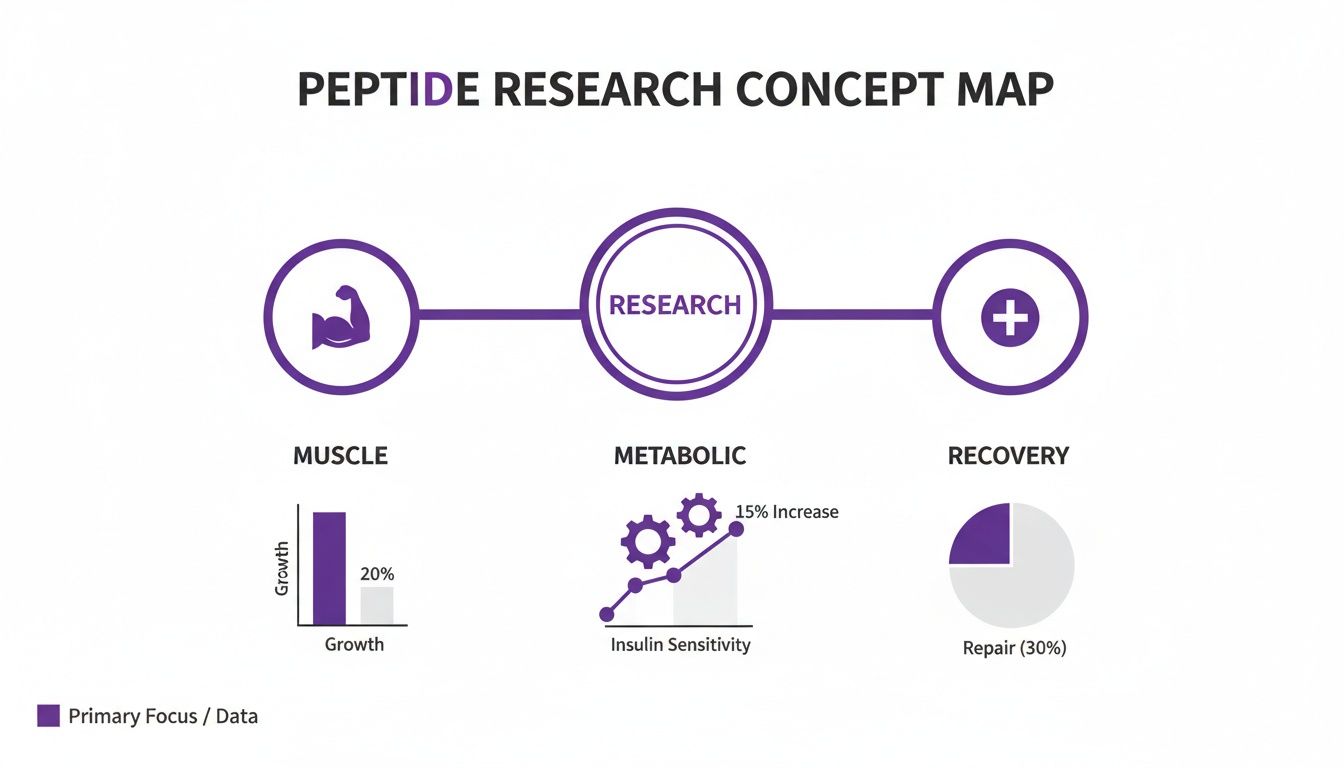
As you can see, a central focus on research spins out into specialized studies on muscle development, metabolic regulation, and recovery mechanisms. Each pathway represents a distinct field where peptides are helping scientists uncover new biological insights.
To give you a clearer picture, here's a table summarizing the main research areas and what scientists are looking for.
Key Areas of Peptide Research and Their Targets
| Research Category | Primary Biological Target | Example Application in Lab Studies |
|---|---|---|
| Muscle Growth & Development | Growth Hormone Signaling Pathways | Using growth hormone secretagogues (GHS) to trigger and study muscle protein synthesis in cell cultures. |
| Metabolic Regulation | Insulin & Glucagon Pathways | Applying GLP-1 agonists to cellular models to investigate appetite signaling and glucose uptake. |
| Tissue Repair & Recovery | Angiogenesis & Cellular Regeneration | Investigating how compounds like BPC-157 stimulate new blood vessel formation in damaged tissue samples. |
These studies are what push our understanding of human biology forward, all thanks to the controlled, targeted nature of these compounds.
Some of the most common laboratory applications in these fields include:
- Muscle Growth Studies: Observing how signaling molecules, particularly growth hormone secretagogues (GHS), influence muscle protein synthesis and hyperplasia in controlled cellular environments.
- Metabolic Control: Using GLP-1 agonists to study the intricate dance of appetite regulation, insulin sensitivity, and glucose metabolism within in vitro models.
- Tissue Repair and Recovery: Applying compounds like BPC-157 to tissue samples to explore angiogenesis (the formation of new blood vessels) and accelerated healing cascades.
It's absolutely crucial to remember that all these applications fall under the strict designation of 'For Research Use Only' (RUO). These compounds are not drugs and are not approved by the FDA for human consumption. They are simply powerful tools for scientific discovery in a laboratory setting.
Diving Into Peptides for Metabolic Regulation

Metabolic control is, without a doubt, one of the most exciting frontiers in peptide research today. It’s a field that gets right to the heart of the mechanisms behind major global health issues, particularly obesity. In the lab, peptides like GLP-1 agonists have become invaluable tools for scientists looking to understand and influence appetite, insulin sensitivity, and how the body handles fat.
Think of these molecules as biological keys. They mimic the body’s own hormones that tell the brain, "Hey, we're full." For a researcher, this is like having a molecular dial to turn down hunger in a controlled environment. It’s a powerful way to observe the cascade of effects on energy expenditure and fat storage.
This line of inquiry is absolutely essential for figuring out how to optimize the body's incredibly complex metabolic machinery. It’s a perfect example of how peptides give scientists a high-precision lens to peer into our most intricate biological systems.
The Role of GLP-1 Agonists in Research
At the very center of this metabolic investigation are the GLP-1 (glucagon-like peptide-1) receptor agonists. This class of peptides works by binding to and activating the GLP-1 receptor, doing the exact same job as the natural hormone your gut releases after a meal. This simple action kicks off a whole series of measurable effects.
In a laboratory setting, this gives scientists a direct window into the gut-brain axis. They can study critical metabolic functions like delayed gastric emptying—which is just a technical way of saying the stomach slows down—and the direct satiety signals sent to the brain's hypothalamus.
The research applications here are massive, helping scientists tackle some of the biggest questions in metabolic health:
- Appetite Signaling: How exactly do these peptide signals tweak the neural pathways that control hunger and fullness?
- Insulin Secretion: Can we use GLP-1 receptor activation to improve how pancreatic beta-cells respond to glucose in cellular models?
- Energy Homeostasis: What happens to body weight regulation and fat storage when a GLP-1 receptor is activated consistently over the long term?
These highly focused studies are fundamental to getting to the root causes of metabolic disorders.
Market Impact and Scientific Validation
The real-world ripple effect of this research is already undeniable, with peptides completely changing the game for managing metabolic diseases. For a deeper look into this specific area, check out our guide on the best peptides for weight loss research.
You just have to look at the numbers to see how big this is. The global peptide therapeutics market, valued at around USD 50.4 billion in 2025, is on track to hit USD 78.9 billion by 2032. Metabolic diseases are the main driver, accounting for over 60% of that market share, thanks to the rising prevalence of obesity and type 2 diabetes.
The data backs it up. GLP-1 agonists have produced staggering results in clinical trials, with some studies showing average body weight reductions of 15-20% over 68 weeks. This immense financial investment and clinical success really highlights the power of peptide-based science. What starts as a focused investigation into a single receptor in a petri dish can blossom into powerful new ways to tackle widespread health crises, proving just how vital this work is.
Investigating Growth Hormone Pathways

For researchers digging into the science of physical optimization and performance, few areas are as fascinating as the body's growth hormone (GH) system. The real breakthrough in this field isn't about introducing synthetic hormones. Instead, scientists are using a specific class of peptides called growth hormone secretagogues (GHS) to figure out how to get the body to produce more of its own GH.
Think of it like this: these peptides don't replace the engine; they're the key that turns the ignition. In the lab, compounds like Ipamorelin and CJC-1295 are used to send a signal directly to the pituitary gland, telling it to release growth hormone in the same natural, rhythmic pulses the body already uses.
This subtle approach gives researchers a front-row seat to the entire hormonal cascade that follows. It allows them to precisely measure downstream effects, like changes in Insulin-like Growth Factor 1 (IGF-1) levels, which is absolutely critical for understanding the deep mechanisms behind physical growth and regeneration.
Unlocking the Pituitary Gland's Potential
The whole point of using GHS peptides in a research setting is to study the body’s own natural—or endogenous—hormone production. It's a completely different ballgame compared to administering synthetic growth hormone, which essentially bulldozes past all the body’s delicate regulatory feedback loops.
By stimulating the pituitary gland directly, scientists can get clean data on several key processes:
- Lean Muscle Development: How exactly do pulsed GH releases affect muscle protein synthesis and hypertrophy in cellular models?
- Tissue Repair Acceleration: Can triggering these natural GH pathways speed up the recruitment of healing factors to damaged tissue samples?
- Body Composition Changes: What’s the precise relationship between higher IGF-1 levels (sparked by GH) and the reduction of fat tissue in controlled experiments?
This research is all about mapping the intricate dance between the pituitary gland, GH, and IGF-1. Getting a handle on this signaling axis is fundamental for any serious scientific inquiry into how muscle grows, how fat is burned, and how the body recovers.
The Scientific and Market Significance
Let's be clear: growth hormone research isn't some niche academic pursuit. It's a cornerstone of modern muscle-building and anti-aging studies. You can see this reflected in the numbers—the endocrine therapeutics market is expected to rocket from USD 140.85 billion in 2025 to a massive USD 260.25 billion by 2030. You can get a deeper look at the peptide therapeutics market and its growth on Grand View Research.
This financial explosion is built on a foundation of compelling research. Studies on well-known peptides like CJC-1295 with DAC and Ipamorelin are exploring their unique ability to create powerful GH pulses, with some results pointing to potential 5-10 fold increases in IGF-1 levels. And it doesn't stop there. Another GHS, Tesamorelin, has shown it can produce significant 15-20% drops in visceral fat during clinical trials with HIV patients.
Numbers like these are exactly why these compounds are such invaluable tools for scientific discovery.
Studying Peptides for Tissue Repair and Recovery
Beyond regulating metabolism or signaling hormones, one of the most exciting frontiers for peptide research is tissue repair. When a muscle, tendon, or ligament gets damaged, the body kicks off a complex healing cascade. For scientists, the real work lies in understanding—and maybe even fine-tuning—that process at the molecular level.
This is exactly where certain research peptides enter the picture. A compound like BPC-157 (Body Protection Compound-157) is a workhorse in in vitro studies designed to unpack the cellular mechanics of recovery. The objective isn't just to see if healing speeds up; it's to figure out why.
Think of it like this: if a bridge is damaged, the city can send out a general call for construction workers. Peptides, in this research analogy, are like dispatching a specialized crew with the exact blueprints straight to the weakest point. They give scientists a way to study highly targeted repair signals with incredible precision. This foundational work is all about building our knowledge base for potential future therapeutic strategies, all within a strictly controlled lab setting.
Investigating Key Healing Mechanisms
Researchers working with these peptides are usually zeroed in on a few core biological processes. By introducing a compound like BPC-157 to a cell culture, they can observe and measure the specific effects that drive the healing process.
These investigations often center on a few key areas:
- Angiogenesis: This is the formation of new blood vessels. Without a fresh supply of blood bringing oxygen and nutrients, effective healing is dead in the water. Peptides are studied to see how they might influence this crucial step.
- Cellular Migration: Scientists want to know if peptides can signal fibroblasts—the cells that build our connective tissue—to get to the injury site faster and start working their magic.
- Inflammatory Response Modulation: Inflammation is a classic double-edged sword. It’s essential for kicking off the repair process, but if it sticks around too long, it can cause more harm than good. Research looks at how peptides might help keep this response in check.
At its core, this research is about decoding the body's natural repair manual. By understanding how these signaling molecules operate, scientists can map out the most efficient pathways for regeneration.
For anyone looking to dive deeper into this particular compound, you can explore more about the BPC-157 peptide and its common laboratory applications in our detailed guide. This kind of work is at the forefront of regenerative science, providing insights that could one day redefine recovery. The sheer precision these molecules offer is what makes them indispensable tools for any researcher asking "what are peptides used for" in the context of physical healing.
Pushing the Boundaries of Therapeutic Research

Sure, peptides are vital for research into metabolism and tissue repair, but that's really just the beginning. Their true potential shines when we look at the most complex frontiers of biomedical science, particularly in fields like oncology and longevity. In these areas, peptides aren't just tools; they're a completely new way for scientists to investigate our biggest health challenges with incredible precision.
These advanced studies reveal the sheer versatility of these molecules. They’re far more than simple messengers. When engineered in the lab, they can perform highly specialized tasks, fundamentally stretching what we thought was possible.
Targeting Cancer with Molecular Precision
In oncology, researchers are exploring peptides as something like molecular "guided missiles." The idea is fascinatingly simple: attach a powerful therapeutic agent to a peptide that's only attracted to receptors on the surface of tumor cells. Nothing else.
This strategy allows scientists to study the direct delivery of a payload right to the cancer's doorstep, which could, in theory, leave healthy surrounding tissue unharmed. It's an elegant concept that plays to a peptide's natural strength—its ability to bind with pinpoint accuracy. This is one of the most critical answers to the question, "what are peptides used for?"
This kind of targeted delivery is a huge leap forward in biomedical science. By homing in on cancer cells, researchers can explore more effective and less damaging intervention strategies, which is a primary goal of modern oncology studies.
The momentum here isn't just scientific; it's financial. The peptide therapeutics market is projected to skyrocket, growing from USD 46.4 billion in 2024 to an estimated USD 100 billion by 2034. This explosive growth is fueled by the promise of precision, with over 100 peptide therapies already FDA-approved around the world, including several major cancer treatments. To get a better sense of these trends, you can check out a detailed forecast on the future of peptide therapeutics on Global Market Insights.
Exploring the Science of Longevity
Another truly captivating area of research is longevity and the science of aging. Here, peptides are used to investigate the core biological processes that make our cells grow old. For instance, certain experimental peptides are studied for their potential effects on telomeres—the protective caps on our chromosomes that fray and shorten with age.
While this research is still in its early days, it offers a window into the future of biology. Scientists are using peptides to ask some profound questions:
- Can we actually influence cellular senescence, the state where cells just stop dividing?
- How do specific peptide signals trigger the genes associated with a longer, healthier life?
- What role do these compounds play in the cellular repair systems that naturally weaken over time?
This work is still confined to the lab, but it underscores the immense potential packed into these tiny molecules. From targeting aggressive tumors to investigating the very blueprint of aging, peptides give researchers a powerful and precise toolkit for tackling biology's greatest challenges.
Why Research Grade Quality and Purity Matter
If you want your scientific study to hold up, every single material you use has to be flawless. When it comes to peptide research, this isn't just a suggestion—it's the absolute baseline for getting results you can trust and, just as importantly, results that others can replicate. Sourcing high-purity, third-party tested peptides is the bedrock of any credible experiment.
Think of it like trying to build a high-performance engine with parts that are slightly warped or made from cheap alloys. The entire machine is compromised from the start. It’s the same logic with peptides; a sample with low purity or the wrong amino acid sequence will spit out junk data, completely torpedoing your experiment. This is why metrics like purity levels (typically >99%) and sequence accuracy are mission-critical.
The Foundation of Scientific Integrity
The integrity of your entire research project comes down to the quality of your compounds. An impure sample could be contaminated with leftover solvents or random peptide fragments from the synthesis process. Any one of these contaminants can throw your results way off course. This is precisely why the 'Research Use Only' (RUO) label is so important.
This designation tells you the compound is a high-grade tool meant for laboratory investigation, not a product for consumption. It confirms the peptide is designed for controlled in vitro studies where you can meticulously manage all the variables, making sure that what you observe is a direct result of the peptide itself.
By insisting on transparent, verified quality, you're building your work on a solid foundation of scientific validity and ethical conduct. Of course, quality only matters if you handle the compound correctly. For a detailed walkthrough, our guide explains how to reconstitute peptides for proper lab use.
Common Questions in Peptide Research
When you're deep in the world of peptide research, a few key questions always seem to pop up, especially around the rules, safety, and how to actually use these compounds in the lab. Let's clear the air and tackle some of the most frequent inquiries to make sure your work stays on the right track.
Are Research Peptides Legal to Buy?
Yes, but with a huge asterisk. It is 100% legal to purchase peptides strictly for in-vitro laboratory research. That's the key. These are not supplements, and they certainly are not approved by the FDA for use in humans or animals.
Their legal standing is tied directly to that one specific purpose. Any legitimate supplier will make this crystal clear by labeling their products "For Research Use Only." This isn't just a suggestion; it's a critical line that keeps their business and your research compliant with federal law and ethical standards.
What’s the Real Difference Between Peptides and Steroids?
This is a common point of confusion, but peptides and anabolic steroids are in completely different leagues. Think of it like this: peptides are like sending a highly specific email instruction to one department in a company, while steroids are like barging into the boardroom and yelling a command at everyone.
Peptides are elegant chains of amino acids that act as precise signals. For instance, they might gently prompt the pituitary gland to release its own growth hormone. Steroids, on the other hand, are synthetic forms of testosterone that muscle their way in, directly binding to androgen receptors for broad and powerful effects. They are studied for entirely different biological questions.
How Do I Pick the Right Peptide for My Study?
Choosing the right peptide isn't about finding the "best" one—it's about finding the correct one for your specific research question. Your experimental goals are your roadmap.
To get it right, follow this simple three-step process:
- Lock Down Your Objective: What, exactly, are you trying to figure out? Are you exploring how cells repair themselves, mapping out a metabolic pathway, or digging into hormonal signaling? Get specific.
- Hit the Books (The Digital Ones): Dive into the existing scientific literature. See what other researchers have used for similar experiments. This groundwork saves you from reinventing the wheel and builds on established science.
- Insist on Proof of Purity: This is non-negotiable. Only work with a supplier who provides comprehensive third-party testing, like HPLC/MS reports. This is your only guarantee that the peptide you ordered is what’s actually in the vial, ensuring your results are valid and can be replicated.
For scientists who demand the highest standards of purity and transparency, Bullit Peptides provides third-party tested compounds to protect the integrity of your lab work. Explore our catalog of research-grade peptides to find the right compounds for your study.