
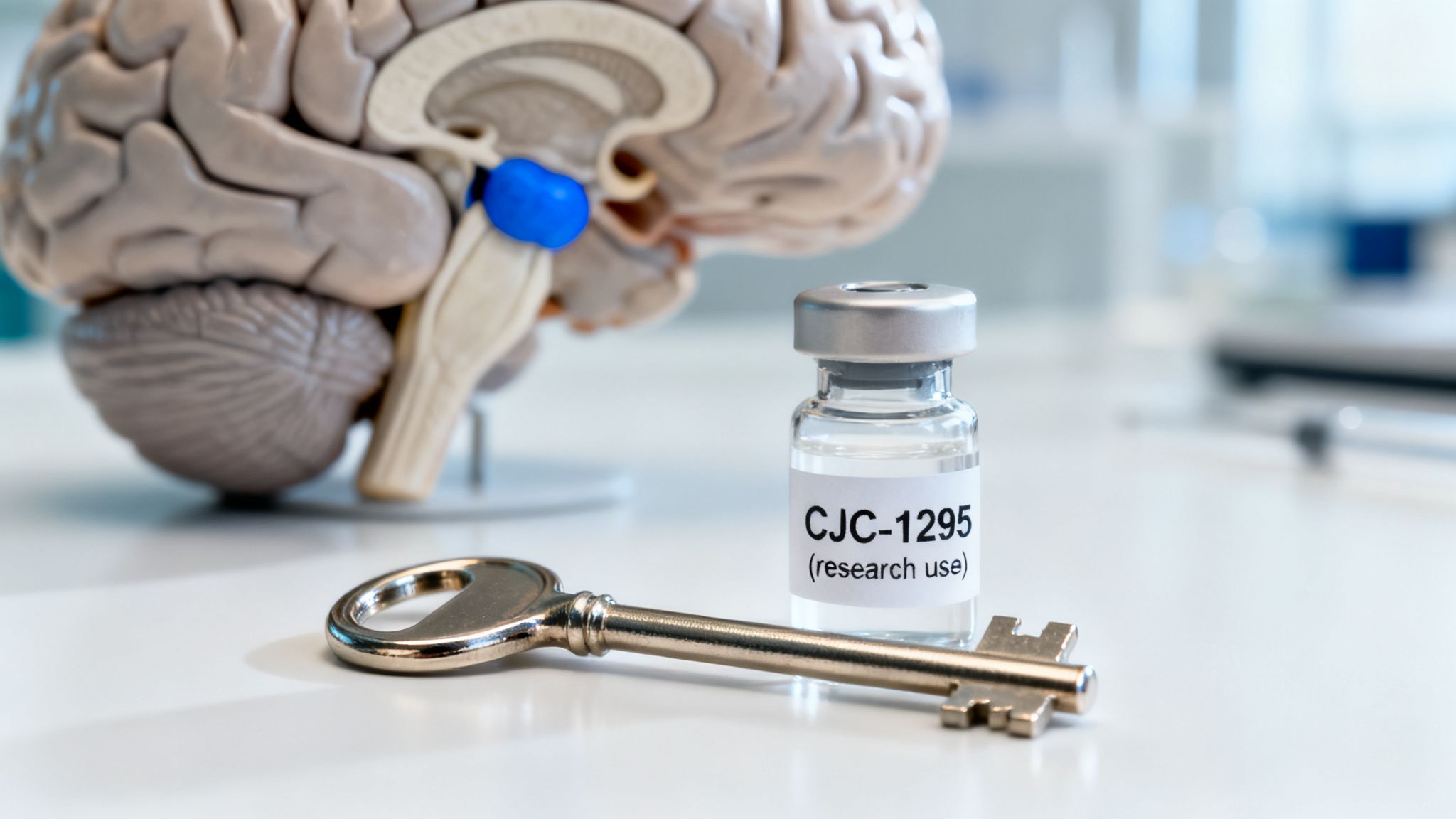
So, what exactly is CJC-1295? Think of it less as a hormone and more like a highly specialized key, engineered to unlock the body's own growth hormone (GH) production.
It's a synthetic peptide that expertly mimics the body's natural Growth Hormone-Releasing Hormone (GHRH). In simple terms, it tells the pituitary gland to get to work and release more GH. This makes it an invaluable tool for researchers investigating the downstream effects of elevated GH and IGF-1 on critical processes like cellular repair, muscle growth, and fat metabolism.
The key difference? Instead of introducing outside hormones, CJC-1295 amplifies the body's own natural production rhythms, offering a more nuanced and physiological approach to research.
Unlocking the Potential of CJC 1295 in Research
To really get a handle on CJC-1295, you have to understand its origin. The body’s own GHRH is incredibly fragile and breaks down almost instantly. That's where clever bioengineering comes in.
CJC-1295 is a modified version—an analogue—of the first 29 amino acids of human GHRH. These modifications are specifically designed to protect it from rapid degradation, allowing it to stick around and deliver its signal to the pituitary gland for a much longer, more effective period.
This mechanism is fundamentally different from how other hormonal agents work. It’s not about overpowering the system; it’s about fine-tuning it. If you want to dive deeper into these distinctions, our guide on peptide hormones vs steroid hormones is a great resource.
CJC 1295 At a Glance for Researchers
For a quick reference, this table breaks down the most critical information about CJC-1295 for any laboratory setting.
| Characteristic | Description |
|---|---|
| Molecule Type | Synthetic Peptide (GHRH Analogue) |
| Primary Function | Stimulates the pituitary gland to release Growth Hormone (GH) |
| Core Structure | Modified version of the first 29 amino acids of human GHRH |
| Mechanism | Binds to GHRH receptors in the anterior pituitary |
| Key Research Areas | Cellular regeneration, metabolic function, muscle growth, anti-aging |
This summary highlights why CJC-1295 is such a compelling compound for controlled, repeatable studies on the GH axis.
The Two Faces of CJC 1295
Now, here’s where it gets really interesting for researchers. CJC-1295 isn't a one-size-fits-all compound. It comes in two distinct forms, and the difference between them will completely dictate your experimental design.
CJC 1295 without DAC (Mod GRF 1-29): This is the fast-acting version. It delivers a short, sharp pulse of GH release that closely mimics the body's natural rhythm. With a very brief half-life of around 30 minutes, it's perfect for studies that require precise, short-term hormonal spikes.
CJC 1295 with DAC (Drug Affinity Complex): Adding the DAC is a total game-changer. This small molecular addition allows the peptide to latch onto albumin, a common protein in the blood. This creates a powerful time-release effect, stretching its half-life from minutes to several days and resulting in a sustained, steady elevation of GH and IGF-1 levels.
This single difference—the presence or absence of DAC—is the most critical factor to consider, as it impacts everything from dosing schedules to the ultimate biological outcomes you'll observe in your research.
In essence, CJC 1295 provides a precision tool for researchers to modulate the growth hormone axis. The choice between its two forms allows for either mimicking the body’s natural, rapid pulses or creating a sustained elevation for long-term studies.
This is exactly why CJC-1295 has become such a staple in labs exploring everything from age-related physiological decline to metabolic disorders and tissue regeneration. Its real power lies in its ability to work with the body's endocrine system, not against it.
How CJC 1295 Works Inside the Body
To really understand what CJC-1295 is and why it's so significant in research, we have to look at how it behaves once it’s in the system. It's a pretty elegant mechanism.
Think of your body's natural Growth Hormone-Releasing Hormone (GHRH) as a key made of ice. It fits the lock on the pituitary gland perfectly, telling it to release growth hormone (GH), but it melts away almost instantly. This means its effect is incredibly short-lived.
CJC-1295, on the other hand, is like a sturdy metal key. As a GHRH analogue, it’s been cleverly modified to resist the enzymes that would normally chew up natural GHRH in seconds. This durability is its superpower, allowing it to stay active for much, much longer.
Because it sticks around, CJC-1295 can continuously signal the GHRH receptors on the pituitary. But it doesn't just kick the door down and flood the system. Instead, it works with the body’s own natural rhythms, amplifying the existing pulses of GH that your system already produces. This creates a more sustained, physiological rise in GH levels.
The Pituitary Gland: Hormonal Command Center
The journey starts when CJC-1295 reaches the anterior pituitary gland—the body’s hormonal command center. Tucked away at the base of the brain, this tiny gland is the factory for a whole host of critical hormones, including growth hormone.
CJC-1295 has one job: find and bind to GHRH receptors on the surface of pituitary cells called somatotrophs. These are the specialist cells that make and store GH. Once CJC-1295 locks on, it sends a strong, persistent signal telling the somatotrophs to release their GH stores into the bloodstream.
The key takeaway is that CJC-1295 doesn't introduce a foreign hormone. It simply gives the pituitary a stronger, more stable "go" signal, enhancing the body's own ability to produce and release GH.
This is exactly what makes it such a valuable tool for researchers. It allows them to study the downstream effects of elevated growth hormone while still respecting the body's natural, pulsatile release patterns. The result? More relevant and well-controlled experimental data.
From Growth Hormone to IGF-1: The Domino Effect
Releasing growth hormone is just the first domino to fall in a powerful biological chain reaction. Once GH is circulating, it travels throughout the body, but its main target is the liver. When GH arrives, it triggers the liver to produce and secrete another crucial compound: Insulin-Like Growth Factor 1 (IGF-1).
IGF-1 is often seen as the primary workhorse that carries out GH's anabolic and regenerative instructions. While GH has some direct effects, it's the jump in IGF-1 that drives many of the outcomes researchers are interested in, such as:
- Muscle Cell Growth (Hypertrophy): IGF-1 signals muscle cells to ramp up protein synthesis, the core process for building and repairing muscle.
- Fat Metabolism (Lipolysis): Both GH and IGF-1 encourage the body to break down stored fat (triglycerides) and use it for energy.
- Tissue Regeneration: IGF-1 is a major player in repairing and regenerating all sorts of tissues, especially connective tissues like tendons and ligaments.
So, when a researcher administers CJC-1295, they're really just setting off a chain reaction. The peptide stimulates the pituitary, the pituitary releases GH, and GH tells the liver to produce IGF-1. This entire pathway, known as the GH/IGF-1 axis, is the central mechanism behind CJC-1295's influence.
It's a common target for peptide research. For instance, our deep dive into Ipamorelin before and after research findings explores a complementary peptide that also aims to optimize this same powerful system.
This multi-step process is why the effects seen in CJC-1295 studies are so widespread. By amplifying the very first signal in the chain, CJC-1295 kicks off a series of events that can influence metabolism, body composition, and recovery on a systemic level.
Choosing Between CJC 1295 With DAC vs. No DAC
When designing a study around CJC-1295, one of the first and most critical decisions a researcher makes is which version to use. The entire experimental outcome hinges on this choice, and it all comes down to a small but mighty addition: the Drug Affinity Complex (DAC).
Think of it this way: CJC-1295 without DAC (often called Mod GRF 1-29) is like a flash of lightning. It provides a powerful, immediate, and very short-lived pulse of GHRH stimulation. The biological activity peaks and then fades in about 30 minutes, making it perfect for studies that need to mimic the body's own natural, pulsatile hormone releases.
On the other hand, CJC-1295 with DAC is more like a steady, slow-burning flame. That DAC component is a game-changer; it latches onto albumin, a common protein circulating in the blood, effectively anchoring the peptide in the system. This dramatically extends its life, creating a sustained, stable elevation of growth hormone levels instead of a quick spike.
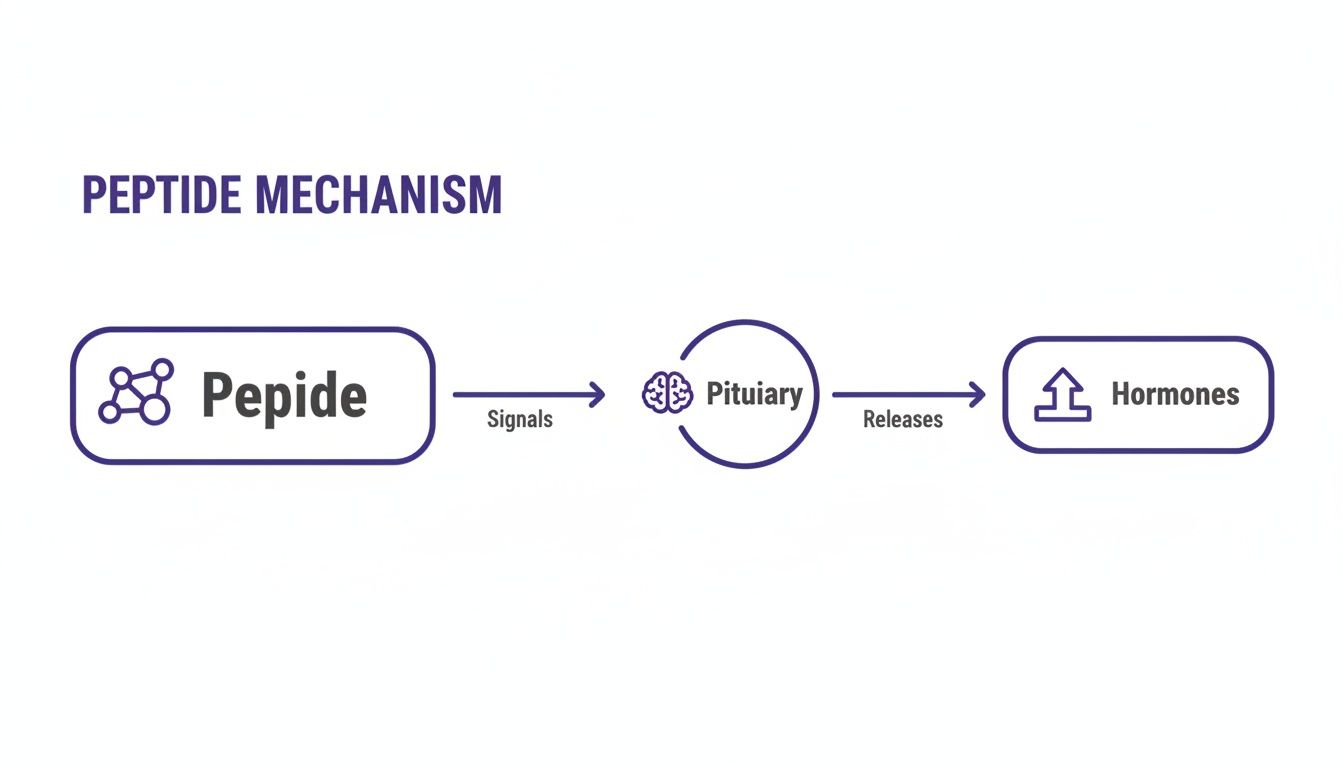
This diagram shows the basic mechanism at play. The peptide signals the pituitary, which in turn releases its hormones—a simple but powerful pathway that both versions utilize.
This fundamental difference in their action profile creates two distinct tools for research.
Why Half-Life Is Everything Here
To really grasp the difference, you have to understand the concept of half-life—the time it takes for half of a substance to be cleared from the body. This single metric dictates dosing frequency, study duration, and the kind of physiological response you'll observe in the lab.
The DAC is what creates the massive divide. By binding to albumin, the DAC extends the peptide’s half-life from a mere 30 minutes to a staggering 6-8 days in human models. This pharmacokinetic shift means a single administration can keep growth hormone (GH) and insulin-like growth factor 1 (IGF-1) levels elevated for nearly a week. You can dig deeper into this mechanism in this Wikipedia overview on CJC-1295.
This profound difference in stability creates two completely different tools for researchers.
The real question isn't about which version is "better," but which one is right for the research question. Are you studying the acute effects of a brief, pulsatile GH release, or the chronic impact of long-term, stable elevation?
Answering that question is the key to designing a successful and valid experiment.
A Practical Comparison for Researchers
Let's break down the key differences in a way that helps guide research decisions. The table below outlines the core distinctions between these two forms of CJC-1295.
Comparing CJC 1295 With DAC vs Without DAC
| Feature | CJC-1295 without DAC (Mod GRF 1-29) | CJC-1295 with DAC |
|---|---|---|
| Primary Action | Creates a short, sharp pulse of GH release. | Creates a sustained, stable "bleed" of GH release. |
| Half-Life | Very short, approximately 30 minutes. | Very long, approximately 6-8 days. |
| Dosing Frequency | Requires multiple daily administrations to maintain effect. | Can be administered once or twice per week. |
| Mimics Physiology | Closely mimics the body's natural pulsatile release. | Creates a supra-physiological, stable elevation. |
| Best For | Acute response studies; synergizing with GHRPs. | Long-term studies on body composition and metabolism. |
Ultimately, choosing the right compound is about matching the tool to the task. The "without DAC" version gives you precision and mimics natural physiology, while the "with DAC" version offers convenience and sustained action for chronic observation.
Where the Science Meets the Lab: Research Applications
It's one thing to understand the chemistry of CJC-1295, but the real excitement begins when we see how it's being used in laboratory research. By creating a steady, elevated baseline of Growth Hormone (GH) and Insulin-Like Growth Factor 1 (IGF-1), this peptide gives scientists a powerful lens to study some of the most critical biological processes—from aging and recovery to performance enhancement.
The downstream effects of activating the GH/IGF-1 axis are massive, touching everything from cellular regeneration to how our bodies use fuel. Researchers are keenly interested in using CJC-1295 to explore these pathways in a way that just wasn't possible before.
Muscle Growth and Cellular Repair
Naturally, one of the biggest areas of focus for CJC-1295 research is muscle. IGF-1 is a cornerstone signal for muscle protein synthesis, the very process that rebuilds and strengthens muscle fibers after they've been broken down by stress. By keeping IGF-1 levels consistently high, CJC-1295 (especially the DAC version) creates a perfect model for studying long-term muscle growth and how to speed up recovery from induced damage.
This makes it a go-to compound for experiments designed to answer questions like:
- Can we accelerate muscle repair? Researchers are investigating if elevated IGF-1 can drastically shorten the healing time for muscle micro-tears.
- What is the upper limit of hypertrophy? The sustained protein synthesis offers a chance to observe how much muscle cell size can be increased over extended periods.
- How do we strengthen connective tissue? Studies are also looking into the impact of GH and IGF-1 on collagen synthesis, which is absolutely vital for healthy tendons and ligaments.
The ability to bypass the body's normal, sporadic GH pulses and maintain a consistently elevated level is a game-changer. It allows for much clearer, more easily measured outcomes in muscle-focused studies.
Think of it this way: the steady hormonal signal from CJC-1295 with DAC creates a biological environment that's constantly primed for growth and repair. It provides a stable backdrop against which the intricate processes of muscle adaptation can be studied with precision.
Fat Loss and Metabolic Regulation
But it's not all about muscle. CJC-1295 is a major player in metabolic research, particularly when it comes to lipolysis—the body's process of breaking down stored fat and turning it into energy. Growth hormone is a primary driver of this process, directly telling fat cells (adipocytes) to release their triglyceride stores to be burned as fuel.
This direct line to fat metabolism makes CJC-1295 an incredible tool for investigating changes in body composition. Some studies have shown that it can boost growth hormone levels by a jaw-dropping 200-1000% after a single administration, with elevated levels lasting for up to six days. For researchers studying how to build lean mass while shedding fat, that kind of sustained action is a massive advantage compared to the sharp peaks and valleys of shorter-acting compounds. You can find more details on these findings at Anderson Longevity Clinic.
The Synergistic Power of Stacking CJC-1295 and Ipamorelin
In peptide research, synergy is everything. It's the idea that combining compounds can create an effect far greater than what either could achieve alone. The combination of CJC-1295 and a Growth Hormone-Releasing Peptide (GHRP) like Ipamorelin is the classic textbook example of this principle.
Here's how this one-two punch works:
- CJC-1295 (The Amplifier): As a GHRH analogue, it increases the amount of growth hormone the pituitary releases with each natural pulse. It basically turns up the volume on every pulse.
- Ipamorelin (The Multiplier): As a GHRP, it increases the number of GH pulses that happen in the first place. It tells the pituitary to release GH much more frequently.
When you put them together, you get the best of both worlds: stronger pulses and more frequent pulses. This creates a powerful, sustained surge in the GH/IGF-1 axis that simply can't be matched by either peptide on its own. This synergistic stack is a hot topic for biohackers and scientists looking to get the maximum possible response from the pituitary gland in a controlled, predictable way. It’s a far more sophisticated approach to hormonal modulation and a fantastic model for studying the full potential of the GH axis.
Getting Your Hands on Quality Peptides and Handling Them Right
Any seasoned researcher knows that an experiment is only as good as the materials you start with. When it comes to sensitive compounds like CJC-1295, sourcing from a trustworthy supplier isn't just a good idea—it's the bedrock of your entire project. Without it, you can't trust your data.
Navigating the peptide market can feel like the Wild West, but there’s one clear sign of a legitimate source: third-party verification. A reputable vendor will always provide documentation proving the identity and purity of their products, no questions asked.
Think of this verification as your insurance policy. It's what stands between your carefully designed experiment and a vial full of contaminants, fillers, or a completely different molecule. If you can't verify what's in the vial, your results are invalid before you even begin.
How to Read Purity Reports Like a Pro
When you're vetting a supplier, don't just glance at the paperwork. You need to look for two specific tests for every single batch of CJC-1295. These reports are the gold standard for confirming you have the right stuff.
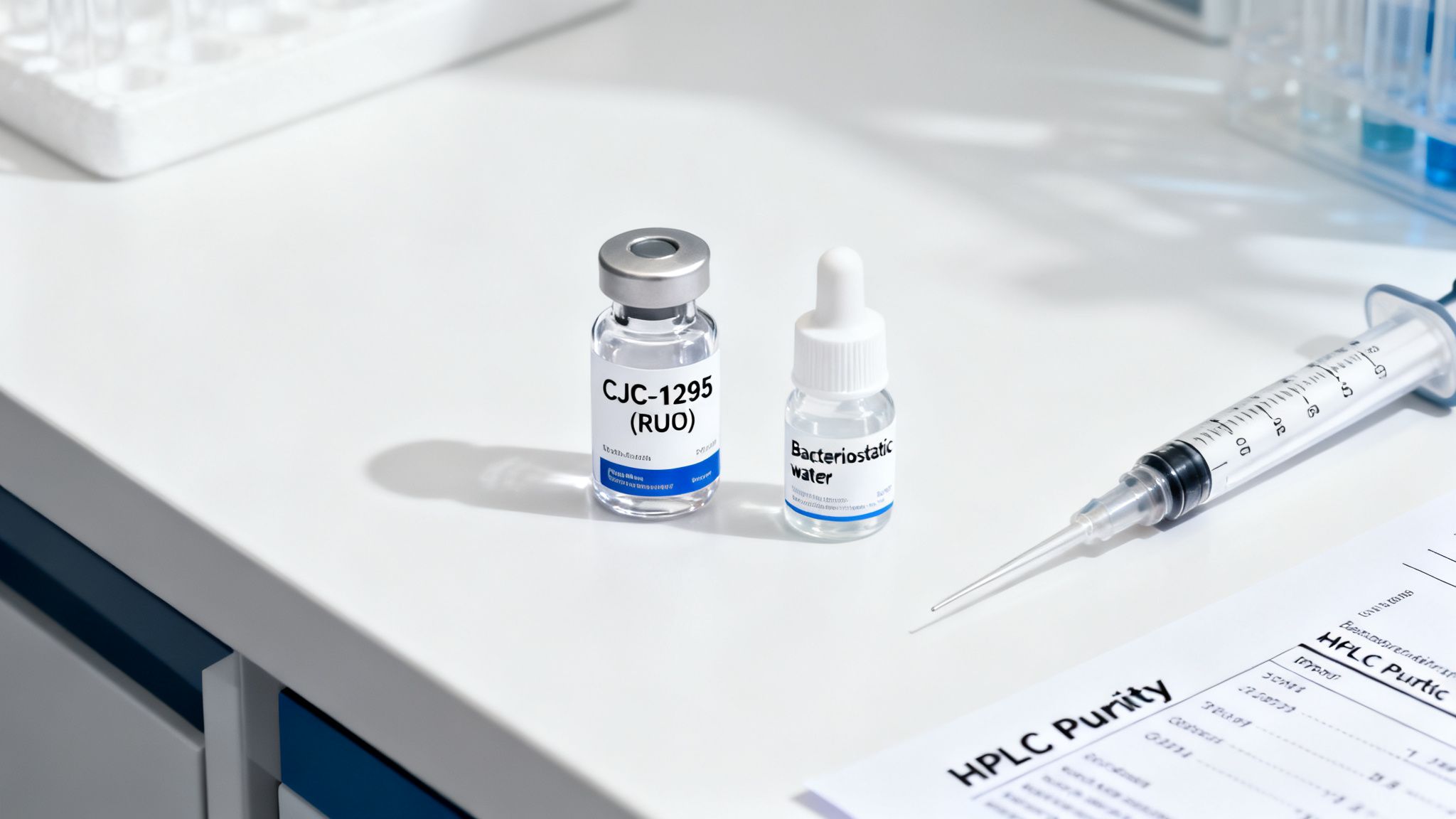
- High-Performance Liquid Chromatography (HPLC): This is the purity test. HPLC separates everything in the vial and tells you exactly how much of it is actually CJC-1295. You should be looking for a purity level of 99% or higher. Anything less introduces unknown variables that can skew your results.
- Mass Spectrometry (MS): This is the identity test. MS analysis confirms the peptide's molecular weight, which proves it has the correct amino acid structure. It’s the final handshake that says, "Yes, this is exactly what you ordered."
Insisting on these documents isn't being difficult; it's just good science. Sourcing from transparent suppliers gives you the confidence you need to produce meaningful work.
What "For Research Use Only" Really Means
You’ll see every legitimate peptide, CJC-1295 included, labeled "For Research Use Only" (RUO). This isn't just a bit of fine print; it's a critical legal and ethical boundary.
This label makes it crystal clear that the compound is a tool for laboratory experiments (in vitro studies) and nothing more. It is not a drug, a supplement, or a cosmetic, and it has not been approved by the FDA for human or animal use.
Staying within the RUO designation is non-negotiable for maintaining legal compliance and upholding the integrity of scientific research. These are tools for discovery, meant only for controlled laboratory settings.
Lab Protocols for Handling and Storage
Once your high-purity CJC-1295 arrives, how you handle it is just as important as where you got it. Peptides are delicate molecules. Mistreat them, and they’ll quickly degrade, rendering them useless.
Most research peptides show up as a lyophilized (freeze-dried) powder. This keeps them stable during shipping and for longer-term storage. Before you can use it in an experiment, it needs to be properly reconstituted.
A Quick Checklist for Reconstitution and Storage:
- Set Up Your Station: Start with a sterile workspace. Gather your supplies: sterile syringes, bacteriostatic water, and alcohol swabs. The goal here is zero contamination.
- Reconstitute with Care: The freeze-dried powder needs to be mixed with a sterile solvent, almost always bacteriostatic water. This specialized water contains 0.9% benzyl alcohol, which acts as a preservative to stop bacterial growth and keep the peptide solution viable. If you need a detailed walkthrough, our guide on how to reconstitute peptides covers every step.
- Store It Properly: Temperature is everything.
- Lyophilized Powder: Keep it in the freezer at around -20°C for maximum shelf life.
- Reconstituted Solution: Once it's a liquid, store it in the refrigerator between 2°C and 8°C. Never freeze the reconstituted solution—the freeze-thaw cycles will tear the delicate peptide bonds apart.
By sticking to these strict sourcing and handling protocols, you ensure the integrity of your CJC-1295 is protected from the moment it arrives to the final data point, leading to far more accurate and repeatable outcomes.
Frequently Asked Questions About CJC-1295
When you start digging into a research compound like CJC-1295, the practical questions come up fast. How safe is it in a lab setting? How is it different from straight HGH? What kind of timeline should I expect for seeing results? Getting these answers right is crucial for designing a solid study.
This is all about building your research on a strong foundation. Let’s walk through the common questions that come up when scientists and researchers start working with this powerful GHRH analogue.
Is CJC-1295 Considered Safe for Research?
In a controlled laboratory environment, CJC-1295 has a solid reputation for safety, provided it's sourced from a quality supplier and handled correctly. The key distinction here is that it’s a peptide that stimulates the body's own growth hormone production—it doesn't introduce an external, synthetic hormone.
This mechanism is generally seen as a lower-risk approach in experimental models. But this all hinges on one critical fact: it is designated For Research Use Only (RUO). That means its sole purpose is for in vitro studies and lab experiments, not for any kind of human or veterinary application.
The safety of any research peptide is a direct result of its purity, how it's handled, and strict adherence to its RUO status. Using compounds from unverified sources or that have been stored improperly throws a wrench in the works, introducing unknown risks and variables that can invalidate your entire experiment.
When you stick to these guidelines, CJC-1295 is a reliable and consistent tool for scientific work. The real problems start when protocols are ignored, which compromises both the research integrity and safety.
What's the Difference Between CJC-1295 and HGH?
This is a great question because it gets right to the heart of how these compounds work. When you use Human Growth Hormone (HGH) in a study, you're directly adding the synthetic hormone itself into the system.
CJC-1295, on the other hand, is a Growth Hormone-Releasing Hormone (GHRH) analogue. It’s a messenger, not the hormone. Its entire job is to knock on the pituitary gland's door and tell it to produce and release more of the body’s own natural GH.
- HGH: Directly adds synthetic growth hormone, which can easily override the body’s delicate endocrine feedback loops.
- CJC-1295: Works with the body's existing machinery to ramp up output, which helps preserve the natural, pulsatile release of GH.
Think of it like this: Using HGH is like pouring water into a bucket from a separate jug. Using CJC-1295 is like turning up the pressure on the hose that's already filling the bucket. One is a replacement, the other is a stimulator.
How Quickly Can Effects Be Observed in Lab Studies?
The timeline for seeing measurable results really depends on what you're looking for and which version of the peptide you're using. Some markers can shift fairly quickly, while others are more of a slow burn.
With consistent administration, you can often detect initial changes within the first few weeks. These are typically things like shifts in cellular energy metrics or observed improvements in sleep quality markers in animal models.
However, more substantial changes—like measurable increases in lean mass or a reduction in adipose tissue in body composition studies—take longer to become obvious. Researchers typically design studies to last 4 to 8 weeks to give GH and IGF-1 levels enough time to remain elevated and produce these more significant downstream effects.
Can CJC-1295 Be Combined With Other Peptides?
Absolutely. In fact, this is one of its most fascinating characteristics for advanced research. CJC-1295 is often studied in tandem with other peptides, especially those from the Growth Hormone-Releasing Peptide (GHRP) family, like Ipamorelin.
This practice, known as "stacking," is all about creating synergy. The two different classes of peptides poke the pituitary gland to release GH, but they do it through different, complementary pathways.
- CJC-1295 (GHRH Analogue): Increases the size (amplitude) of each GH pulse.
- Ipamorelin (GHRP): Increases the number (frequency) of GH pulses.
By putting them together, researchers can generate a powerful and sustained release of growth hormone that's much greater than what either compound could ever achieve alone. This synergistic effect opens the door to studying the GH/IGF-1 axis under conditions of maximum stimulation.
What Are the Potential Side Effects in Research Subjects?
While CJC-1295 is generally well-tolerated in controlled studies, some potential side effects have been observed. They are almost always mild and short-lived, often linked to the administration itself or the body's response to increased growth hormone.
The most common observations noted in the literature include:
- Injection Site Reactions: A bit of redness, swelling, or discomfort right where the compound was administered.
- Water Retention: A temporary and mild increase in fluid retention is possible while hormone levels find their new normal.
- Headaches or Nausea: Some subjects might experience a light headache or a fleeting sense of nausea, especially with the first few doses.
- Flushing Sensation: A brief feeling of warmth that passes quickly after administration.
It's important to remember that the purity of the peptide and the dosing protocol play a huge role here. Careful observation and monitoring are standard practice in any legitimate research involving these compounds.
At Bullit Peptides, our mission is to equip the scientific community with research compounds of the absolute highest purity. Our CJC-1295 undergoes rigorous third-party testing to guarantee it meets the uncompromising standards your work requires. Explore our full catalog of research-grade peptides to advance your next project with total confidence.