When researchers ask, "What is glow peptide?" the answer isn't a single molecule. Instead, it’s a specific research blend combining three well-known peptides: GHK-Cu, BPC-157, and TB-500. This trio is designed for in-vitro lab studies exploring complex cellular repair, tissue regeneration, and the intricate mechanics of wound healing.
Unpacking the Glow Peptide Research Blend
For anyone working in biochemistry or regenerative medicine, the best way to think about the Glow Peptide blend is as a synergistic team. It's like having a specialized crew for a delicate cellular operation, where each member has a distinct and complementary job. This multi-faceted approach allows researchers to investigate interconnected biological pathways that a single peptide just couldn't address on its own.
The real interest in this blend comes from how each component targets a different, critical stage of the regenerative process. This synergy is why it has become a popular subject for comprehensive tissue regeneration studies. In short, the blend’s investigated mechanism involves GHK-Cu driving collagen and elastin production, BPC-157 promoting new blood vessel growth via VEGFR2 signaling, and TB-500 enhancing cell migration with its influence on actin. You can find more details on the science of these combined peptides at 1stOptimal.com.
The Three Core Components
To really get a handle on how this works in a research context, it helps to see what each peptide brings to the table. Let’s break down their individual roles.
Here’s a quick overview of the individual peptides in a typical 'Glow Peptide' blend and their primary areas of investigation.
| Peptide Component | Primary Research Focus | Key Investigated Mechanism |
|---|---|---|
| GHK-Cu | Extracellular matrix (ECM) remodeling, skin and connective tissue repair. | Stimulates collagen and elastin synthesis; modulates metalloproteinases. |
| BPC-157 | Angiogenesis, cytoprotection, and soft tissue healing. | Upregulates Vascular Endothelial Growth Factor Receptor 2 (VEGFR2). |
| TB-500 | Cell migration, differentiation, and anti-inflammatory responses. | Promotes actin sequestration, leading to enhanced cell motility. |
Each of these components provides a distinct piece of the puzzle, allowing for a more complete picture of the body's natural healing processes in a laboratory setting.
To make this even clearer, let's assign each one a job title based on its function within the research framework:
- GHK-Cu, the 'Reconstruction Specialist': This peptide is studied primarily for its ability to rebuild the foundational extracellular matrix by stimulating key structural proteins.
- BPC-157, the 'Vascular Engineer': Its main area of research is angiogenesis—the formation of new blood vessels—which is crucial for establishing supply lines for tissue repair.
- TB-500, the 'Cellular Coordinator': This component's role in research revolves around directing cell migration, essentially guiding the repair agents to where they need to go.
By combining these three agents, researchers can create experimental models that more closely mimic the body's multifaceted healing cascade. It’s a shift from studying one isolated mechanism to observing a coordinated, multi-stage response.
This overview gives us a solid foundation. Now, we can dig deeper into the molecular mechanisms that make this blend such a compelling subject in modern regenerative science.
GHK-Cu: The Architect of Cellular Renewal
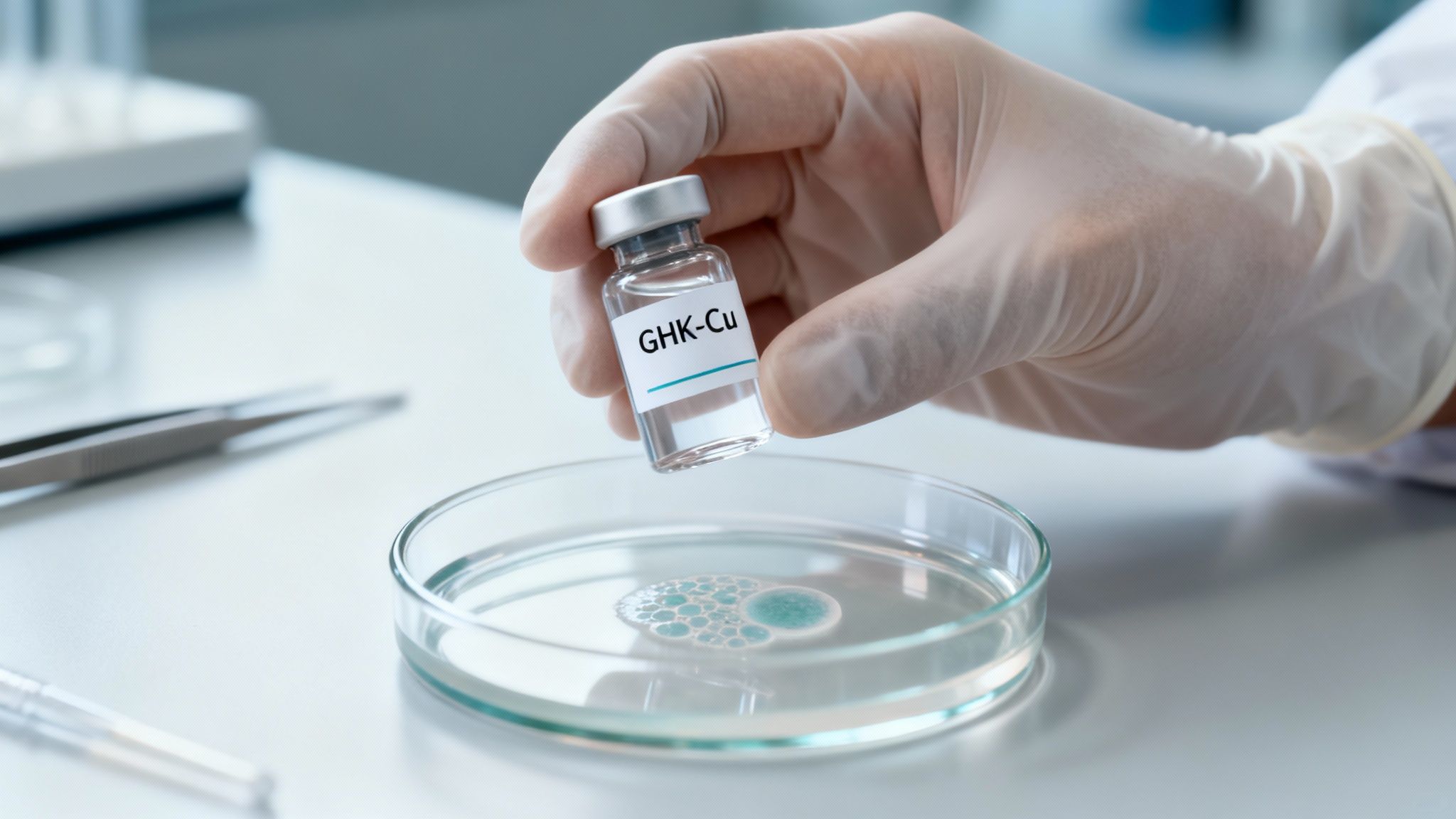
At the very core of any "Glow Peptide" blend, you'll find GHK-Cu (Glycyl-L-Histidyl-L-Lysine-Copper). This isn't just another ingredient; it's the foundational component responsible for rebuilding the cellular environment. A good way to think of it is as the lead architect for tissue remodeling. In a research setting, its main job is to direct the synthesis of the key proteins that give our tissues structure and resilience.
This peptide isn't some new fad, either. It was first identified way back in 1973 by Dr. Loren Pickart. He noticed something remarkable: the tripeptide could encourage older human liver tissue to function more like younger tissue. His work was a huge leap forward in our understanding of tissue regeneration.
What makes this particularly relevant today is a key finding from ongoing research: our natural plasma levels of GHK-Cu plummet as we age. They drop from around 200 ng/ml at age 20 down to just 80 ng/ml by age 60. You can dive deeper into the peptide's history and impact on innerbody.com. This natural decline is precisely why GHK-Cu is such a hot topic in regenerative science and why it's a critical part of any glow peptide research blend.
A Master Regulator of Gene Expression
So, what makes GHK-Cu so effective in laboratory models? It all comes down to its incredible ability to influence gene expression. It doesn't just nudge one or two proteins into action; it affects the activity of literally thousands of human genes. This powerful signaling gives it the unique ability to coordinate a whole cascade of complex cellular events.
By interacting directly with cellular DNA, GHK-Cu can essentially "reset" a large number of genes to a more youthful state of function. This involves turning up the genes responsible for repair and regeneration while simultaneously turning down the ones linked to inflammation and tissue breakdown.
This profound genetic influence is why G-HK-Cu is a go-to for studies focusing on skin elasticity and wound repair. It signals cells to ramp up production of essential structural proteins, leading to a much more robust and organized extracellular matrix.
The Mechanisms of Renewal
The regenerative potential of GHK-Cu isn't just tied to a single trick. Researchers are actively exploring its multifaceted actions across a wide range of experimental setups.
Here are some of its key investigated mechanisms:
- Stimulating Collagen and Elastin: It directly promotes the synthesis of these two proteins, which are absolutely fundamental for tissue strength and flexibility.
- Antioxidant Properties: GHK-Cu has been shown to neutralize damaging free radicals, helping protect cells from the constant assault of oxidative stress.
- Anti-Inflammatory Action: It helps dial down the presence of inflammatory cytokines, creating a much better environment for healing and repair to take place.
These effects combined make it an indispensable tool for any scientist studying complex tissue renewal. For this reason, sourcing high-purity GHK-Cu for laboratory use is crucial for getting accurate, repeatable results. It's this foundational role in rebuilding the cellular scaffolding that truly puts the "glow" in any Glow Peptide research blend.
The Systemic Repair Crew: BPC-157 and TB-500

While GHK-Cu lays down the foundational blueprint for new tissue, the Glow Peptide blend brings in two other specialists to manage the hands-on repair work. These are the systemic project managers: BPC-157 and TB-500. They're the ones ensuring the entire regenerative process runs smoothly, from initial injury to final recovery.
First, let's look at BPC-157. In research circles, it’s often called the 'master repair agent'—and for good reason. Derived from a protein naturally found in gastric juice, this peptide has shown extraordinary cytoprotective (cell-protecting) abilities in preclinical studies, impacting everything from tendons and muscles to the gut.
What makes BPC-157 so compelling for researchers is its systemic reach. One of its most studied mechanisms is its ability to promote angiogenesis, which is just a technical term for the formation of new blood vessels. Healing can't happen without a supply chain, and BPC-157 helps build those critical pathways to deliver oxygen and nutrients right where they're needed.
Orchestrating Cellular Movement with TB-500
Working in tandem with BPC-157 is TB-500, the synthetic version of a naturally occurring protein called Thymosin Beta-4. If BPC-157 is building the roads (blood vessels) to the construction site, TB-500 is the traffic controller, directing the skilled workers to their exact positions.
TB-500's core function is promoting cell migration. It achieves this by upregulating actin, a protein crucial for a cell's internal scaffolding and movement. This helps guide stem cells and other repair agents directly to the site of damage, ensuring a targeted and efficient response.
This coordinated action doesn't just speed up healing; it's also been shown to help manage inflammation and reduce the formation of adhesions or scar tissue. It's all about making the repair process cleaner and more organized.
When studied together, such as in a Wolverine Blend of BPC-157 and TB-500, researchers can observe how these synergistic effects play out.
BPC-157 and TB-500 form a powerful logistical duo. They manage the complex, body-wide mechanics of repair, ensuring the regenerative signals sent by GHK-Cu are fully supported. This is the one-two punch that gives the Glow Peptide blend its comprehensive potential in a research context.
How the Glow Peptide Blend Works in Synergy
The real magic of the Glow Peptide blend isn't just about what each individual peptide does, but how they work together. When you combine GHK-Cu, BPC-157, and TB-500, you get a synergistic effect where the final outcome is much greater than the sum of its parts. Their roles aren't just stacked on top of each other; they're intertwined and amplify one another.
Think of it like a highly specialized surgical team during a complex operation. Every member has a distinct, vital role, and their success depends entirely on the others. Without that seamless coordination, the whole procedure would be clunky and far less effective.
The synergistic action of the Glow Peptide blend allows researchers to study a complete, multi-stage regenerative cascade. This multi-pronged approach offers a more holistic view of tissue repair than investigating any single peptide could provide alone.
This coordinated effort gives researchers a window into how the different phases of healing—from initial structural repair to establishing vital supply lines—are all connected.
The Team in Action
Let's stick with our surgical team analogy to see how this synergy actually plays out in a research setting. Each peptide performs its job in a specific order, kicking off a powerful chain reaction that pushes the entire regenerative process forward.
- GHK-Cu as the Architect: It kicks things off by rebuilding the foundational cellular scaffolding. GHK-Cu stimulates the production of essential proteins like collagen and elastin, literally laying the structural groundwork.
- BPC-157 as the Vascular Engineer: With the framework in place, BPC-157 gets to work on the plumbing. It promotes angiogenesis, ensuring the new structure gets the blood flow it needs to thrive by forming new capillaries and establishing critical supply lines for nutrients and oxygen.
- TB-500 as the Project Foreman: Finally, TB-500 steps in as the foreman, efficiently managing the cellular workforce. It enhances cell migration, guiding repair cells directly to the "construction site" where the architect (GHK-Cu) has set the foundation and the engineer (BPC-157) has run the supply lines.
This carefully orchestrated sequence can potentially ramp up fibroblast activation and capillary formation far more effectively than any single peptide ever could. This dynamic interplay is what makes the blend such a compelling tool for advanced studies in sports medicine, dermatology, and cellular biology—fields where understanding complex healing pathways is absolutely critical.
Comparing Individual vs. Blended Peptide Research Applications
The following table breaks down the research applications for each peptide on its own versus the comprehensive applications possible with the combined Glow Peptide blend. It really highlights how the blend opens up more sophisticated and integrated avenues of study.
| Research Focus | GHK-Cu Alone | BPC-157 Alone | TB-500 Alone | Glow Peptide Blend (Combined) |
|---|---|---|---|---|
| Skin & Tissue Remodeling | Primarily focused on stimulating collagen and elastin synthesis for structural integrity. | Limited direct role; more focused on vascular support for the tissue. | Promotes actin upregulation and cell motility, assisting in wound closure. | A comprehensive approach: GHK-Cu builds, BPC-157 nourishes, and TB-500 populates the new tissue. |
| Angiogenesis (Blood Vessel Formation) | Some influence on vascular growth factors, but not its primary mechanism. | Strong, targeted focus on promoting new capillary growth and blood flow. | Indirectly supports by improving endothelial cell migration and survival. | A multi-phase study: BPC-157 initiates vessel growth, supported by the structural matrix from GHK-Cu. |
| Wound Healing Cascade | Excellent for studying the initial matrix-laying and anti-inflammatory phases. | Ideal for investigating the revascularization stage of healing. | Focused on the cell migration and proliferation phase of tissue repair. | Allows for the study of the entire healing cascade, from inflammation control to final tissue maturation. |
| Cellular Migration & Proliferation | Encourages fibroblast proliferation to produce extracellular matrix. | Helps endothelial cells proliferate to form new blood vessels. | Its primary strength is enhancing the migration of various cell types to an injury site. | Synergistic effect where cells (mobilized by TB-500) have a pre-built, nourished scaffold to populate. |
Ultimately, while the individual peptides are powerful for isolating specific biological mechanisms, the blend provides a model to study the intricate, cooperative nature of tissue regeneration in a more holistic way.
Ensuring Quality and Integrity: Sourcing and Handling Glow Peptide
When you're working with peptides in a research setting, the quality of your materials is everything. Your entire experiment, from the initial hypothesis to the final data, rests on the purity and stability of the compounds you use. This is especially true for a blend like Glow Peptide, where multiple components are involved.
Sourcing high-purity peptides isn't just a box to check—it's the bedrock of credible, reproducible science. You need to be confident that what's in the vial is actually what you think it is, without unwanted extras.
Vetting Your Source: Purity and Proof
Any trustworthy peptide supplier will back up their products with independent, third-party lab reports. Look for a recent Certificate of Analysis (CoA) for every batch you purchase. This document is your proof of quality, verifying the peptide's identity, sequence, and, most importantly, its purity.
You should be aiming for a purity level of over 99%. Anything less introduces variables—contaminants that could interfere with your cellular models and throw your results into question.
This diagram helps visualize how the individual peptides within the Glow Peptide blend—GHK-Cu, BPC-157, and TB-500—are thought to work together.
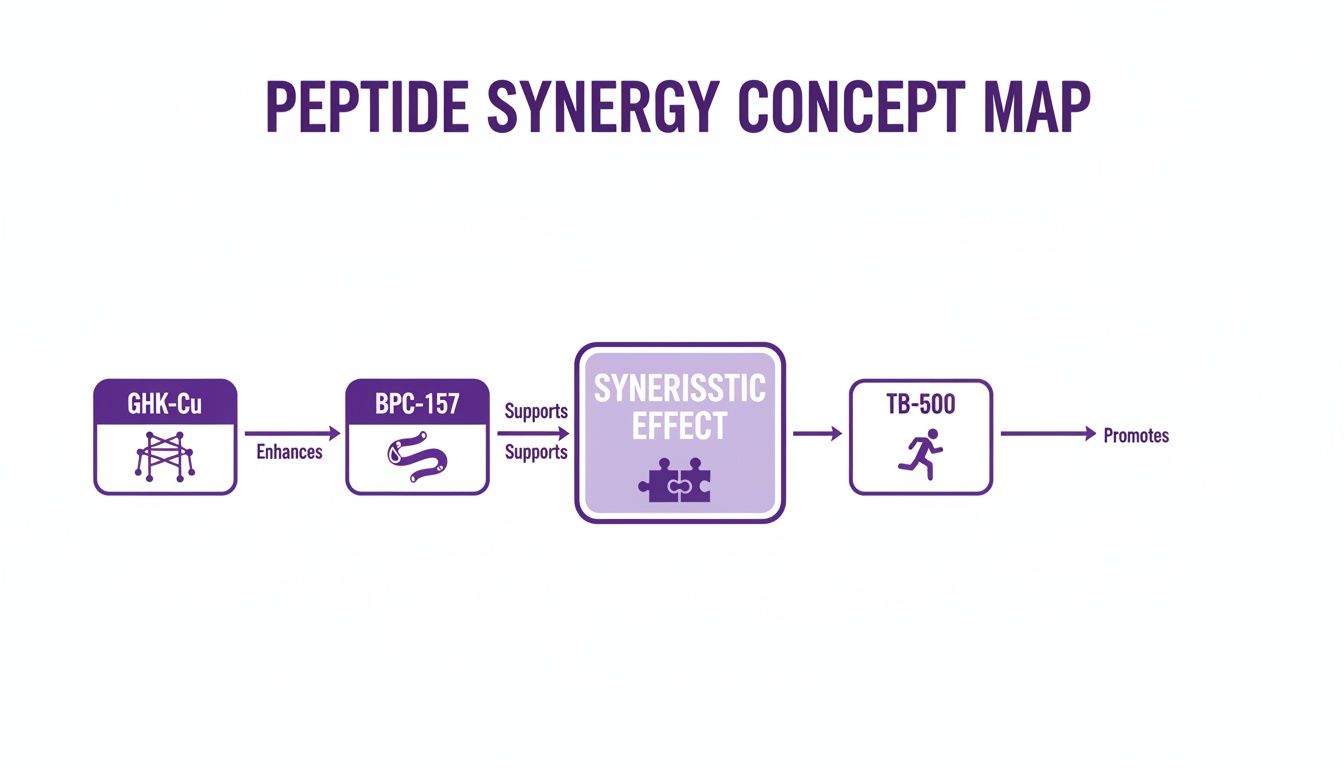
It’s not about one hero molecule; the blend's potential lies in how these three distinct peptides might collaborate to produce a combined effect.
Understanding the "Research Use Only" Label
You'll notice that every legitimate vial of Glow Peptide is labeled "Research Use Only" (RUO). This isn't just fine print; it's a critical legal and ethical boundary for any researcher.
The RUO designation means the compound is intended strictly for lab-based, in-vitro studies. It has not been approved by any regulatory body for human or animal use.
Respecting the RUO label is a core part of responsible science. It ensures these powerful compounds are studied safely within a controlled laboratory environment, upholding scientific standards and preventing any potential for misuse.
This classification protects everyone involved, drawing a clear line between investigational compounds and approved therapeutic agents.
Lab Bench Essentials: Proper Handling Protocols
Once you've secured a high-purity blend, your work has just begun. Proper handling is crucial to preserve the peptide's integrity. These are delicate molecules, and a simple mistake in storage or preparation can render them useless.
To get consistent and reliable data, stick to these core lab protocols:
- Reconstitution: Peptides arrive as a lyophilized (freeze-dried) powder and need to be mixed with a liquid, typically bacteriostatic water, to be used in experiments. This step requires precision. For a full walkthrough, see this guide on how to properly reconstitute peptides for research.
- Storage: Before it's mixed, the freeze-dried powder is best kept in a freezer. Once reconstituted into a liquid, the solution should be refrigerated immediately to prevent degradation and maintain stability.
- Dosing and Measurement: Accuracy is key. You'll need to perform careful calculations to get the exact concentrations required for your in-vitro models. Consistent dosing is non-negotiable for repeatable results.
By starting with a vetted source, respecting the legal framework, and using meticulous lab technique, you build a solid foundation for your research with the Glow Peptide blend.
Where Regenerative Peptide Blends Are Headed
When you look at a product like "Glow Peptide," it's clear it’s more than just a clever name. It's a precisely engineered tool for researchers exploring the very edges of cellular regeneration and tissue engineering. We’ve seen how its components—GHK-Cu, BPC-157, and TB-500—each bring something unique to the table, creating a powerful synergy in a controlled research environment. This blend is a fantastic snapshot of where the entire field is moving.
As peptide science pushes forward, we're going to see more of these multi-component blends. They are becoming the new standard for serious discovery in molecular biology and regenerative studies. Why? Because they let scientists probe complex, interconnected healing pathways in ways a single peptide just can't. The real breakthroughs are hiding in those intricate molecular conversations.
For any researcher serious about contributing to this field, the way forward is paved with an absolute commitment to quality. Every single experiment, every data point, has to be built on a foundation of precision and reliability. Without it, the data is meaningless.
This means you have to be relentless about your sourcing. It’s about partnering with suppliers who can prove their peptides are high-purity and have been validated by third-party testing. Making sure your research materials are impeccable isn't just a box to check—it's the single most important step you can take.
By making quality the top priority, the scientific community can confidently build on this kind of foundational work, opening up entirely new avenues in the study of how our cells repair and regenerate.
Common Questions About Glow Peptide Research
Working with any new research compound is going to raise some questions. With a specialized blend like Glow Peptide, getting clear answers on what it is, how it's handled, and its intended purpose is absolutely crucial for the integrity of your lab work. Let's tackle some of the most frequent inquiries from researchers.
Is Glow Peptide a Single Chemical Compound?
No, and that's probably the most important thing to get straight right from the start. "Glow Peptide" isn't one giant molecule. It's more of a shorthand, a colloquial name for a research blend that brings together three distinct peptides: GHK-Cu, BPC-157, and TB-500.
Each one of these has its own specific molecular structure, weight, and job to do at a biological level. They're combined in precise ratios so scientists can explore their potential synergistic effects on things like cellular repair and regeneration, all within a controlled, in-vitro setting. A good analogy is to think of it not as a single chemical, but as a pre-formulated cocktail of reagents.
Why Is Third-Party Testing So Important?
For anyone serious about their research, third-party testing is non-negotiable. It's the gold standard for verifying that what you have is what you think you have. This process gives you an unbiased, independent analysis of a product's purity, identity, and concentration.
Using a peptide blend with verified high purity is the only way to eliminate variables that could completely derail your results. It guarantees that any effects you observe are actually from the peptides—and not from some unknown contaminant or an incorrect dose—which is the foundation of reliable and reproducible scientific data.
Without a recent Certificate of Analysis (CoA) from an independent lab, you’re basically flying blind. And that completely undermines the point of the experiment in the first place.
Why Are These Peptides Labeled "Research Use Only"?
That "Research Use Only" (RUO) label you see is a critical legal and safety designation. It means the product is intended strictly for laboratory experiments and scientific investigation—and nothing else. It has not been approved by any regulatory body, like the FDA, for use in humans or animals as a treatment or diagnostic tool.
The RUO label really serves two key functions:
- Ensures Regulatory Compliance: It draws a clear line in the sand, separating these compounds from medical-grade drugs and preventing them from being used outside of a controlled research environment.
- Upholds Scientific Ethics: It’s a constant reminder that these are investigational compounds. We're still figuring out their full effects. Sticking to this guideline is a fundamental part of responsible scientific conduct.
By respecting this boundary, you not only protect the integrity of your work but also stay within the established legal and safety protocols that govern scientific discovery. It ensures that the study of what glow peptide is and how it works stays firmly within the proper ethical framework.
For researchers committed to pushing the boundaries of regenerative science, starting with high-purity, third-party-tested materials is everything. Bullit Peptides offers research-grade compounds, all verified to be over 99% pure, so you can run your experiments with confidence and precision. You can explore our full catalog of meticulously engineered peptides for your next project at https://bullitpeptides.com.